Chuseok Livelihood Stabilization Measures
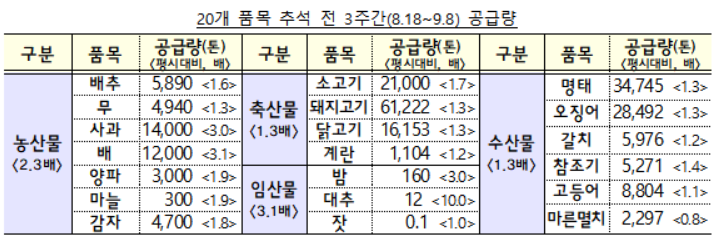
[Asia Economy Sejong=Reporter Son Seon-hee] The government is increasing the supply of key food items in preparation for an earlier-than-usual Chuseok holiday and is promoting a large-scale price discount event for agricultural, livestock, and marine products involving large supermarkets, online malls, and traditional markets. For small business owners and small and medium-sized enterprises, the government plans to provide the largest-ever amount of holiday funds. Additionally, the government is considering waiving toll fees on nationwide expressways during the holiday period and plans to finalize and announce this measure by the end of this month.
On the 11th, about a month before Chuseok, the government held an emergency economic and livelihood meeting chaired by President Yoon Seok-yeol and announced these Chuseok livelihood stabilization measures. According to the Ministry of Economy and Finance, as of the end of last month, the average prices of 20 major seasonal products such as cabbage, radish, and apples rose by 7.1% (weighted average adjusted for inflation) compared to last year’s Chuseok period. In particular, concerns have arisen that agricultural product shipments will decrease due to recent record-breaking heavy rains.
In response, the government plans to fully mobilize available resources by releasing stockpiled supplies and newly applying a 10% tariff quota on some items such as onions to increase supply. The government intends to supply 230,000 tons of the 20 major seasonal products, which is 1.4 times the usual amount, to minimize upward price pressure. Yoon In-dae, Director of the Economic Policy Bureau at the Ministry of Economy and Finance, said, "We will manage prices with the goal of bringing the average prices of the 20 major seasonal products during this year’s Chuseok period as close as possible to the levels of last year’s Chuseok."
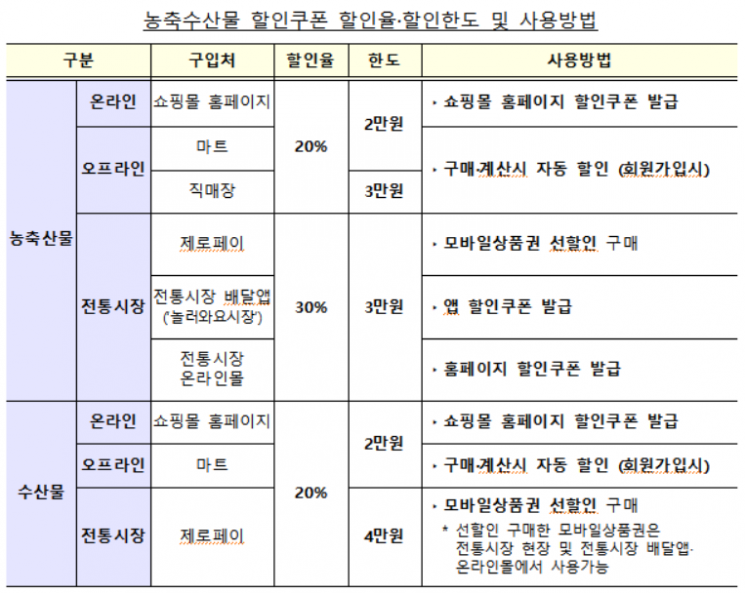
The discount coupon event for agricultural, livestock, and marine products will involve a record-high budget of 65 billion won. This amount is 1.8 times larger than last year’s, and the per-person discount limit has been increased from 10,000 won (20,000 won for traditional markets and direct stores) to 20,000 won (30,000 won for traditional markets and direct stores). Large supermarkets such as E-Mart, Lotte Mart, and Homeplus, along with 10 online malls including 11st and Coupang, as well as traditional markets and direct stores nationwide, will participate.
This year, prices, especially for vegetables, have surged by more than 25% compared to the previous year, and combined with recent heavy rains, agricultural product prices are in a state of emergency. Therefore, for key agricultural products with high demand such as cabbage, radish, onions, garlic, and potatoes, the government will release stockpiled supplies and pursue emergency imports. Flooding and damage to crops, fruit drop, and losses have occurred due to heavy rains, and there are concerns about disease outbreaks if high temperatures continue after the rainfall. The government has formed a joint crop management team involving the Ministry of Agriculture, Food and Rural Affairs and related agencies, focusing on the central region including Gangwon, Gyeonggi, and Chungbuk provinces, to minimize supply and demand impacts during the peak season through intensive management.
For livestock products, although tariff quotas have already been applied to imported pork and beef, prices remain higher than usual. The government plans to continue supply and demand management by supporting slaughter fees during the three-week Chuseok peak season. For marine products, all stockpiled quantities of pollock (11,170 tons) and mackerel (1,042 tons) will be released.
Additionally, to support the holiday fund demand of small business owners and small and medium-sized enterprises, the government will newly supply a record-high 42.6 trillion won (38.2 trillion won in loans + 4.4 trillion won in guarantees). For vulnerable groups, measures include discounts on public transportation, support for daily necessities, and freezing interest rates (2.15~3%) on housing loans such as the Buttress and Didimdol loans for housing stability within this year. For 145,000 vulnerable households who have long-term arrears of health insurance premiums for over seven years due to livelihood difficulties (annual income below 1 million won, assets below 4.5 million won), the government will suspend collection rights (write-off) after review.
The government is also considering waiving toll fees on nationwide expressways during the holiday period (September 9?11) to ease the burden of travel expenses for returning home and returning from the holiday. However, toll fee waivers are not expected to apply on the last day of the holiday and substitute holiday, September 12. The government plans to finalize and announce this after consultation with health authorities by the end of this month. Furthermore, 10 metropolitan local governments nationwide have decided to fully freeze local public utility fees such as bus, subway, and city gas charges for the second half of the year.
© The Asia Business Daily(www.asiae.co.kr). All rights reserved.
![Clutching a Stolen Dior Bag, Saying "I Hate Being Poor but Real"... The Grotesque Con of a "Human Knockoff" [Slate]](https://cwcontent.asiae.co.kr/asiaresize/183/2026021902243444107_1771435474.jpg)
















