Vegetable Prices Surge Amid Continued Heatwave and Heavy Rain
305ha of Crops Flooded... Rain Expected Throughout Next Week
Price Increases Likely Until Chuseok
Past Rainy Seasons Also Caused Price Hikes
Ministry of Agriculture Reviews Measures to Stabilize Agricultural and Livestock Supply
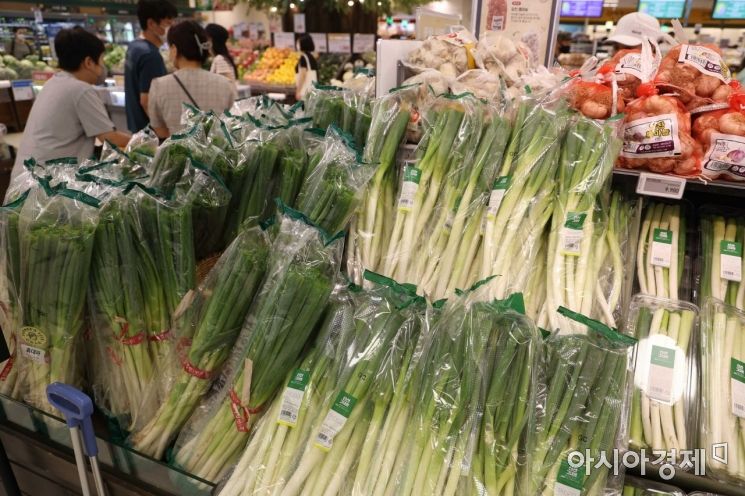 Ahead of Chuseok, there is an emergency regarding the price of food on the table. According to the National Statistical Portal (KOSIS) of Statistics Korea, the food and non-alcoholic beverage price index in July was 113.12 (2020=100), up 8.0% from a year earlier. Food prices rose at the fastest rate in one year and five months since February last year. In particular, prices of processed foods such as edible oils (34.7%) and fresh foods such as vegetables and seaweed (24.4%) increased significantly. On the 7th, citizens were shopping at a large supermarket in Seoul. Photo by Moon Honam munonam@
[Asia Economy Reporters Song Seung-yoon and Moon Je-won] Since the 8th, record-breaking heavy rain continuing in the Seoul metropolitan area has caused already soaring vegetable prices to show further upward movement. The heavy rain is expected to continue throughout this week, raising concerns about additional damage to crops. There are also forecasts that vegetable prices may rise further due to these effects ahead of Chuseok.
According to the Central Disaster and Safety Countermeasures Headquarters and the Ministry of Agriculture, Food and Rural Affairs as of 6 a.m. on the 11th, flooding damage to crops has occurred over an area of 305 hectares (922,625 pyeong) due to the heavy rain. As of the afternoon of the previous day, greenhouses suffered damage over 0.1 hectares, and farmland loss and burial areas reached 2.3 hectares. Livestock and bee colonies also perished, with 20,533 animals and 660 hives lost respectively.
Initially, the rain was concentrated in urban areas of the metropolitan region, causing little damage to crops, but since the previous day, the rain cloud band moved south to the central region, resulting in numerous damage cases. As heavy rain is expected to continue this week, the scale of damage may increase, especially in rural areas. Due to the heavy rain, the harvest of crops like napa cabbage and radish, which are in their harvesting season, has been delayed, potentially leading to supply instability.
Earlier, prices of agricultural products including vegetables had already surged due to heatwaves, and there are concerns that vegetable prices may rise further ahead of Chuseok because of the heavy rain. In fact, vegetable prices have been rising sharply day by day recently. According to the Korea Agro-Fisheries & Food Trade Corporation’s agricultural product distribution information, the wholesale price of radish (20 kg) was 21,200 KRW as of the 5th, up 38.9% from 15,256 KRW a year ago, but it surged again by over 40% to 29,700 KRW as of the previous day, just five days later. The price of zucchini (20 pieces), which was 22,252 KRW, rose slightly to 24,780 KRW by the 5th, then jumped 58% year-on-year to 35,160 KRW as of the previous day. Cucumber prices also fell slightly from 28,100 KRW to 23,800 KRW (10 kg basis) by the 5th, but then rose over 56% to 37,250 KRW as of the previous day.
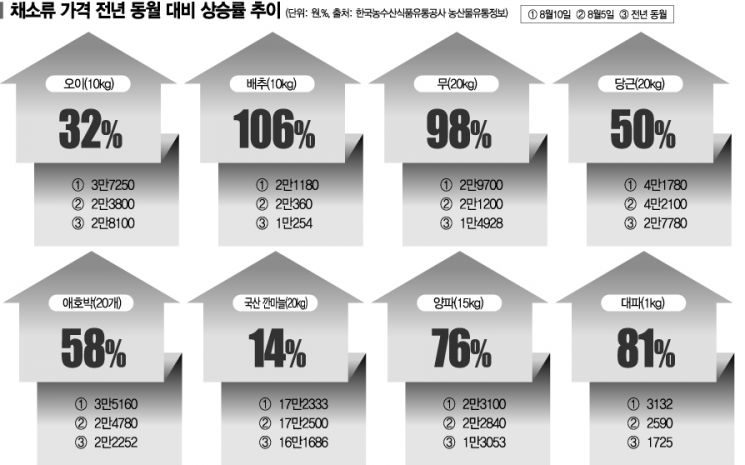
Additionally, napa cabbage prices (10 kg basis) soared over 106%, from 10,254 KRW a year ago to 21,180 KRW. Green onions also rose more than 81%, from 1,725 KRW to 3,132 KRW per kilogram, and onions surged over 76%, from 13,053 KRW to 23,100 KRW per 15 kg. Carrots increased by more than 50%, from 27,780 KRW to 41,780 KRW per 20 kg, and water dropwort prices rose over 14%, from 44,778 KRW to 61,275 KRW per 7.5 kg.
In the past, heavy monsoon rains or concentrated downpours often caused sharp increases in consumer prices, especially for agricultural products. During the longest monsoon period on record in 2020, despite the spread of COVID-19 and low dining-out demand, poor crop conditions caused agricultural product prices to surge 31.8% year-on-year in September. At that time, most crop prices, including onions (152.9%), apples (142.5%), and green chili peppers (79%), continued to soar. The Bank of Korea warned that "concentrated heavy rain causes supply disruptions in vegetables and fruits, raising inflation rates," and that "the third-quarter gross domestic product (GDP) growth rate could also decline."
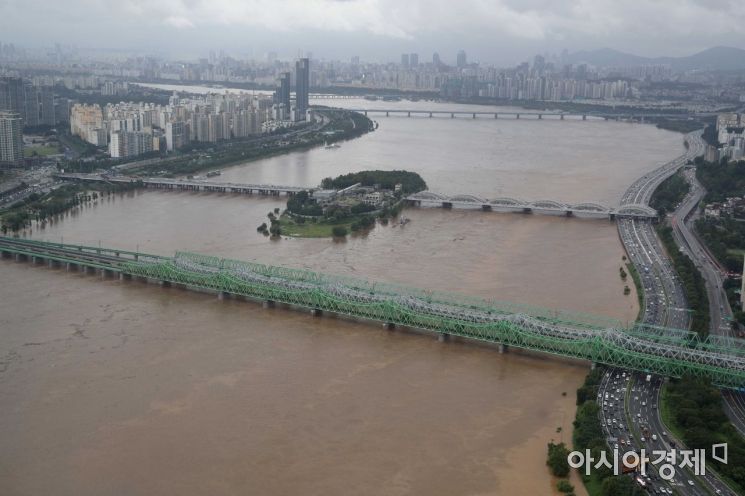 On the 9th, when record-breaking heavy rain fell mainly in Seoul and the central region, the Han River turned muddy. Photo by Moon Honam munonam@
In years with heavy summer rainfall like 2011 and 2006, agricultural product price increases during July and August significantly exceeded normal levels, intensifying inflationary pressure around Chuseok. Particularly in 2010, when Typhoon Gonpas had a strong impact, inflationary pressure was high enough to influence the Bank of Korea’s decision to raise the base interest rate by 0.25 percentage points. Recently, with the Ukraine crisis and global supply bottlenecks driving food prices up, concerns have been raised that inflationary pressure from heavy rain on agricultural product prices will be even greater than in the past. The Bank of Korea also pointed out in a recent inflation review meeting that "uncertainty remains high regarding summer weather conditions such as typhoons and heatwaves."
Kim Won-tae, head of the Horticulture Division at the Agricultural Outlook Center of the Korea Rural Economic Institute, said, "Due to drought, heatwaves, and monsoon rains continuing until early July, overall crop conditions are poor, and this trend is expected to continue until Chuseok." He advised, "Although damage from this heavy rain is not yet relatively large, the situation needs to be monitored, and thorough pest control measures should be taken to respond to supply reductions for agricultural products to be shipped after Chuseok."
Meanwhile, the Ministry of Agriculture, Food and Rural Affairs held a situation review meeting on the previous day regarding the recent heavy rain to check emergency response systems and measures to stabilize supply and demand of agricultural and livestock products. Earlier, Minister Jeong Hwang-geun instructed all affiliated and related organizations to maintain emergency preparedness until the heavy rain stops during an urgent review meeting on the 8th. He also urged inspections of agricultural facilities such as reservoirs and irrigation facilities, livestock barns, greenhouses, and quarantine facilities including African Swine Fever (ASF) containment fences. Special emphasis was placed on taking measures to prevent disease and physiological damage to crops such as radish, napa cabbage, and potatoes in the Gangwon region.
© The Asia Business Daily(www.asiae.co.kr). All rights reserved.
![Clutching a Stolen Dior Bag, Saying "I Hate Being Poor but Real"... The Grotesque Con of a "Human Knockoff" [Slate]](https://cwcontent.asiae.co.kr/asiaresize/183/2026021902243444107_1771435474.jpg)

















