After the Korea-China Foreign Ministers' Meeting, Chinese Foreign Ministry Issues Statement
Mentions Exchanges with China... Indirect Warning to Korea
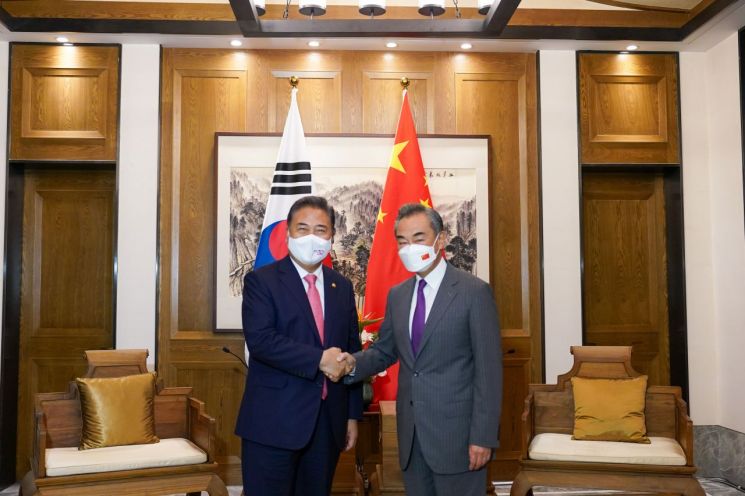
[Asia Economy Senior Reporter Cho Young-shin] The Chinese Ministry of Foreign Affairs issued a statement under the name of Wang Yi, State Councilor and Foreign Minister, warning against the "political forces of some countries that follow the United States." Although no specific country was named, the statement was released immediately after a meeting with Park Jin, South Korea's Foreign Minister, leading to analyses that it was indirectly targeting South Korea.
The People's Daily, the official newspaper of the Chinese Communist Party, published Wang's statement on the 11th, noting that the situation in the Taiwan Strait remains unstable and emphasizing the need to be vigilant against three new risks.
Wang first defined U.S. House Speaker Nancy Pelosi's visit to Taiwan as a political provocation. He further stated that this provocation seriously infringed on China's sovereignty and that China would exercise its right to self-defense to protect its territorial integrity.
Wang pointed out that attention must be paid to three risks: politicians from some countries pursuing political interests, the U.S. military buildup in the Taiwan Strait, and miscalculations by Taiwan separatist (independence) forces.
He stressed the need to be wary of politicians from some countries who follow the false claims of the United States. Wang warned that due to some politicians, the political foundation for exchanges with China could be seriously damaged. He also threatened that this would have a serious impact on the international order and system established after World War II.
At the Korea-China Foreign Ministers' meeting held on the 9th in Qingdao, China clearly showed a difference in stance with South Korea by demanding restrictions not only on the THAAD (Terminal High Altitude Area Defense) "three no's" (no additional THAAD deployment, no participation in the U.S. missile defense system, no Korea-U.S.-Japan military alliance) but also on the operation of the already deployed THAAD system.
China also expressed discomfort regarding South Korea's participation in the U.S.-led semiconductor technology alliance (Chip 4), while mentioning the importance of maintaining smooth supply chains.
There is analysis that the statement under Wang's name was aimed at South Korea. Since the U.S. military buildup in the Taiwan Strait and Taiwan's independence aspirations are not new risks, the statement is seen as targeting South Korea.
There is also an interpretation that the phrase "exchanges with China," which deliberately hints at South Korea, was included in the statement. South Korea is China's largest trading partner.
The Chinese Ministry of Foreign Affairs stated that Wang issued the statement after meetings with the foreign ministers of South Korea, Mongolia, and Nepal to analyze recent developments, but trade volumes with Mongolia and Nepal are negligible.
At the end of the statement, Wang added, "China will resolutely respond to all dangerous actions that undermine peace in the Taiwan Strait and safeguard the 'One China' principle."
Meanwhile, the Chinese State Council publicly threatened the United States and Taiwan in a white paper titled "The Taiwan Issue and China's Reunification in the New Era," released the previous day, stating that while China aims for peaceful reunification with Taiwan, it may resort to force if necessary.
© The Asia Business Daily(www.asiae.co.kr). All rights reserved.
![Clutching a Stolen Dior Bag, Saying "I Hate Being Poor but Real"... The Grotesque Con of a "Human Knockoff" [Slate]](https://cwcontent.asiae.co.kr/asiaresize/183/2026021902243444107_1771435474.jpg)















