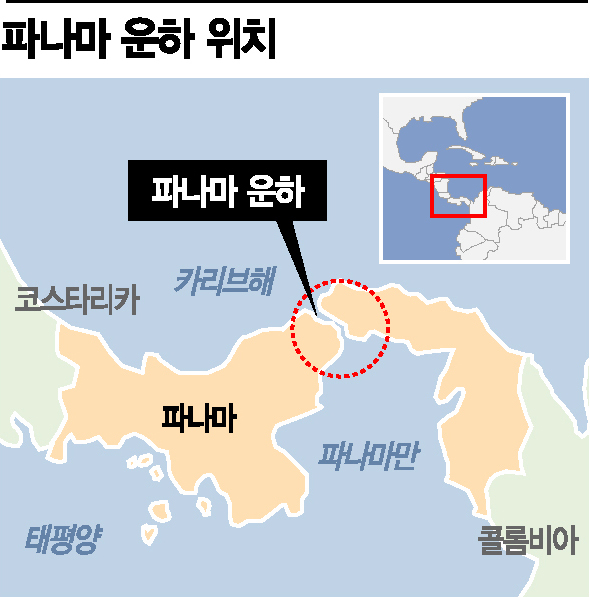
[Asia Economy Reporter Park Byung-hee] Opened in 1914, the Panama Canal, a central gateway for Atlantic-Pacific maritime trade responsible for 6% of global trade, is increasingly facing operational difficulties due to the impacts of climate change, according to a recent report by the British BBC.
Due to its design characteristics, the Panama Canal requires over 9 billion liters of water daily, but with climate change making rainfall predictions more difficult, water management has become more challenging.
The Panama Canal is designed with a mountain range in the middle, requiring ships to pass through multiple locks at different heights. The highest point of the Panama Canal is 26 meters above sea level. Each time a ship passes through a lock, the dock must be filled with water to adjust the water level so the ship can pass. Approximately 250 million liters of water are needed per ship. Since an average of 37 ships pass through the Panama Canal daily, more than 9 billion liters of water are required. The Panamanian government supplies the water needed for canal operations by creating large artificial lakes on surrounding mountain tops.
Due to the characteristics of the Panama Canal, changes in rainfall directly affect canal operations. When rainfall is low, the water used to float the vessels must be reduced, which means ships must reduce their cargo load to lower their weight to pass through the locks.
Because of climate change, rainfall predictions are becoming increasingly difficult. The Panama Canal Authority has kept rainfall data since 1880, and among the ten largest storms since then, eight have occurred in the past 25 years. This indicates an increasing frequency of storms. Conversely, the second and third driest years since 1880 have also occurred consecutively.
Stephen Patton, a researcher at the Smithsonian Tropical Research Institute (STRI) in Panama, said, "Weather changes are becoming increasingly unpredictable," adding, "This year, the rainy season started earlier than ever before, and there is no similar precedent." Excessive rainfall also causes problems, as the artificial lakes can overflow.
The water from the artificial lakes is used not only for Panama Canal operations but also supplies drinking water to half of Panama's population. Since the Panama Canal accounts for 12% of Panama's economy, properly managing the water in the artificial lakes is a very important issue for the Panamanian government. The Panama Canal Authority is considering various measures to store more water stably. These include deepening the artificial lakes, constructing dams, desalinating seawater for drinking purposes, and increasing the proportion of desalinated water used for Panama Canal operations.
© The Asia Business Daily(www.asiae.co.kr). All rights reserved.
![Clutching a Stolen Dior Bag, Saying "I Hate Being Poor but Real"... The Grotesque Con of a "Human Knockoff" [Slate]](https://cwcontent.asiae.co.kr/asiaresize/183/2026021902243444107_1771435474.jpg)















