Yeouido Seongmo Ophthalmology Hospital Professor Hwang Hosik's Research Team
Deep Learning Surpasses Specialists in Image Interpretation Accuracy
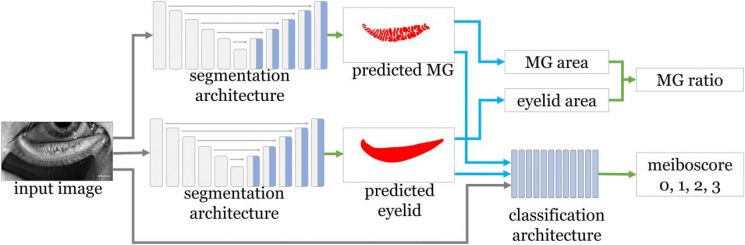
[Asia Economy Reporter Lee Gwan-joo] A research team led by Professor Hwang Ho-sik at the Catholic University Yeouido St. Mary's Eye Hospital (in collaboration with Professor Jeong Ui-hyun from the Department of Biomedical Engineering at Gwangju Institute of Science and Technology) announced on the 11th that they have developed a technology to interpret eyelid meibomian gland images using artificial intelligence (AI).
The meibomian glands are a type of sebaceous gland located in the eyelids that secrete an oil called meibum onto the ocular surface, forming the lipid layer of the tear film. Since this lipid layer suppresses tear evaporation, dysfunction of the meibomian glands is considered a major cause of dry eye syndrome.
The research team utilized a big data set of meibomian gland images owned by Yeouido St. Mary's Hospital and applied deep learning technology at Gwangju Institute of Science and Technology to quantitatively analyze the degree of meibomian gland loss. They annotated the eyelid and meibomian gland areas in 1,000 meibomian gland images, after which two dry eye specialists scored the degree of gland loss. Among these, 800 images were used to train the deep learning model at Gwangju Institute of Science and Technology, and the results of the deep learning model were compared and analyzed against the specialists' readings.
As a result, in terms of validation accuracy for the degree of meibomian gland loss, the 'deep learning model' and 'specialist readings' achieved 73.01% and 53.44%, respectively, with deep learning showing superiority. Additionally, to verify reproducibility, when 600 meibomian gland images taken at Korea University Ansan Hospital were analyzed by the deep learning model and compared with evaluations by dry eye specialists, the deep learning model again demonstrated higher accuracy.
Professor Hwang explained, "This study created a deep learning model using data from equipment that captures meibomian gland images, which can be directly applied to medical devices and utilized for the diagnosis and treatment of dry eye syndrome."
This research was published in the June online edition of the prestigious international ophthalmology journal 'Ocular Surface.'
© The Asia Business Daily(www.asiae.co.kr). All rights reserved.
![Clutching a Stolen Dior Bag, Saying "I Hate Being Poor but Real"... The Grotesque Con of a "Human Knockoff" [Slate]](https://cwcontent.asiae.co.kr/asiaresize/183/2026021902243444107_1771435474.jpg)















