New Buildings with Semi-basement Residential Use to be Denied 'Building Permits'
200,000 Existing Houses to be Phased Out with Grace Period
Active Promotion of Flood-prone Area Improvement Projects
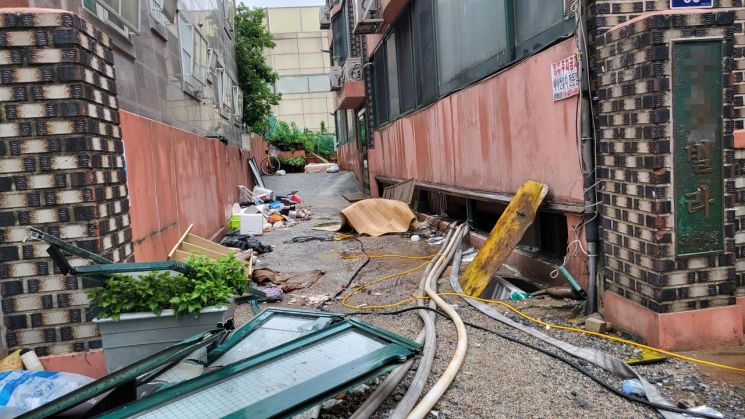
[Asia Economy Reporter Kim Hyemin] The Seoul Metropolitan Government has decided to eliminate 'banjiha housing' (semi-basement housing). Following recent record-breaking heavy rains that reaffirmed the vulnerability of banjiha homes, the city announced safety measures on the 10th.
The core of this plan is to completely ban the construction of underground or banjiha housing for residential purposes. The city has begun consultations with the government.
In fact, the Building Act was amended in 2012 under Article 11 to allow the denial of construction permits for underground floors in flood-prone areas after review. However, more than 40,000 banjiha homes have been built since then. Accordingly, the city has proposed improvements to prohibit habitation in underground and banjiha floors regardless of the area.
Existing underground and banjiha homes will be phased out through a sunset policy. According to Statistics Korea, as of 2020, about 200,000 households, approximately 5% of all households in Seoul, live in underground or banjiha housing.
The Seoul Metropolitan Government plans to grant a grace period of 10 to 20 years for already approved underground and banjiha buildings and gradually eliminate them. After tenants move out, the city will encourage conversion to non-residential uses. To promote participation from building owners, incentives will also be provided. The city is considering supporting remodeling or offering floor area ratio benefits during redevelopment projects if converted to neighborhood living facilities, warehouses, parking lots, etc.
Additionally, underground and banjiha spaces left vacant after tenants move out will be purchased through the Seoul Housing Corporation (SH) 'Vacant House Purchase Project' and remodeled for use as community warehouses or community facilities.
For areas prone to frequent flooding or at risk of flooding, the city will expedite redevelopment projects such as collective housing and redevelopment. Tenants of underground and banjiha homes in these areas will be supported with public rental housing or housing vouchers.
This month, Seoul will first identify the status of about 17,000 banjiha homes where more than two-thirds of the housing is underground to prepare countermeasures. Subsequently, a full survey of 200,000 underground and banjiha homes across Seoul will be conducted to build a database and classify risk levels for management.
Seoul Mayor Oh Se-hoon stated, "Underground and banjiha housing is a backward housing type that threatens vulnerable residents in all aspects, including safety and living environment, and must now disappear. This time, we will implement fundamental measures that protect citizens' safety and provide housing stability, not short-term solutions that are mere stopgaps."
© The Asia Business Daily(www.asiae.co.kr). All rights reserved.
![Clutching a Stolen Dior Bag, Saying "I Hate Being Poor but Real"... The Grotesque Con of a "Human Knockoff" [Slate]](https://cwcontent.asiae.co.kr/asiaresize/183/2026021902243444107_1771435474.jpg)















