"140mm per hour is heavy rain... Cement-covered city cannot handle it"
"Air warms due to climate change... Amount of water vapor also increases"
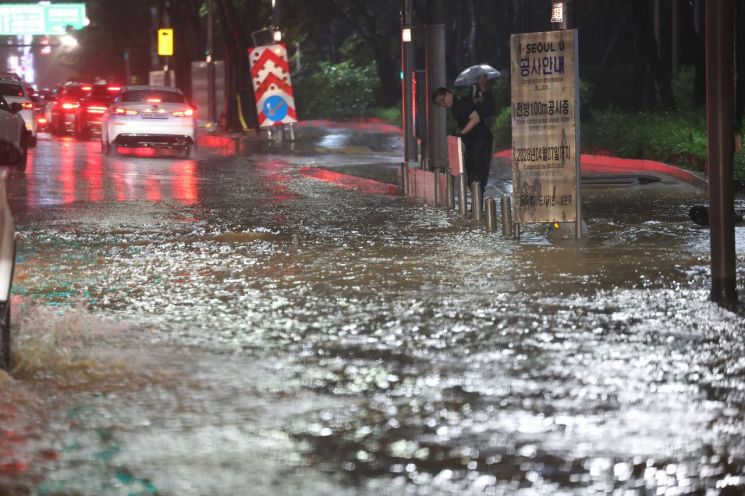 On the night of the 8th, officials near Bongeunsa Station in Gangnam-gu, Seoul, urgently installed flood barriers at the COEX entrance as nearby roads began to flood.
 [Image source=Yonhap News]
[Asia Economy Reporter Yoon Seul-gi] Amid torrential rains exceeding 500mm centered around Seoul and the metropolitan area on the 8th and 9th, forecasts suggest that 'record-breaking heavy rain' will continue to recur. Experts have pointed to climate change as the cause.
On the 10th, Kim Seung-bae, head of the Korea Meteorological Industry Association, appeared on CBS Radio's "Kim Hyun-jung's News Show" and said, "Rainfall exceeding 30mm per hour is called a heavy downpour," adding, "Even 50mm is like pouring water from a bucket, but 140mm per hour is an enormous amount of rain."
From the 8th until 7 a.m. on the 10th, the highest accumulated rainfall was recorded at Yongmunsan in Yangpyeong, Gyeonggi Province, with 532.5mm. This was followed by Seoul with 525mm and Gwangju, Gyeonggi Province with 524.5mm. Heavy rain also fell in Gangwon Province, including Hoengseong with 363mm, Hongcheon with 356mm, and Pyeongchang with 280mm.
Kim explained, "When this much rain falls in cities covered with cement and concrete, the water cannot seep into the ground and inevitably gathers and overflows in one place," adding, "No matter how well drainage facilities are installed, they cannot handle such a massive amount; cities cannot accommodate 140mm per hour."
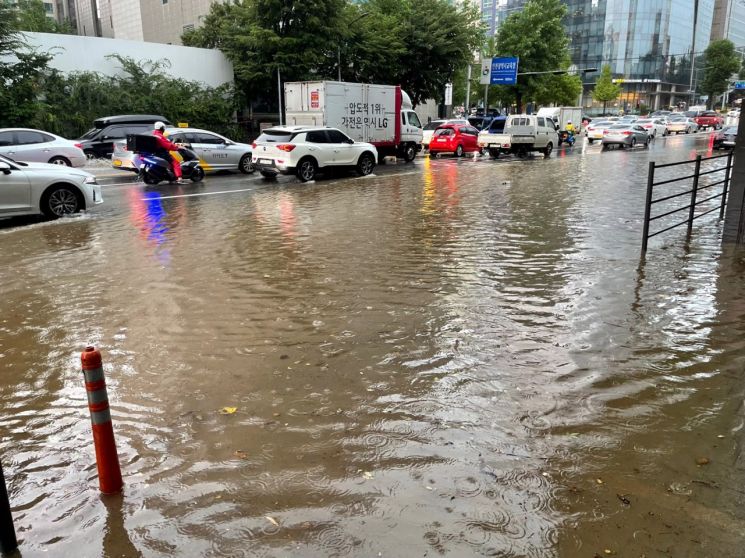 On the afternoon of the 8th, when a heavy rain warning was issued for the inland area of Incheon, a city road in Guwol-dong, Namdong-gu, Incheon, was flooded with rainwater. [Image source=Yonhap News]
Kim further explained that due to recent climate change, the frequency and intensity of localized heavy rain have become stronger than before. He said, "Originally, Korea's summer rainfall patterns had significant local variations," and added, "With climate change, the air covering the Earth is warming, so the amount of water vapor it can hold is increasing."
Regarding the early onset of the autumn rainy season, which usually begins from late August to early September, Kim described it as "a facet of climate change," and said, "These weather phenomena will occur more frequently in the future." He predicted, "The frequency of heavy rain will increase," and "In the past, 100mm per hour was the maximum, but going forward, records like 140mm will be broken, and such events will become more intense. The heavy rain will become more extreme."
Meanwhile, unprecedented heavy rain poured over Seoul and the metropolitan area from the 8th to the 9th. Water infiltrated various subway stations in Seoul, paralyzing transportation, and a sinkhole incident led to the isolation and death of a family living in a semi-basement home. According to the Central Disaster and Safety Countermeasures Headquarters (CDSCH) as of 6 a.m. on the 10th, casualties from the heavy rain include 9 deaths (5 in Seoul, 3 in Gyeonggi, 1 in Gangwon), 7 missing persons (4 in Seoul, 3 in Gyeonggi), and 17 injured (in Gyeonggi).
© The Asia Business Daily(www.asiae.co.kr). All rights reserved.


















