[Asia Economy Reporter Bu Aeri] The Chinese government claimed that the South Korean government has externally promised to limit the operation of the previously deployed Terminal High Altitude Area Defense (THAAD) system. This contradicts the South Korean government's position and is expected to become a flashpoint between the two countries in the future.
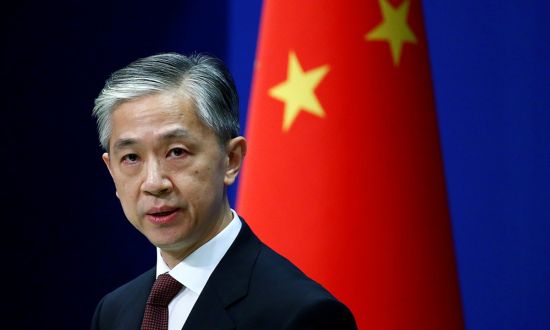
Wang Wenbin, spokesperson for the Chinese Ministry of Foreign Affairs, responded on the 10th during a regular briefing to a question about the meaning of "taking security concerns seriously and handling them appropriately," which China mentioned at the recent South Korea-China foreign ministers' meeting regarding THAAD. He said, "The deployment of THAAD by the United States in South Korea clearly harms China's strategic security interests, and China has repeatedly expressed concerns to the South Korean side."
He continued, "The South Korean government has formally made a political pledge of '3 No's and 1 Limit' externally," adding, "China values this position of the South Korean government, has reached an understanding with South Korea, and both sides have gradually and amicably handled the THAAD issue."
The "3 No's" of THAAD refer to not deploying additional THAAD systems, not participating in the U.S. missile defense (MD) system, and not forming a South Korea-U.S.-Japan military alliance.
This is the first time the Chinese government has publicly stated that the "1 Limit," which refers to restricting the operation of the THAAD already deployed by the U.S. Forces Korea, is a promise made by South Korea externally.
The South Korean government's previously stated position regarding THAAD is the "3 No's." On October 30, 2017, Kang Kyung-wha, then Minister of Foreign Affairs, mentioned this in response to China's retaliatory measures such as the ban on Korean Wave (Hallyu) content, known as the Hanhanryeong.
China's mention of the controversial "THAAD 1 Limit" as a South Korean promise is interpreted as a demand not to operate the already deployed THAAD normally.
Because of this, THAAD could become a source of conflict not only in South Korea-China relations but also between the U.S. and China. The South Korean and U.S. governments decided to deploy THAAD to U.S. Forces Korea in 2016 amid increasing nuclear missile threats from North Korea, and in 2017, the THAAD launchers were temporarily deployed in Seongju.
© The Asia Business Daily(www.asiae.co.kr). All rights reserved.
![Clutching a Stolen Dior Bag, Saying "I Hate Being Poor but Real"... The Grotesque Con of a "Human Knockoff" [Slate]](https://cwcontent.asiae.co.kr/asiaresize/183/2026021902243444107_1771435474.jpg)
















