3 Trillion Won Invested in Sewer Maintenance, Small Rainwater Storage Tanks, and Rainwater Pump Stations
"5 Deaths, 3032 Displaced... Taking Responsibility"
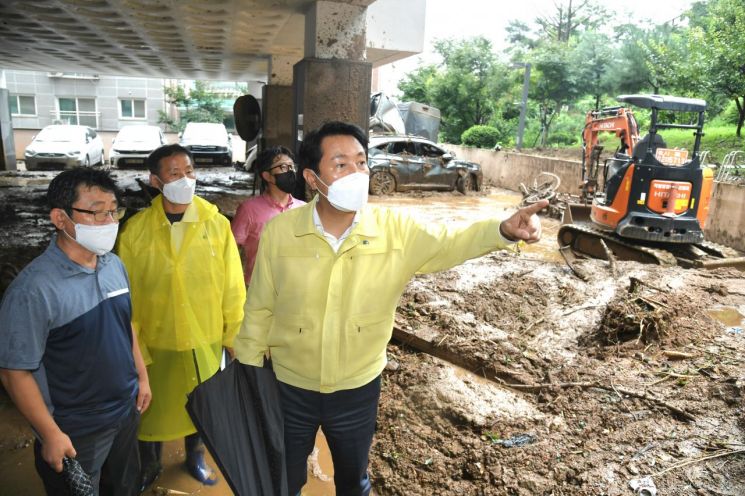
[Asia Economy Reporter Lim Cheol-young] Seoul Mayor Oh Se-hoon expressed deep responsibility regarding the recent heavy rainfall concentrated in the central region since the 8th, which resulted in 5 deaths and 3,032 displaced persons, and announced plans to invest 4.5 trillion won to significantly strengthen the city's flood control management goals.
On the 10th, Mayor Oh stated in a press release, "As the mayor of a city of ten million, I deeply feel responsible and offer my apologies," adding, "We will swiftly proceed with support for restoring flooded homes and businesses to their original state, as well as emergency repairs of roads and rivers. We reaffirmed the need to shift from post-disaster recovery to a preemptive prevention system."
Accordingly, Mayor Oh decided to substantially raise the city's flood control management targets. Seoul plans to increase the hourly drainage capacity from the current standard of 95mm for a 30-year frequency to at least 100mm for a 50-year frequency, and for the basin-shaped Gangnam area, to handle 110mm for a 100-year frequency. He said, "In cooperation with the government, we will resume construction of rainwater storage and drainage facilities in six habitual flood-prone areas, which had been halted since 2011," and added, "We will concentrate an investment of 1.5 trillion won over the next ten years." Furthermore, he stated, "Alongside this project, we will invest a total of 3 trillion won by improving existing sewage pipelines, small-scale rainwater storage tanks, and rainwater pumping stations."
Seoul plans to complete the first phase by 2027, focusing on the Gangnam Station area, Dorimcheon Stream, and Gwanghwamun area, which suffered significant flood damage this time. Despite implementing the 'Comprehensive Drainage Improvement Plan for the Gangnam Station Area' in 2015, Mayor Oh judged that it was insufficient to accommodate the changed weather environment caused by climate change and heavy rainfall.
Mayor Oh said, "Seoul will invest 350 billion won to restore the original deep rainwater storage and drainage facility construction plan and implement fundamental flood control measures," adding, "We will invest 300 billion won in the Dorimcheon area to build rainwater storage and drainage facilities to increase storage and flow capacity, and in Gwanghwamun, we will proceed with plans for deep rainwater storage and drainage facilities."
The second phase will be carried out sequentially by 2030, targeting areas such as Sadang-dong in Dongjak-gu, Gangdong-gu, and Yongsan-gu, in line with related linkage projects or urban development progress.
Mayor Oh explained, "To prepare for the concrete execution of the measures, we will immediately allocate related funds such as disaster funds," and added, "We will conduct a feasibility study in the second half of the year to set directions regarding the actual conditions, installation methods, and scale for the six areas, and reflect design costs in the 2023 budget to expedite subsequent procedures."
He also stated, "Despite Seoul's poor financial conditions, since this is a proactive investment to protect citizens' safety, we plan to proceed even if it requires issuing local bonds," and added, "We received a positive response regarding national government support at a meeting presided over by the president."
© The Asia Business Daily(www.asiae.co.kr). All rights reserved.
![Clutching a Stolen Dior Bag, Saying "I Hate Being Poor but Real"... The Grotesque Con of a "Human Knockoff" [Slate]](https://cwcontent.asiae.co.kr/asiaresize/183/2026021902243444107_1771435474.jpg)















