Seoul City Bans 'Basement Apartments for Residential Use'
Plans to Phase Out Existing Facilities
327,320 Households Still Exposed to Danger in Basement Living
Cost Savings Major Reason for Residence
Experts Urge Provision of Minimum Safety Measures Like Flood Barriers
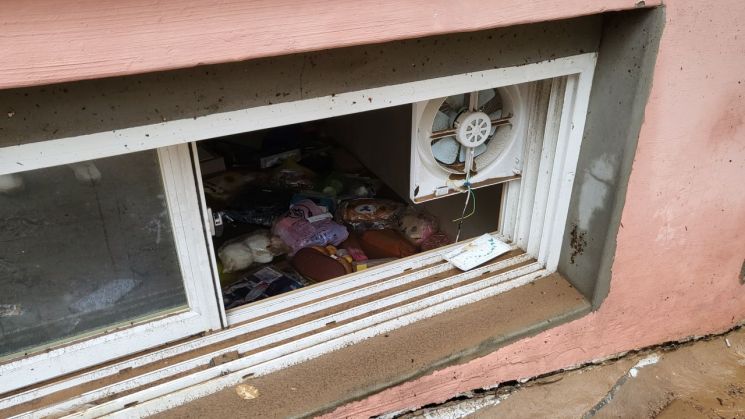 On the 8th at around 9:07 PM, a family of three trapped in a semi-basement villa near Gwanak-gu, Seoul, due to heavy rain flooding, reported the incident but ultimately died. / Yonhap News
[Asia Economy Reporter Kang Juhee] The safety of living in semi-basement houses has become a major issue as flooding in semi-basement homes surged due to record-breaking heavy rain across Seoul and the metropolitan area. Following this incident, the Seoul Metropolitan Government announced plans to gradually eliminate underground and semi-basement residences in the city over the long term. However, there are still residents whose homes are semi-basements even after the accident. The anxiety that a 'home' once considered safe can suddenly turn into a 'disaster site' remains unresolved.
On the 8th, a family of three living in a semi-basement in Gwanak-gu, Seoul, died due to heavy rain concentrated in the central region. On the same day, a woman in her 50s living in a semi-basement in Sangdo-dong, Dongjak-gu, also died after being unable to escape the sudden floodwaters. It was revealed that the flood victims were a family with developmental disabilities and recipients of basic livelihood security benefits, reaffirming that socially vulnerable groups are more susceptible to disasters.
The Seoul Metropolitan Government plans to prohibit the use of underground and semi-basement spaces as residential areas and to phase out already permitted buildings over a grace period of 10 to 20 years. They announced a 'Safety Measures for Households Living in Underground and Semi-basement Residences' and stated they would consult with the government on revising related building laws. Seoul Mayor Oh Se-hoon said, "Underground and semi-basement houses are backward housing types that threaten vulnerable residents in all aspects, including safety and living environment. To protect citizens' safety and provide housing stability, they must now disappear."
The problem is that despite regulatory improvements, many citizens still live in semi-basements. According to Seoul city data, as of 2020, about 200,000 households, or 5% of all households in Seoul, live in underground or semi-basement residences. According to the 2020 Population and Housing Census by Statistics Korea, a total of 327,000 households nationwide live in underground or semi-basement homes. Notably, 96% of these households are concentrated in the metropolitan area, including Seoul, Incheon, and Gyeonggi Province.
Article 11 of the current Building Act stipulates that if it is recognized as inappropriate to use certain spaces such as basements for residential purposes or to install living rooms in areas prone to frequent flooding or flood risk, permission can be restricted after review by the city building committee. However, Seoul has identified that more than 40,000 semi-basement houses have been built since this regulation was enacted in 2012. Even if the proposed amendments to the Building Act are passed, there are still people living in semi-basements, so the risk of casualties due to flooding remains when heavy rain occurs in the metropolitan area.
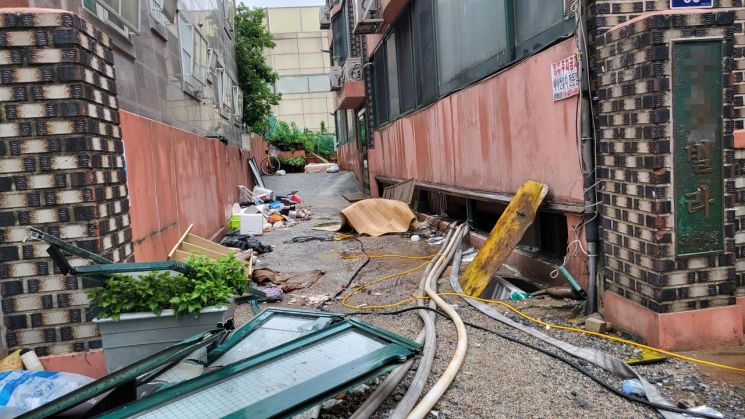
Semi-basement houses are known to have first appeared in the 1970s. At that time, the government amended the Building Act to mandate the construction of basements in buildings of a certain size, leading to the emergence of semi-basements in multi-family housing and other buildings. Some speculate that semi-basements were introduced as a kind of 'air-raid shelter' concept during a period of heightened military tension between North and South Korea. However, as the population concentrated in Seoul and the metropolitan area, housing shortages led to the use of semi-basements as living spaces.
It is well known that semi-basements are vulnerable to flooding damage caused by events such as heavy rain. However, due to the advantage of being relatively affordable compared to market prices, they are still used as living spaces. Park, a person in their 30s who has experience living in a semi-basement, said, "Even under the same conditions, the monthly rent difference between a semi-basement and a ground-level unit is more than 100,000 won. Although it is inconvenient with no sunlight, noise, and humidity, I lived in a semi-basement to save on monthly housing costs."
Experts emphasize the need to gradually reduce semi-basement housing while conducting safety inspections of currently used semi-basement residences. Professor Gong Ha-seong of the Department of Fire and Disaster Prevention at Woosuk University said, "For semi-basement houses located in low-lying areas, it is essential to install flood barriers and take other measures. Regular inspections, such as removing debris from drainage outlets, are necessary to minimize flood damage." Regarding actions to take during flooding, he advised, "If water starts entering the house even slightly, evacuate immediately. Even if water reaches above the knees, the water pressure can prevent doors from opening."
© The Asia Business Daily(www.asiae.co.kr). All rights reserved.


















