Ecosystem Expansion Strategy Through Upgrades... Full Effort on 'Customer Experience'
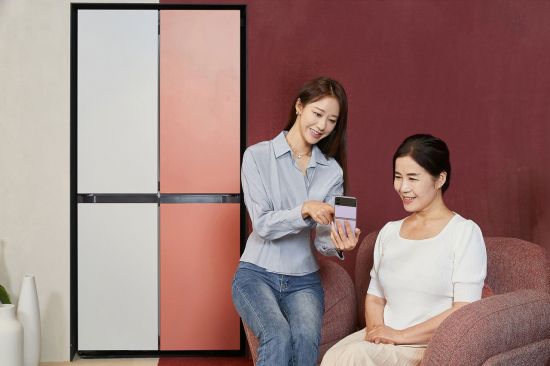 Samsung Electronics has updated its SmartThings Home Care service and added a family care feature.
 [Photo by Samsung Electronics]
[Asia Economy Reporter Han Yeju] Samsung Electronics and LG Electronics are focusing on creating new customer experiences through 'upgrades.' Unlike before, when the focus was on shortening the product replacement cycle, the new approach allows customers to experience new features simply by enhancing existing functions without purchasing new products.
According to the home appliance industry on the 14th, Samsung Electronics strengthened the family care feature among the main functions of the integrated home appliance solution 'SmartThings Home Life,' launched in February. A new feature was added that analyzes refrigerator usage frequency to check on the well-being of family members living alone or separately.
Since acquiring the smart home company 'SmartThings' in 2014, Samsung Electronics has been integrating it into various home appliances. Samsung emphasizes personalized services where users do not need to be aware of or pay attention to related functions, as the products automatically perform their functions. While Samsung's past home appliances showcased excellent individual performance focusing on solo play, now they aim to operate like 'one team,' delivering connected experiences tailored to each consumer's lifestyle.
In particular, the long-term plan to create a 'Galaxy Eco Ecosystem' that provides connected experiences enabling Galaxy smartphone users to use home appliances more effectively stands out.
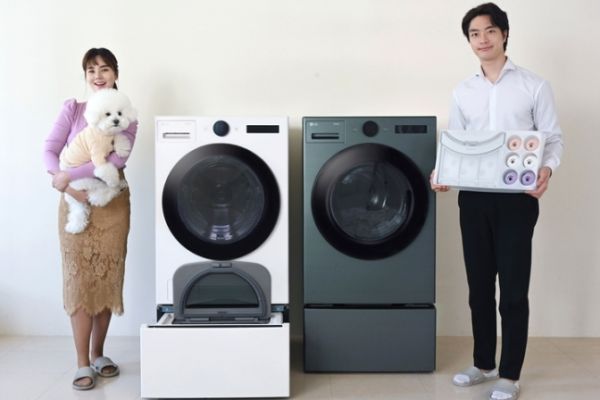 LG Electronics is upgrading the 'Pet Care Course' on laundry and drying appliances such as Tromm washing machines, dryers, Mini Wash, and Wash Tower to provide customers with pets a differentiated customer experience unique to UP appliances.
 [Photo by LG Electronics]
If Samsung Electronics has SmartThings, LG Electronics has 'ThinQ.' While Samsung talks about Team Samsung, LG Electronics emphasizes the concept of UP appliances.
UP appliances focus on continuously identifying and customizing upgrades based on real-time customer needs and inconveniences detected throughout the home where LG products are installed. When customers connect their appliances through the ThinQ app, the products continuously self-check their performance and provide customized solutions when problems arise. Beyond home appliances, LG Electronics currently offers smart apartment services through the smart home platform 'LG ThinQ Home.' Starting with linking and controlling various home appliances, it also provides apartment entry history checks, utility bill payments, elevator calls, and parking lot information.
Samsung Electronics and LG Electronics plan to further expand their smart home platforms that combine artificial intelligence (AI) and the Internet of Things (IoT). It is interpreted that they have decided to focus more on strategies to retain current customers rather than expanding new ones.
An industry insider said, "The trend in home appliance competition has shifted from who makes better products to who can more smartly connect their diverse products and quickly understand customers' lifestyles," adding, "If a company incorporates customers into its brand ecosystem and continuously satisfies them, it can also aim for a 'lock-in' effect to prevent customers from moving to other ecosystems."
© The Asia Business Daily(www.asiae.co.kr). All rights reserved.
![Clutching a Stolen Dior Bag, Saying "I Hate Being Poor but Real"... The Grotesque Con of a "Human Knockoff" [Slate]](https://cwcontent.asiae.co.kr/asiaresize/183/2026021902243444107_1771435474.jpg)
















