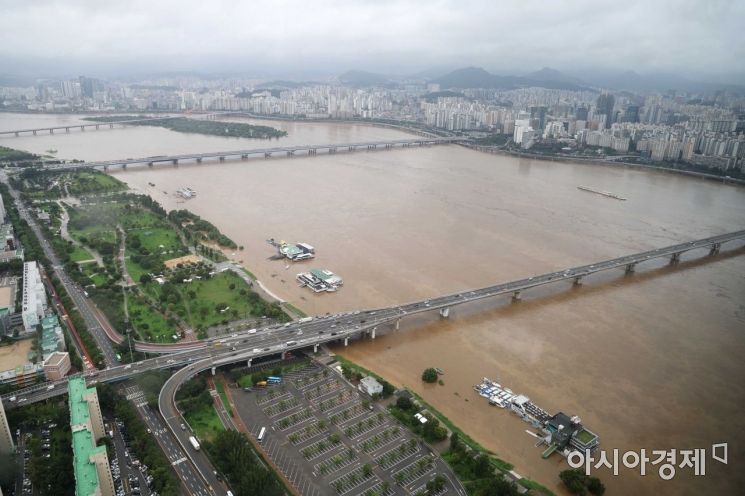
 On the 9th, when record-breaking heavy rain fell mainly in Seoul and the central region, the Han River turned muddy. Photo by Moon Honam munonam@
[Asia Economy Reporter Junho Hwang] Amid record-breaking heavy rains occurring for the first time in 80 years, investor expectations are rising as they try to view disaster recovery projects as opportunities. However, an analysis shows that the actual returns of such investment strategies are not very favorable. Since government-led reconstruction projects are carried out, it is difficult for individual stocks to secure performance based on market economy principles. For this reason, it is analyzed that natural disaster ETFs listed in the U.S. have regulations such as 'excluding companies listed in Korea from investment targets.'
Researcher Tae-hyun Seol of DB Investment Securities stated on the 10th, "Looking at the calculation process of the underlying index of the 'Natural Disaster Recovery ETF' listed on the U.S. stock market last June, there is a peculiar condition excluding companies listed in Taiwan and Korea," adding, "In Korea, natural disaster recovery is government-led, so it is relatively difficult to expect benefits based on market economy."
Over the past 10 years since 2012, 11.7 trillion KRW has been invested in natural disaster recovery, with 9.7 trillion KRW (85%) coming from national and local government funds, indicating that recovery efforts have been government-driven. Accordingly, this ETF includes stocks or ETFs from Japan, Canada, and the U.S., but does not invest in domestic companies.
Researcher Seol also analyzed that the actual stock prices of domestic natural disaster beneficiary stocks fell after disasters. This suggests that the benefits were short-term, reducing long-term investment value, which is why they were not included in the ETF.
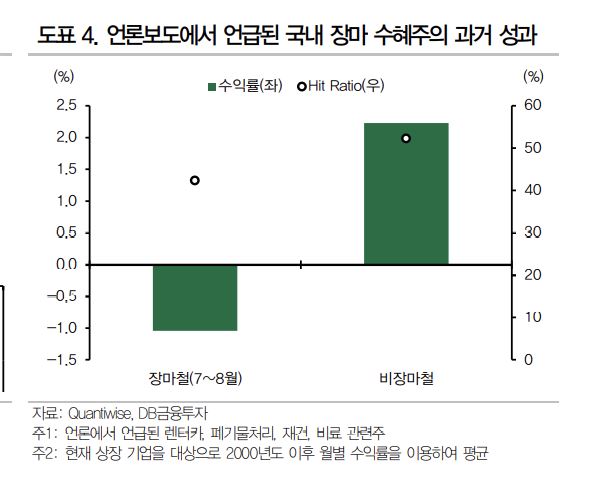
He said, "Since Korea also suffers the most damage from heavy rains, every summer there is a movement to find beneficiary companies related to keywords such as monsoon, floods, and heavy rain," adding, "however, looking at the monthly returns of these companies since 2000, the average returns in July and August, when heavy rains are concentrated, were lower than during other periods."
Typically, companies related to rental cars, waste disposal, agricultural machinery, and fertilizers are mentioned in connection with heavy rains, but the actual monthly average returns of these industries before and after disasters were lower than usual.
He advised, "Valuation changes based on expectations unsupported by performance improvements last less than a month, so caution is needed when investing."
© The Asia Business Daily(www.asiae.co.kr). All rights reserved.
![Clutching a Stolen Dior Bag, Saying "I Hate Being Poor but Real"... The Grotesque Con of a "Human Knockoff" [Slate]](https://cwcontent.asiae.co.kr/asiaresize/183/2026021902243444107_1771435474.jpg)
















