Over 50 Vehicles Flooded Around Gangnam Station
To Identify Flooded Cars, Check Smell, Seatbelt, Fuse Box, and More
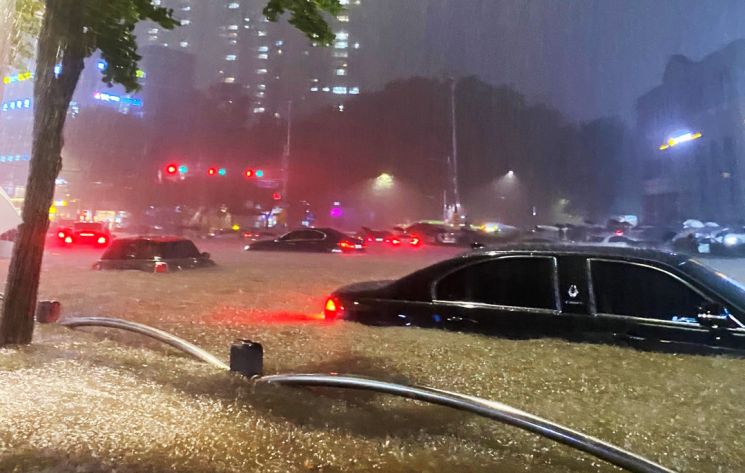 On the night of the 8th, when heavy rain poured down in Seoul, the road near Daechi Station in Seoul was flooded. Vehicles were submerged in water. [Image source=Yonhap News]
[Asia Economy Intern Reporter Kim Gun-chan] As record-breaking heavy rain falls for the first time in 80 years, flooding damage continues, and cases of vehicle flooding are occurring one after another. Caution is required as flooded vehicles may circulate in the used car market.
On the 8th, record-breaking heavy rain caused flooding in various parts of Seoul. Damage was concentrated mainly in the Gangnam area, which has many low-lying areas. In Sindebang-dong, Dongjak-gu, 136.5mm of rain fell in one hour until 9 p.m., with more than 100mm of rain pouring per hour mainly in the southern region. This surpassed the previous highest hourly rainfall record in Seoul of 118.6mm set in August 1942.
The area around Gangnam Station, flooded by the heavy rain, was completely closed off. According to Seoul city and fire authorities, around 8 p.m. that day, sewage near Gangnam Station backflowed, flooding the roads. About 50 vehicles were submerged, with passenger cars submerged to the extent that only the upper parts of the vehicles were visible.
On social networking services (SNS) and online communities that day, photos of vehicle flooding damage were uploaded in real time. A photo of a man climbing on top of a flooded vehicle in front of an apartment in Seocho-gu, Seoul, to take shelter gained attention. A video of a driver pushing the car from behind after it was submerged also circulated.
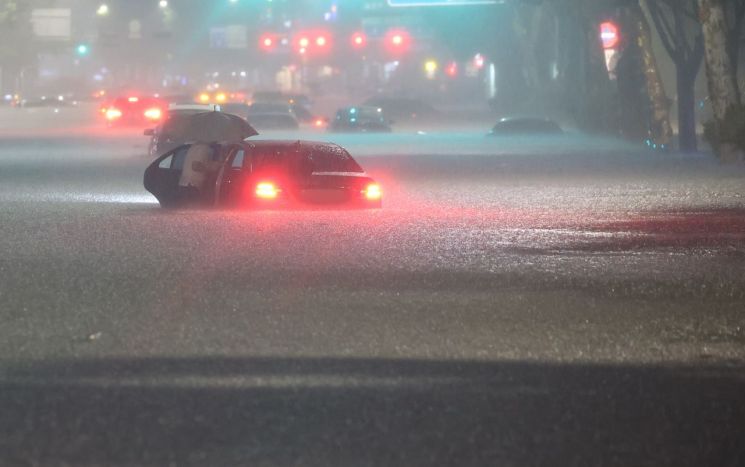 A driver is evacuating after a vehicle was submerged on a road near Daechi Station in Gangnam-gu, Seoul. [Image source=Yonhap News]
◆ "This isn’t a flooded car, right?" How to distinguish a 'water-damaged car'
As vehicle flooding damage continues, anxiety is growing among consumers looking to purchase used cars. This is because cases of selling flooded cars disguised as regular used cars occasionally occur.
There are several ways to check for flooded cars when purchasing a used car. First, you can use the 'Car History' insurance record inquiry. By accessing the 'Car History' website and entering the vehicle number, you can check the history. Flooding history inquiries are provided free of charge.
If you need to identify a flooded car by direct inspection, you can check by 'smell.' Flooded vehicles are usually submerged in muddy water. Since the interior materials of the car absorb water well, if washing and drying are not done, a musty smell will linger inside the vehicle. After drying, carefully smelling for mold odors can help avoid flooded cars.
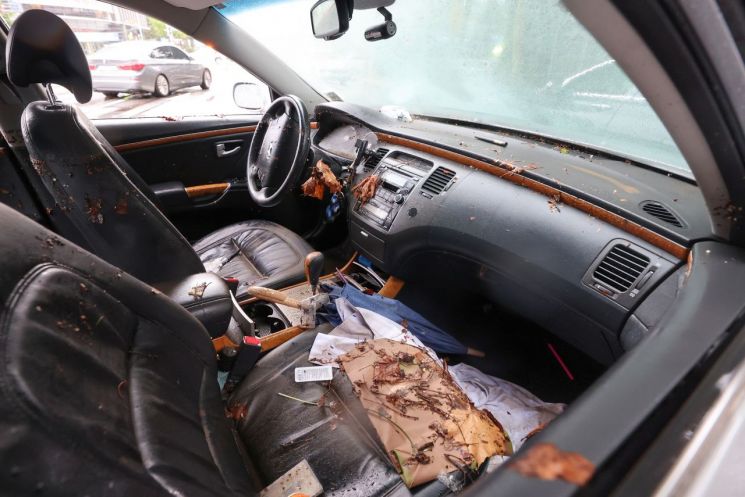 There are fallen leaves and trash inside a vehicle parked on the road near Daechi Station in Gangnam-gu, Seoul. [Image source=Yonhap News]
You can also check through the seat belts. Pull the seat belt all the way out to look for traces of mud or dirt. It is especially recommended to check the rear seat belts, which are harder to replace than the front seat belts. However, if only the vehicle floor was flooded, water may be below the seat belts, so stains may not appear on the seat belts.
The fuse box should also be inspected. The fuse box, which allows checking the wiring condition of the car, is rarely replaced and is structured to prevent external foreign substances from entering. If there is mud or water marks, the vehicle can be suspected as flooded.
In addition, weatherstrips installed on the vehicle doors and electrical devices should be examined.
Meanwhile, the Ministry of the Interior and Safety raised the Central Disaster and Safety Countermeasures Headquarters from level 2 to level 3 at 1 a.m. on the 9th. The wind and flood disaster crisis alert was upgraded from 'caution' to 'serious.'
© The Asia Business Daily(www.asiae.co.kr). All rights reserved.
![Clutching a Stolen Dior Bag, Saying "I Hate Being Poor but Real"... The Grotesque Con of a "Human Knockoff" [Slate]](https://cwcontent.asiae.co.kr/asiaresize/183/2026021902243444107_1771435474.jpg)


















