Amendment to 'University Establishment and Operation Regulations' on the 2nd... Relaxed Criteria for Increasing Semiconductor Master's and Doctoral Quotas
Increase in 'Full-time' Programs Requiring Daily Attendance for Research and Thesis Activities
Still Insufficient Semiconductor 'Small and Medium Enterprise Contract Departments' for Work-Study Balance
Only One Semiconductor Master's and Doctoral Quota Nationwide (Myongji University, 20 Seats)
"To Resolve the Materials, Parts, and Equipment Workforce Shortage, Increase Related Budgets and Enhance Industry-Academia Cooperation Quality"
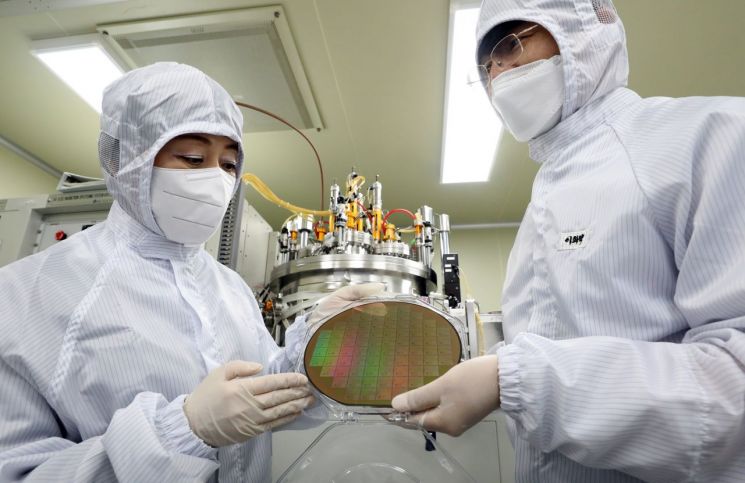 Deputy Prime Minister and Minister of Education Park Soon-ae visited the Semiconductor Laboratory at Chungnam National University in Gung-dong, Yuseong-gu, Daejeon on the morning of the 25th to observe the research site for semiconductor talent development.
 [Image source=Yonhap News]
[Asia Economy Reporter Kwak Min-jae] #A company, listed on KOSDAQ and producing semiconductor piping components, is suffering from chronic labor shortages. The company is willing to spare no financial support, such as assisting employees to enter graduate school to cultivate advanced talent in the semiconductor field, but there is no suitable school to send them to. A company official lamented, "Last year, we created an unprecedented in-house program that supports tuition fees and allows external activities during classes for employees who have worked for more than two years and wish to enter graduate school. However, there is a lack of semiconductor master's and doctoral programs for current employees, so no one has been able to use this program so far."
On the 2nd, the government deliberated and approved an amendment to the 'Regulations on University Establishment and Operation' at the Cabinet meeting, which increases the quota for master's and doctoral students in advanced fields such as semiconductors, provided that universities achieve a 100% faculty recruitment rate. This is a follow-up measure to the 'Semiconductor Talent Development Plan' aiming to nurture 150,000 semiconductor talents over ten years. However, small and medium-sized enterprises (SMEs) and mid-sized companies in the related fields responded that it is merely a "bureaucratic measure full of loopholes." They say the policy is ineffective because it does not properly understand the reality.
The increased master's and doctoral personnel under the amendment are full-time researchers who must attend university labs daily to focus on research and thesis activities. However, SMEs and mid-sized companies, which urgently need personnel, cannot afford to send people. SMEs cannot afford to keep factories and research centers idle while key personnel complete their degrees. The reality for companies is that they cannot nurture talent by allowing employees to take leave for studies.
SMEs, which are absolutely short of personnel, need institutional support that allows employees to study while working to build expertise. The Ministry of SMEs and Startups has been operating the 'SME Contract Department' for degree programs for employees since 2010, considering the characteristics of SMEs. Through collaboration with universities, this program establishes degree courses for employees needed by companies, cultivates excellent SME talents, and aims to encourage long-term employment.
The problem is that the quota for 'SME Contract Departments in the semiconductor field' is woefully insufficient. According to the Ministry of SMEs and Startups' 'SME Contract Department,' there is only one place nationwide (Myongji University Department of Semiconductor Equipment Engineering) with a master's and doctoral recruitment quota for employees of SMEs and mid-sized companies, limited to just 20 people. Moreover, the quota for mid-sized companies, which have relatively high demand for semiconductor master's and doctoral personnel, is restricted to within 30% (6 people) of the total 20 recruits, making the quota extremely insufficient. Professor Hong Sang-jin of Myongji University's Department of Electronic Engineering said, "The need for this program is greater for semiconductor mid-sized companies with high R&D demand, but since the quota is only six, many companies cannot apply due to lack of slots."
Currently, Kongju University has a 'SME Contract Department' in Semiconductor Mechanical Engineering (quota of 20), but this program targets bachelor's degree students (transfer students entering the third year), not master's or doctoral students, and is criticized as insufficient for cultivating 'advanced talent' in semiconductors. According to the Korea Semiconductor Industry Association's forecast, the average annual growth rate of required personnel by education level until 2031 is higher for advanced personnel classified as doctoral (6.8%) and master's (5.7%) than for bachelor's (5.3%).
Semiconductor materials, parts, and equipment (SoBuJang) companies cannot rely solely on this system, making the problem more serious. Large companies, which have relatively higher application rates, are more likely to hire new master's and doctoral personnel. In contrast, semiconductor SoBuJang companies consider it best to educate existing employees to enhance R&D capabilities rather than hiring new high-quality advanced personnel. The CEO of semiconductor fabless company B in Bundang, Seongnam City, Gyeonggi Province, said, "For SMEs like us, we gave up a long time ago on hiring high-quality master's and doctoral advanced personnel. Since fabless companies specialize in design, securing excellent talent is crucial, but we are worried because we cannot hire or nurture talent."
Regarding this, a Ministry of SMEs and Startups official replied, "We plan to increase the number of contract departments in the semiconductor field by about two next year." However, experts point out that increasing the number by only a few dozen per year is insufficient to resolve the manpower shortage in SoBuJang. Compared to the government's plan to nurture 150,000 people over ten years, the personnel in the 'SME Contract Department' are woefully insufficient. Researcher Noh Min-seon of the Korea Institute for Startup & Entrepreneurship Development advised, "The current support budget is very insufficient to systematically expand re-education programs for employees based on the demand in SME workplaces. It is necessary to significantly increase related budgets and expand industry field experts as faculty to improve the quality of industry-academia cooperation."
© The Asia Business Daily(www.asiae.co.kr). All rights reserved.
![Clutching a Stolen Dior Bag, Saying "I Hate Being Poor but Real"... The Grotesque Con of a "Human Knockoff" [Slate]](https://cwcontent.asiae.co.kr/asiaresize/183/2026021902243444107_1771435474.jpg)
















