If No Alternative to Chinese Raw Materials Found, Tax Benefits in US May Be Lost
Dependence on Chinese Imports at 92.3%...Concerns Over Rising China Tensions
[Asia Economy Reporters Oh Hyung-gil and Jung Dong-hoon] Another opportunity has arisen for the domestic secondary battery industry through the U.S. Inflation Reduction Act. As production facilities are being expanded through entry into the North American market, it is expected that government funding support from the U.S. will also be available. If partnership requests for the three Korean battery companies continue locally, the scale of investment in North America is expected to increase further.
However, the industry faces the major challenge of achieving 'supply chain independence' from China. Given the absolute dependence on Chinese raw materials, sourcing raw materials directly from third countries inevitably increases costs. In particular, China controls more than 70% of key raw materials such as lithium and nickel. There are concerns that this could adversely affect the ongoing collaborative relationship with China.
◆‘Increasing U.S. production while reducing Chinese raw materials’... Battery Dilemma= The Inflation Reduction Act, which passed the U.S. Senate on the 7th (local time), is superficially good news for the domestic battery industry. The bill includes tax credits of $7,500 for new electric vehicle buyers and $4,000 for used electric vehicle buyers. However, vehicles released or registered after December 31, 2024, will be excluded from benefits if certain minerals in their batteries are extracted, manufactured, or recycled in foreign countries of concern. As a result, demand for Korean batteries in the U.S. is increasing, and the scope of tax benefits is expanding, which is expected to benefit domestic battery companies. However, the reality is that they cannot simply rejoice. If alternatives to Chinese raw materials are not secured by 2024, it will be difficult to expect an increase in electric vehicle demand due to tax benefits.
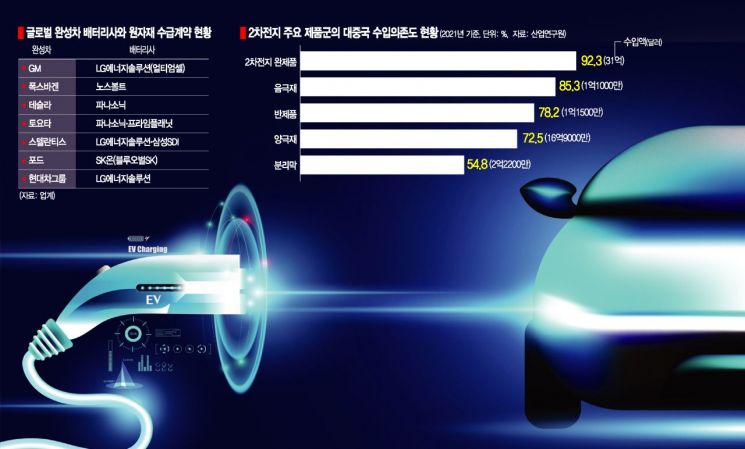
Domestic battery companies face a dilemma of needing to increase local production due to the U.S.-led global supply chain restructuring and the explosive growth of the North American electric vehicle market, while also needing to reduce raw material supply from China. Currently, dependence on Chinese raw materials and intermediate goods is overwhelming. According to the Korea Institute for Industrial Economics and Trade, last year, the import dependence on China for finished secondary battery products reached 92.3%. This includes anode materials (85.3%), semi-finished products (78.2%), cathode materials (72.5%), and separators (54.8%), all exceeding 50%.
The problem is that as battery companies accelerate their entry into North America, urgent measures are needed to reduce dependence on Chinese raw material imports. In fact, LG Energy Solution is expected to secure an annual production capacity of 150 GWh in North America alone by 2025. SK On is continuing investments in the North American market, securing two factories in Georgia, U.S., with a total investment of 3 trillion won. It launched BlueOvalSK, a joint venture with Ford, and plans to operate joint production plants with a total capacity of 129 GWh in Tennessee and Kentucky sequentially from 2025 to 2026. Samsung SDI is investing $3.1 billion (4.05 trillion won) through a joint venture with Stellantis to build a battery plant with an annual capacity of 23 GWh by 2025, with plans to expand to 33 GWh in the future.
Kim Ba-woo, a former senior researcher at the Korea Institute for Industrial Economics and Trade, advised, "It is necessary to induce diversification of procurement sources by item or establish cooperation models with New Southern countries that handle raw material mining, processing, and component manufacturing locally."
◆"China will shake the battery supply chain until 2030"= China plays a key role in the battery supply chain. According to the International Energy Agency (IEA)'s report on the global supply chain of electric vehicle batteries released last month, China produces three-quarters of all lithium-ion batteries. It also holds 70% and 85% of the production capacity for cathode and anode materials, respectively. For key raw materials such as lithium, cobalt, and graphite, China controls more than 50% of processing and refining capabilities.
In contrast, Europe accounts for more than 25% of global electric vehicle assembly but has a weak supply chain except for cobalt processing (20% share). The U.S. accounts for only 10% of electric vehicle production and 7% of battery production capacity.
Global electric vehicle manufacturers are also not free from dependence on the Chinese supply chain. Tesla's impact report from last year shows that it has raw material purchase contracts with Chinese companies such as Huayou Cobalt, CNGR Advanced Materials, and Gangfeng Lithium, receiving supplies of lithium, cobalt, and nickel.
In particular, the IEA pointed out, "Although the U.S. and Europe are promoting the development of domestic battery supply chains, there is a significant possibility that most supply chains will remain in China until 2030," and emphasized, "Cooperation between producing and consuming countries should be strengthened to promote sustainable investment and knowledge sharing."
It is not easy for the three Korean battery companies to give up cooperation with China. Their competitiveness in materials and raw materials is still weak. A representative example is that more than 90% of battery precursors are imported from China.
If Chinese raw materials are no longer used in the future, conflicts between companies from both countries may also arise. Currently, LG Energy Solution has secured a production plant in Nanjing, Jiangsu Province, China, and is promoting the establishment of a battery recycling joint venture with Huayou Cobalt. Cooperation with China is increasing not only in raw materials but also in battery recycling. SK On has secured four battery production bases in Changzhou, Huizhou, and Yancheng, with production capacity expected to reach 77 GWh.
© The Asia Business Daily(www.asiae.co.kr). All rights reserved.
![Clutching a Stolen Dior Bag, Saying "I Hate Being Poor but Real"... The Grotesque Con of a "Human Knockoff" [Slate]](https://cwcontent.asiae.co.kr/asiaresize/183/2026021902243444107_1771435474.jpg)















