Government Holds Emergency Economic Ministers' Meeting
Foreign Workforce Quota Increased by Over 15,600
Foreign Entry Procedures Shortened to 39 Days
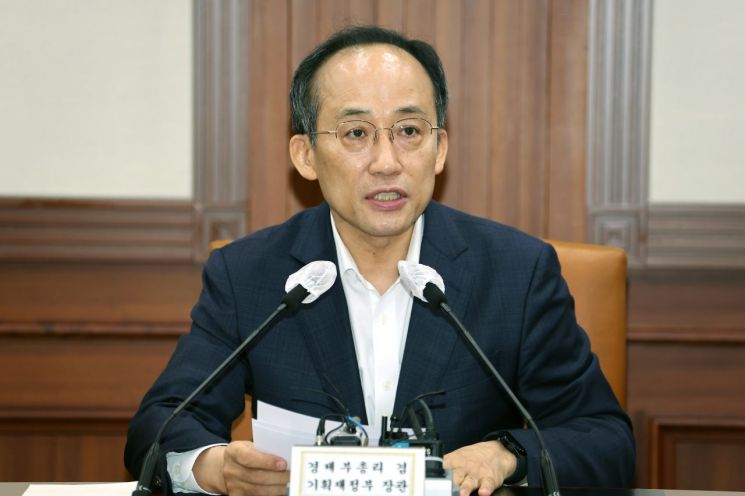 Deputy Prime Minister and Minister of Economy and Finance Choo Kyung-ho is presiding over the Emergency Economic Ministers' Meeting held at the Government Seoul Office Building on the 8th. [Image source=Yonhap News]
The government has decided to accept more foreign workers to resolve the labor shortages occurring in key industries. The foreign workforce quotas for the root industry, shipbuilding, and agriculture and livestock sectors will be expanded by about 15,600, and the current entry procedures, which take nearly three months, will be simplified to less than 40 days.
On the 8th, the government held an emergency economic ministers' meeting chaired by Deputy Prime Minister and Minister of Economy and Finance Choo Kyung-ho, where they finalized the "Labor Shortage Resolution Support Plan" containing these measures. This response was prepared as labor shortages intensified recently due to the lifting of social distancing and increased private consumption, following the blockade of foreign workforce entry caused by COVID-19.
First, the government will expand the foreign visa quotas to secure about 15,600 more workers. The quota for manufacturing industries such as the root industry will increase from the existing 10,480 to an additional 6,000. In shipbuilding, the welding and painting worker quotas will be abolished, and up to 9,000 more workers will be brought in by improving the Specific Activities (E-7) visa. In agriculture and livestock, the quota will increase from 1,624 by an additional 600.
Additionally, the government plans to admit 50,000 more foreign workers this year, averaging about 10,000 per month. This will bring the total number of foreign workers residing domestically to approximately 264,000, approaching the pre-COVID-19 level of about 277,000. To achieve this, the government will expedite the entry of those who were issued visas between 2020 and 2022 but could not enter, as well as those scheduled to be issued visas in the second half of this year.
The current foreign workforce entry procedure, which takes about 84 days, will be drastically reduced to 39 days. A new quota without industry classification will be allocated to allow flexible responses to demand fluctuations. The "flexible allocation quota" will increase more than threefold from about 3,000 last year to 10,000+α next year.
Deputy Prime Minister Choo emphasized, "The government will actively support so that labor shortages in industrial sites do not become an obstacle to economic recovery," adding, "We will also pursue mid- to long-term improvement efforts to fundamentally enhance competitiveness, such as high value-added industrialization."
© The Asia Business Daily(www.asiae.co.kr). All rights reserved.
![Clutching a Stolen Dior Bag, Saying "I Hate Being Poor but Real"... The Grotesque Con of a "Human Knockoff" [Slate]](https://cwcontent.asiae.co.kr/asiaresize/183/2026021902243444107_1771435474.jpg)
















