[Asia Economy Reporter Lee Seon-ae] The Korean stock market is thoroughly isolated as an outcast among global stock markets. The decoupling phenomenon, where it fails to follow the ups and downs of other countries' stock markets, has become particularly pronounced in recent months. When global markets falter, the Korean market shakes even more and boasts one of the highest rates of decline. When it recovers, it only rises slightly, showing notably weak resilience that exhausts investors. This is why individual investors started betting on a decline in August.
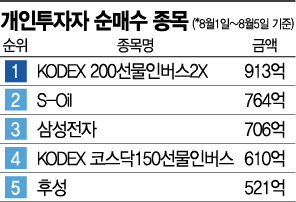
According to the Korea Exchange on the 8th, from the 1st to the 5th, individual investors purchased about 91.3 billion KRW worth of 'KODEX 200 Futures Inverse 2X.' It was the top net purchase item among individuals. This product inversely tracks the daily fluctuation rate of the KOSPI 200 index by two times, meaning the more the index falls, the more investors can earn up to twice the investment profit. Because it tracks double, it is called 'Gopbus' (double inverse). Additionally, individual investors bought 61 billion KRW worth of 'KODEX KOSDAQ 150 Futures Inverse.' This product also inversely tracks the daily fluctuation rate of the KOSDAQ 150 index, profiting when the index declines. It ranked fourth in net purchases by individuals.
Why are individual investors betting on a decline? Experts say it is due to the particularly weak resilience of the KOSPI and the anticipation of further declines. Especially, the downward revision of corporate operating profit forecasts is cited as a factor unsettling the stock market.
Lee Jin-woo, a researcher at Meritz Securities, explained, "The recent difference in stock price resilience between Korea and the U.S. can be explained by differences in economic and corporate earnings uncertainties." He added, "Currently, the U.S. has recovered about 38% of its decline, but Korea has only recovered about half of that, which is due to Korea's greater exposure to the global economy compared to the U.S."
Lee Jong-bin, another researcher at Meritz Securities, said, "The KOSPI has approached its average level since 2010, and concerns about whether the rebound will continue and which leading sectors will emerge have begun." He recommended establishing selective strategies accordingly.
The downward revision of operating profit forecasts for the second half of this year and next year around the Q2 earnings season is considered a risk factor for further KOSPI declines. Kang Min-seok, a researcher at Kyobo Securities, stated, "So far, Q2 earnings have exceeded expectations, and the Q2 earnings consensus has been slightly revised upward since the end of July. However, due to concerns about economic slowdown in the second half, the Q3 and Q4 earnings consensus is being revised downward."
Lee Jung-yeon, a researcher at Meritz Securities, also noted, "In the past two months, the KOSPI operating profit forecasts for this year and next year have been revised downward by 3.2% and 7.1%, respectively," adding, "There has been a strong downward revision of earnings forecasts around the earnings announcement period."
The decoupling phenomenon of the KOSPI observed in June and July is also a reason why individual investors have turned away. In June, among 40 major global stock indices, the KOSDAQ and KOSPI recorded the highest and second-highest declines at 16.01% and 11.89%, respectively. They ranked below Sweden's OMX Stockholm 30 (-11.73%), Brazil's Bovespa (-11.39%), Austria's ATX (-10.78%), and Argentina's Merval (-10.49%), placing them among the lowest worldwide. Export slowdown, won depreciation, foreign selling due to concerns over the interest rate inversion between Korea and the U.S., and forced selling were cited as reasons for the Korean stock market's poor performance.
In July, major global stock markets showed movements to recover the losses from June. Among 20 countries, only China (-7.02%) and Russia (-0.41%) saw stock price declines. Russia was affected by the war, and China by COVID-19 lockdown measures. The KOSPI rose 5.10% in July, but its rise ranked 12th out of 20 countries, remaining near the bottom.
© The Asia Business Daily(www.asiae.co.kr). All rights reserved.
![Clutching a Stolen Dior Bag, Saying "I Hate Being Poor but Real"... The Grotesque Con of a "Human Knockoff" [Slate]](https://cwcontent.asiae.co.kr/asiaresize/183/2026021902243444107_1771435474.jpg)














