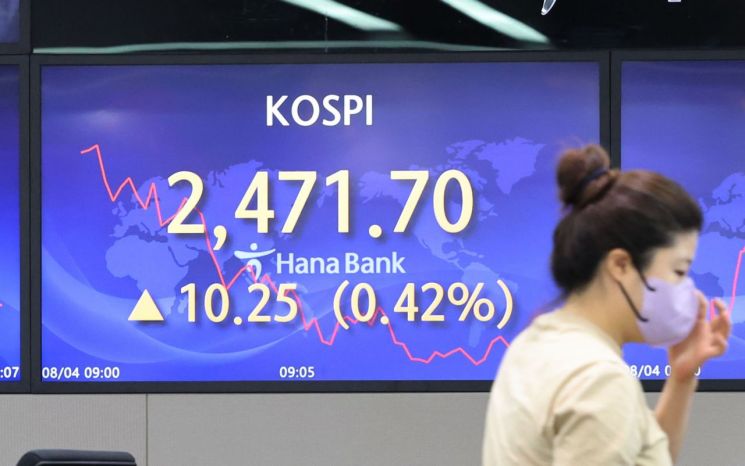
[Asia Economy Reporter Ji Yeon-jin] Foreign investors have net purchased more than 1.7 trillion won worth of domestic stocks since the beginning of this month. Following the first net buying in the domestic stock market this year last month, they continued their 'Buy Korea' trend.
According to the Korea Exchange on the 7th, foreign investors net purchased 1.5643 trillion won in the KOSPI market and 196.2 billion won in the KOSDAQ market from the 1st to the 5th of this month, totaling 1.6756 trillion won. This marks seven consecutive trading days of net buying. During the same period, institutions net sold over 1 trillion won worth of domestic stocks, and individuals also net sold about 559.1 billion won.
The stock most purchased by foreigners this month was Samsung Electronics, with net buying of approximately 259.5 billion won. This was followed by Samsung SDI (224.6 billion won), LG Energy Solution (224.6 billion won), Hyundai Motor (129.9 billion won), and Hyundai Mipo Dockyard (129.9 billion won).
On the other hand, S-Oil was the most sold stock by foreigners, with net selling of about 51.6 billion won, followed by NAVER (-29.8 billion won), Samsung Electronics Preferred (-29.6 billion won), OCI (-26.8 billion won), and Jusung Engineering (-25.8 billion won).
The buying trend by foreigners is analyzed as a preference for risk assets due to the easing of the strong dollar trend. The decline in international oil prices has increased the possibility of easing inflation, reflecting market expectations that the U.S. Federal Reserve's tightening stance will soften. On the 5th, the won-dollar exchange rate in the Seoul foreign exchange market closed at 1,298.3 won per dollar, down 11.8 won from the previous day's closing price.
Park So-yeon, a researcher at Shin Young Securities, said, "Considering that the pain in the asset market in the first half of this year started from inflation and tightening, the butterfly effect of the oil price decline cannot be ignored. Although concerns about a bear market rally remain, avoiding recession is much more important than controlling inflation at this point. With the Chinese Party Congress in October and the U.S. midterm elections in November, monetary tightening pressure is expected to weaken, economic stimulus momentum will increase, and autonomous rebounds are likely to continue."
There is also speculation that foreigners may have engaged in short covering due to the government's strengthened short-selling regulations. The Financial Services Commission announced a comprehensive government joint plan on short selling last month, stating that if the short selling ratio exceeds 30%, short selling will be banned for a day if the stock price falls more than 3%. Furthermore, if the stock price falls more than 5% during the short selling ban, the ban period will be automatically extended to the next day. Park Seung-young, a researcher at Hanwha Securities, said, "We judge that foreign investors' purchases have a strong short-covering nature. Stocks that had high net foreign selling this year also saw high net foreign buying in July."
© The Asia Business Daily(www.asiae.co.kr). All rights reserved.
![Clutching a Stolen Dior Bag, Saying "I Hate Being Poor but Real"... The Grotesque Con of a "Human Knockoff" [Slate]](https://cwcontent.asiae.co.kr/asiaresize/183/2026021902243444107_1771435474.jpg)















