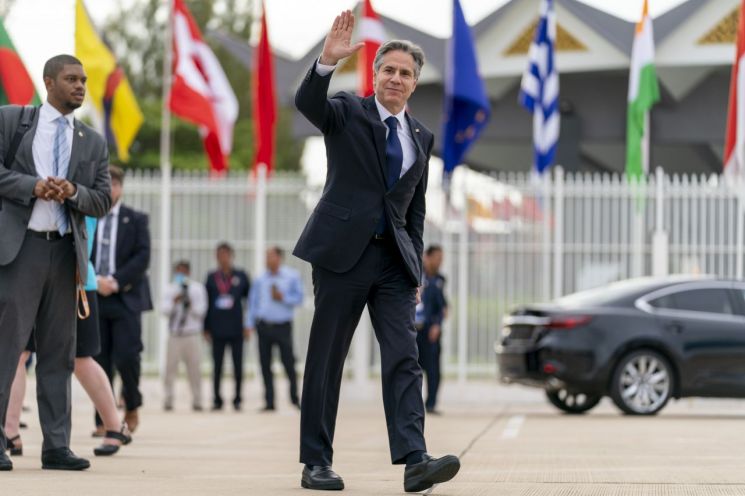
[Asia Economy Reporter Seongpil Cho] U.S. Secretary of State Tony Blinken visited the allied Philippines to counter China, which is expanding its influence in the Southeast Asian region.
According to multiple foreign media reports on the 6th, Blinken arrived at Manila Airport the previous night and visited President Ferdinand Marcos on the same day. At the meeting, Blinken said, "The alliance between our two countries is strong and will become stronger," adding, "The United States will faithfully uphold the mutual defense treaty that has lasted for decades." In response, Marcos expressed concern over the escalating tensions between the U.S. and China following House Speaker Nancy Pelosi's recent visit to Taiwan and emphasized the importance of the military alliance. He said, "The current situation in Taiwan has once again made us realize the importance of our bilateral relationship," and added, "This incident has once again shown the intensity of conflicts in the region."
Additionally, Blinken held a video conference with Philippine Foreign Minister Enrique Manalo, who is currently in isolation after being infected with COVID-19. Minister Manalo emphasized the importance of the bilateral alliance and requested that the U.S. work to ease tensions in the Taiwan Strait. In response, Secretary Blinken said, "The United States will act responsibly to avoid crises and conflicts."
Blinken headed to the Philippines after attending the East Asia Summit (EAS) and ASEAN Regional Forum (ARF) foreign ministers' meetings held in Phnom Penh, the capital of Cambodia, the previous day. The Philippines, located about 260 km from Taiwan, is a strategic military and economic hub in Southeast Asia where the U.S. and China are fiercely competing to expand their influence. Although the Philippines and the U.S. have a traditional alliance, the relationship has been strained under former President Rodrigo Duterte, who consistently criticized U.S. foreign policy while showing a friendly attitude toward China.
Earlier, Chinese Foreign Minister Wang Yi visited President Marcos on the 6th of last month to discuss cooperation between the two countries. When Wang proposed seeking solutions through dialogue and communication regarding the South China Sea territorial disputes, Marcos responded that he also wished to find amicable solutions.
Meanwhile, after U.S. House Speaker Nancy Pelosi made a sudden visit to Taiwan on the night of the 2nd, China strongly opposed the visit by conducting military demonstrations such as missile launches in the Taiwan Strait, escalating sharp tensions between the two countries. Subsequently, China partially cut off military communication channels with the U.S., announced the suspension of climate change cooperation, and began imposing sanctions on Speaker Pelosi, raising the level of its response.
© The Asia Business Daily(www.asiae.co.kr). All rights reserved.
![Clutching a Stolen Dior Bag, Saying "I Hate Being Poor but Real"... The Grotesque Con of a "Human Knockoff" [Slate]](https://cwcontent.asiae.co.kr/asiaresize/183/2026021902243444107_1771435474.jpg)















