'Interest Rate Hike and Household Debt Trends' Report
Top 5 Banks' Credit Loan Rates 3.2%→5.1%
One-Third Impact from Increased Spread Rates
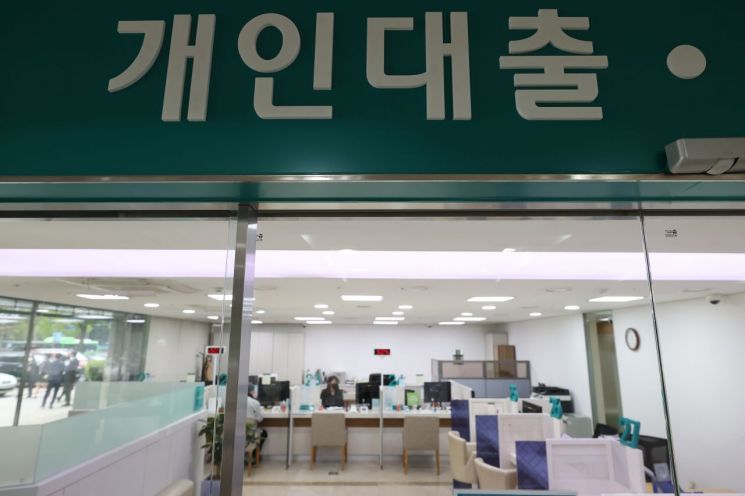
[Asia Economy Reporter Sim Nayoung] According to an analysis of bank credit loan interest rates by the National Assembly Budget Office, over the past year, not only has the 'benchmark interest rate' used to calculate credit loan rates increased, but the 'spread' has also risen significantly, resulting in a greater interest burden on the public.
According to the report "Trends in Interest Rate Increases and Household Debt" released by the National Assembly Budget Office on the 8th, the average interest rate on general credit loans from the five major banks (KB Kookmin, Shinhan, Hana, Woori, NH Nonghyup) was 3.2% as of June last year, but rose sharply by 2 percentage points (p) to 5.1% in May this year. The report analyzed, "Since last year, the COFIX (Cost of Funds Index) and financial bond interest rates, which serve as the basis for household loan interest rate calculations, have risen, and the spread, which is the source of bank margins, has also increased, leading to a higher interest repayment burden."
Breaking down the 2%p increase in interest rates, the benchmark rate rose by 1.26%p, and the spread increased by 0.64%p. One-third of the interest rate hike was used by banks to fatten their own profits. This explains why the five major financial holding companies recorded a record high interest income of 23 trillion won in the first half of this year alone. The net interest income and growth rates (compared to the same period last year) of the five major financial holding companies in the first half were ▲ KB 5.4418 trillion won (18.7%) ▲ Shinhan 5.1317 trillion won (17.3%) ▲ Hana 4.1906 trillion won (18.0%) ▲ Woori 4.1033 trillion won (23.5%) ▲ Nonghyup 4.5669 trillion won (9.6%).

The reason why financial holding companies' "interest business" has been more prosperous than ever is due to rising interest rates and a surge in loans. Over the past two years, during the COVID-19 pandemic, household and corporate loans increased to record levels. Although household loans have decreased this year, corporate loans, which commercial banks are focusing on, have increased by about 5%.
Loans have increased significantly, but since the Bank of Korea raised the base interest rate after August last year, market interest rates rose, causing loan interest rates to jump and interest income to increase. During periods of rising interest rates, the speed of deposit rate increases is slower than that of loan rates, so the net interest margin?the difference between deposit and loan rates?inevitably widens.
The somewhat fortunate point is that household debt is decreasing. Since the second half of last year, as the rate of increase in housing prices has slowed, household loans from the five major banks have been declining for seven consecutive months. Last month, the total household loan balance of the five major banks was 697.4366518 trillion won, down about 2.2155 trillion won from the end of the previous month (699.6521131 trillion won), and down 11.6163 trillion won compared to the end of last year.
The report stated, "The trend of rising interest rates and a weak asset market can have a positive impact on stabilizing household debt." Although household debt decreased in the first quarter of this year for the first time in nine years, the household debt-to-GDP ratio remains high at 89.9%, so the government needs to continue efforts to reduce the risk of defaults among vulnerable groups."
© The Asia Business Daily(www.asiae.co.kr). All rights reserved.
![Clutching a Stolen Dior Bag, Saying "I Hate Being Poor but Real"... The Grotesque Con of a "Human Knockoff" [Slate]](https://cwcontent.asiae.co.kr/asiaresize/183/2026021902243444107_1771435474.jpg)
















