Industry Market Preemption Battle
Market Size of 600 Trillion by 2050
Annual Growth Expected up to 45%
[Asia Economy Reporter Jeong Dong-hoon] As the use of electric vehicle batteries increases, companies are fiercely competing to dominate the recycled battery market. Not only are raw material prices soaring and supply difficulties intensifying, but the demand for eco-friendly manufacturing processes is also growing, leading to increased investment in reusing spent batteries.
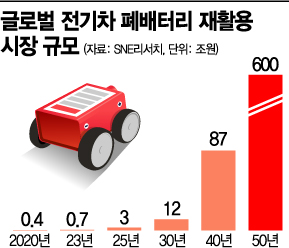
◆ Explosive Growth in the Spent Battery Industry, a 600 Trillion Won Market in 28 Years= Economies of scale have yet to appear in the spent battery recycling industry.
According to energy market research firm SNE Research on the 5th, as the lifespan of electric vehicle batteries that began in 2020 approaches, it is expected that more than 100,000 batteries will be discarded annually starting from 2030. The spent battery market is estimated to expand to ▲3 trillion won in 2025 ▲21 trillion won in 2030 ▲87 trillion won in 2040 ▲600 trillion won in 2050. Explosive growth of 25-45% annually is anticipated.
In particular, the spent battery recycling business is directly linked to reducing battery and electric vehicle prices. Battery costs account for 30-40% of an electric vehicle’s price, with more than half of that being raw material costs. As electric vehicle demand increases, recycling raw materials from the flood of spent batteries is expected to significantly lower prices. Additionally, the recent trend of countries weaponizing resources and the resulting global supply chain crisis further increase the value of the spent battery market. As of 2020, China’s market share of the four major battery materials (cathode, anode, separator, electrolyte) ranged from 54% to 71%. The era has arrived where heavy dependence on resources from specific countries becomes a risk.
The European Union’s (EU) introduction of the ‘carbon footprint’ system is also accelerating battery recycling. The carbon footprint refers to the total amount of carbon dioxide emissions generated throughout the entire process of activities or production and consumption of goods by individuals, companies, or countries. From July 2024, the EU will mandate disclosure of the carbon footprint for electric vehicle and rechargeable industrial batteries, and from July 2027, it plans to set upper limits on battery carbon footprints. Starting in 2030, mandatory recycled material usage rates will be applied, requiring that new batteries use at least 12% recycled cobalt, 4% recycled nickel, and 4% recycled lithium. This reflects a continuing trend demanding eco-friendly manufacturing processes.
◆ Battery and Automaker Companies Enter the Market with Equity Investments and Recycling Technology Development= LG Energy Solution announced on the 26th of last month that it will establish a joint venture with China’s top cobalt refining company, Huayou Cobalt, for battery recycling. Additionally, together with LG Chem, it participated in a paid-in capital increase of the North American number one battery recycling company, Li-Cycle, and will supply 20,000 tons of nickel extracted from spent batteries starting next year.
SK Innovation, which has the battery subsidiary SK On, has identified battery recycling as a new growth engine. The company is advancing a business to extract high-purity minerals from spent batteries using its newly developed lithium hydroxide extraction technology. Furthermore, SK On, SK Ecoplant, SK Rent-a-Car, and others plan to collaborate to establish a circular economy for spent batteries throughout their lifecycle.
Samsung SDI also established a ‘Recycle Research Lab’ within its research center dedicated to spent battery recycling research. This organization aims to develop technologies that increase battery material recovery rates by researching low-cost, eco-friendly methods to recover materials. Samsung SDI has also built a recycling system for scrap generated at its Cheonan and Ulsan plants since 2020 to promote spent battery recycling. Scrap (metal fragments or waste from products) generated at the plants is collected by specialized recycling companies, processed to extract mineral raw materials such as nickel sulfate and cobalt sulfate, which are then reintroduced into the manufacturing process. Tesla and Chinese battery maker CATL are also internalizing spent battery businesses or making aggressive investments, intensifying competition in the spent battery market.
© The Asia Business Daily(www.asiae.co.kr). All rights reserved.
![Clutching a Stolen Dior Bag, Saying "I Hate Being Poor but Real"... The Grotesque Con of a "Human Knockoff" [Slate]](https://cwcontent.asiae.co.kr/asiaresize/183/2026021902243444107_1771435474.jpg)














