First Day Debate on Pros and Cons Tight at First Meeting on the 4th
Government: "Will Listen Fully to Ensure a Win-Win Game"
"10 Years After Mandatory Closure, the System's Purpose Undermined by Online Competition"
"Protecting Local Businesses Still Meaningful... Ready to Face Collective Opposition"
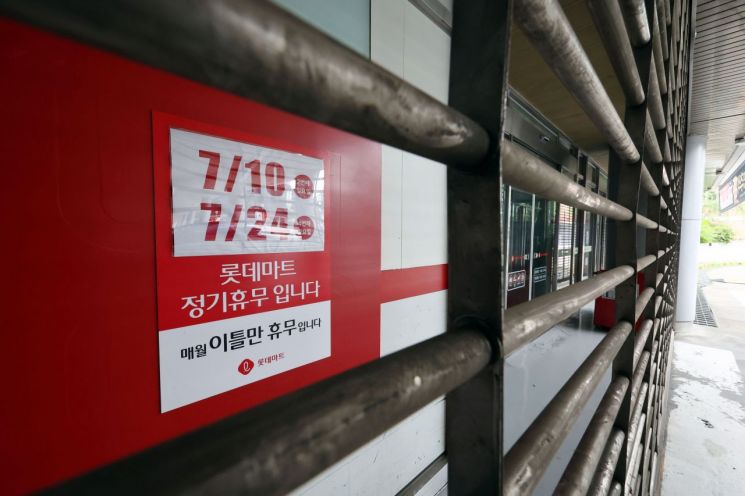
[Asia Economy Reporter Kim Yuri] As the restriction on large mart operations became the first topic of discussion at the Regulatory Judgment Meeting, heated debates are also taking place outside the official venue. Large marts have raised their voices, saying that the retail environment has drastically changed over the 10 years since the mandatory closure was implemented, rendering the original purpose of protecting traditional markets and small business owners meaningless. Meanwhile, merchant associations have expressed their willingness to take collective action if the regulation is abolished.
On the afternoon of the 4th, the Office for Government Policy Coordination held the first Regulatory Judgment Meeting at the Government Complex Sejong to discuss the regulation on large mart operating restrictions. The Regulatory Judgment Meeting, newly established under the Yoon Seok-yeol administration, is a forum mainly composed of about 100 regulatory judges, including private experts and field activists, to gather opinions related to regulations.
According to the Distribution Industry Development Act introduced in 2012, large marts are currently required to close twice a month and cannot operate from midnight to 10 a.m. On this day, the Federation of Korean Industries and the Korea Chain Store Association attended the meeting to argue for regulatory improvements. The Small Business Federation, the National Merchant Federation, and the Korea Supermarket Cooperative Federation emphasized the necessity of regulations on large marts to protect small business owners. The relevant ministries, including the Ministry of Trade, Industry and Energy, the Ministry of SMEs and Startups, and the Fair Trade Commission, also attended to listen to both pros and cons.
The Office for Government Policy Coordination stated that the meeting discussed ▲ fostering protection for traditional markets and small business owners ▲ effectiveness of mandatory closure regulations ▲ necessity of allowing online delivery ▲ need for mandatory closure regulations considering regional characteristics, and that the judges and participants agreed to seek coexistence measures going forward. They added, "Considering the high public interest and complex stakeholders regarding large mart regulations, we plan to continue meetings until alternatives are agreed upon after sufficient opinion gathering from large marts and small business owners." An online discussion open to the general public will also be held on the Regulatory Information Portal for two weeks from the 5th to the 18th regarding large mart regulations.
Prime Minister Han Duck-soo emphasized on Facebook after the meeting, "This is not about deciding whether to improve the regulation immediately or tomorrow," adding, "The Regulatory Judgment Meeting is a forum for listening to and sharing opinions to find a compromise." He continued, "Regarding the improvement of large mart operating restrictions, we will listen thoroughly until solutions desired by both supporters and opponents are derived." Prime Minister Han stressed, "Regulatory innovation is not a 'zero-sum game' of taking and giving but a 'win-win game' where all stakeholders gather wisdom to create coexistence alternatives," and pledged to do his best to help the regulatory judgment system fulfill its role at the government level.
On the ground, large marts are calling for the abolition of the regulation due to its ineffectiveness, while merchants are concerned about a sharp decline in sales in local commercial districts. A large mart official said, "The mandatory closure of large marts, which started with the intention of revitalizing traditional markets, does not reflect the current era where competition between online and offline retail channels has changed the framework," adding, "Even though academic research later showed that the mandatory closure had a limited impact on increasing traditional market sales, it has continued for 10 years." There are voices that, contrary to the original intent, online channels and large food material marts have benefited from this.
On the other hand, the National Merchant Federation plans to decide whether to take action based on the results of the Regulatory Judgment Meeting. Previously, the federation announced that from the 8th to the 12th, they would hang banners opposing the abolition of mandatory closure of large marts at 1,947 traditional markets nationwide and start collective action. The National Merchant Federation and others are also voicing opposition to the abolition of mandatory closure. Some traditional markets have put up opposition banners and are engaging in joint responses.
Earlier, the Ministry of SMEs and Startups conducted a survey on traditional market merchants regarding the abolition of mandatory closure days for large marts. It was reported that most respondents opposed abolishing the mandatory closure days. The survey included five questions: ▲ support or opposition to abolishing mandatory closure days ▲ impact of mandatory closure days on traditional market sales ▲ opinions on changing mandatory closure days to weekdays ▲ suggestions related to mandatory closure days ▲ opinions on the regulation banning online delivery during large mart non-operating hours.
© The Asia Business Daily(www.asiae.co.kr). All rights reserved.
![Clutching a Stolen Dior Bag, Saying "I Hate Being Poor but Real"... The Grotesque Con of a "Human Knockoff" [Slate]](https://cwcontent.asiae.co.kr/asiaresize/183/2026021902243444107_1771435474.jpg)















