Display Association to Showcase 'Innovative Process Platform Project' Products at K-Display 2022 Exhibition, Dec 10-12
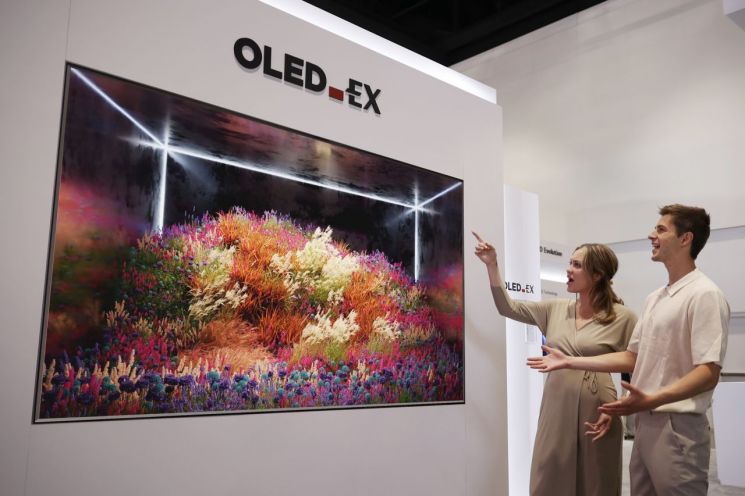 LG Display showcased the 97-inch OLED.EX at the Society for Information Display (SID) 2022 on May 10th (local time). Photo by LG Display
[Asia Economy Reporter Moon Chaeseok] The government is set to reveal for the first time the results of its innovation project, which has invested over 500 billion KRW to protect the OLED (organic light-emitting diode) technology and display market share of Korean display companies from China. This showcases some of the outcomes from a large-scale project involving 63 tasks carried out by 305 institutions over six and a half years, including a project aimed at reducing costs by 50%.
On the 4th, the Korea Display Industry Association announced that it will disclose the R&D achievements of the Ministry of Trade, Industry and Energy’s 'Display Innovation Process Platform Construction Project.' This will be presented at the 'Korea Display Industry Exhibition' held for three days from the 10th to the 12th at COEX in Samseong-dong, Gangnam-gu, Seoul.
At the exhibition, prototypes from 10 innovation process projects will be unveiled. The innovation process project, valued at 528.1 billion KRW, has been underway since July 2019 and will continue until December 2025, spanning six and a half years. The government initiated this project after China’s LCD (liquid crystal display) production capacity began to surpass Korea’s in 2017. The goal is to secure a production gap of five years and a technology gap of more than three years in OLED compared to competing countries by 2025.
During this exhibition, participating institutions will showcase core technologies aimed at achieving ultra-low costs. Samsung Display will reveal its QHD+ panel applying 'inkjet printing' technology to reduce production costs. Kyung Hee University will exhibit ultra-fluorescent materials and device technology known as 4th generation OLED, Narae Nanotech will present panel-integrated inkjet color filter process technology, and Asta will display the LDI-TOF mass spectrometry equipment that revolutionizes OLED surface analysis technology.
According to the association, the technologies to be unveiled are expected to significantly enhance product price competitiveness and performance. In particular, the mass spectrometry equipment developed by Asta, which applies mass spectrometry?commonly used in medical and chemical fields?to displays for the first time, allows OLED device lifespan impact evaluation through surface inspection alone, drawing considerable attention. It began supplying domestic panel companies in October last year, generating about 1 billion KRW in sales.
The innovation process center service, currently being established in Chungcheongnam-do, will also be introduced at the exhibition. The center, scheduled for completion next year, will serve as a testbed for verifying new OLED technologies. It will be equipped with advanced facilities comparable to R&D lines owned by panel companies to validate new technologies from material, component, and equipment companies. Detailed plans for key services such as equipment support, evaluation and certification for material, component, and equipment companies, as well as panel production and demonstration using integrated process lines, will be provided.
An association official stated, "Until the innovation process project concludes in 2025, we will continuously produce technological development outcomes necessary for Korean companies to maintain an overwhelming market share in the OLED market," adding, "We also plan to actively propose future-oriented R&D strategies such as inorganic light emission preliminary feasibility studies that go beyond OLED."
© The Asia Business Daily(www.asiae.co.kr). All rights reserved.
![Clutching a Stolen Dior Bag, Saying "I Hate Being Poor but Real"... The Grotesque Con of a "Human Knockoff" [Slate]](https://cwcontent.asiae.co.kr/asiaresize/183/2026021902243444107_1771435474.jpg)











