Ministry of Education Announces Academic Operation Plan for 2nd Semester
Symptomatic Individuals Only Tested Instead of Mandatory Preemptive Testing
Two Test Kits Provided to Students and Staff After School Starts
Confirmed Cases Quarantined for 7 Days, 10-Day Passive Monitoring for Household Contacts
Flexible Academic Operations Based on School-Specific Confirmed Cases and Attendance Suspension Rates
Universities to Prioritize In-Person Classes, Avoid Online Classes for Quarantine Purposes
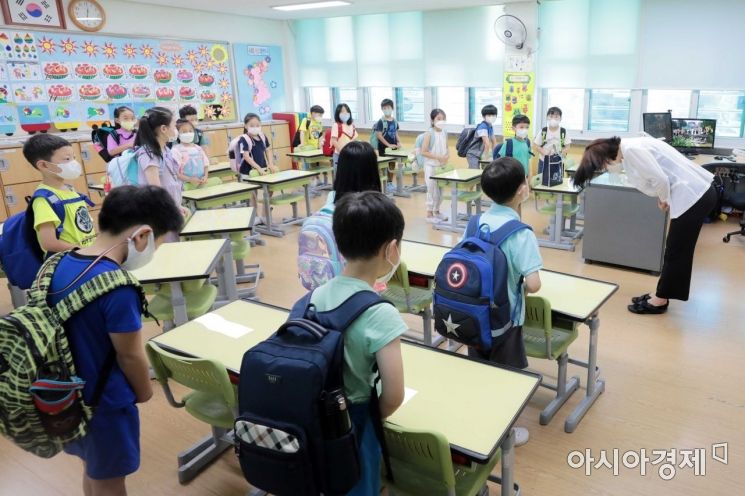 On the 15th, as summer vacation began at Cheonggu Elementary School in Jung-gu, Seoul, students who finished the vacation ceremony were greeting their teachers. Photo by Kang Jin-hyung aymsdream@
[Asia Economy Reporter Han Jinju] The Ministry of Education will implement normal in-person attendance as the principle after the start of the second semester. Instead of conducting preemptive testing, two test kits will be provided to allow testing if symptoms appear. Whether confirmed students can take midterm and final exams will be discussed and announced in September.
On the 4th, the Ministry of Education announced the quarantine and academic operation plan for kindergartens, elementary, middle, high, special schools, and universities for the second semester of the 2022 academic year. The core is to respond to the spread of COVID-19 by region and school based on normal educational activities such as attendance and face-to-face classes. This is because the resurgence of COVID-19 is expected to peak in mid to late August, the start of the semester, with confirmed cases reaching up to 250,000.
Principle of Normal Attendance, Flexible Academic Operation by School if Infection Situation Worsens
The principle of academic operation for the second semester is normal attendance. The Ministry of Education's policy is that switching to remote classes uniformly should be decided cautiously. Switching to remote classes by city/province or nationwide will be adjusted through prior consultation among the Ministry of Education, local education offices, and quarantine authorities based on nationwide infection and attendance situations and risk levels.
However, if the infection situation worsens, flexible academic operation will be allowed according to criteria set by the city/provincial education offices and schools. The criteria for switching to remote classes are the proportion of newly confirmed cases among enrolled students and the proportion of students suspended from attendance (confirmed or quarantined). In the first semester, the Ministry of Education required remote classes by class if the confirmed rate exceeded 3% or attendance suspension exceeded 15%, but from this semester, it will be based on school-specific criteria.
An official from the Ministry of Education said, "Even when there were more than 600,000 confirmed cases, 97% of schools conducted in-person classes. Whether to switch to remote classes can be decided according to the continuity plans prepared by each school."
Testing Only Symptomatic Individuals Instead of Preemptive Testing
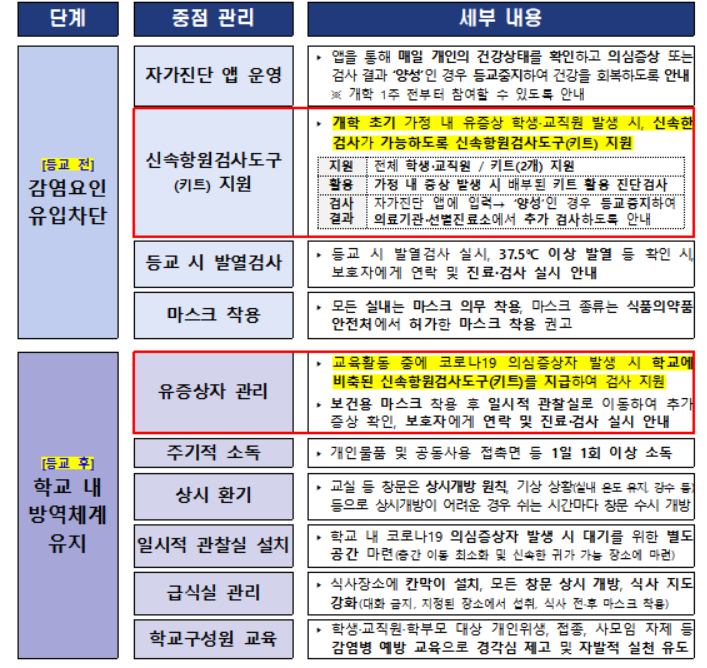
The Ministry of Education will operate a 'Focused Quarantine Inspection Period' for one week before and two weeks after the semester starts. To enable quick testing when symptoms appear, two rapid antigen test kits will be provided to students and staff after the semester begins. Initially, weekly or biweekly preemptive testing was considered, but it was changed to testing only symptomatic individuals. Additionally, education offices are to stockpile kits for symptomatic individuals at about 20% of the total number of students and staff. 60,000 personnel dedicated to quarantine and supplies such as disinfectants and masks will also be supported.
Confirmed cases must suspend attendance for seven days. Whether confirmed students can take midterm and final exams will be finalized and announced in September. During the first semester final exams, separate exam rooms were prepared for confirmed cases to provide exam opportunities. A Ministry of Education official said, "There is a possibility that the infection situation could suddenly worsen, so it is difficult to judge based on current numbers. The current forecast shows the peak in August followed by a decline, so it is expected that confirmed cases taking the October midterm exams will not be problematic."
Overnight Programs Continue as Before... Passive Monitoring if Cohabitant is Confirmed
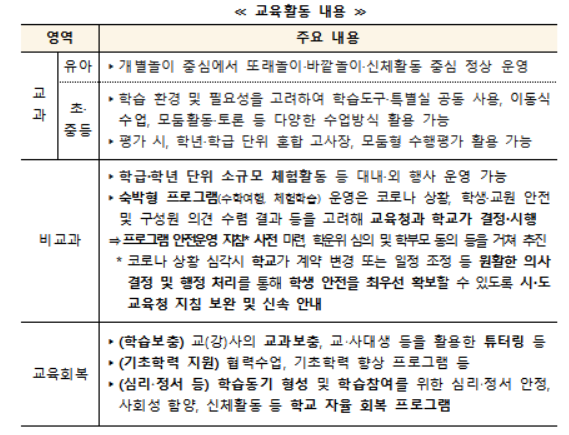
Overnight programs such as school trips and experiential learning will also maintain existing policies. They can be conducted with parental consent and school operation committee review. However, considering the recent cluster infection of about 150 people in Jeonju, operational guidelines by city/provincial education offices will be supplemented to allow smooth contract changes or schedule adjustments by schools. For example, the Jeonbuk Education Office prioritizes day programs after the cluster infection incident and operates overnight stays in single or double rooms.
If a cohabitant is confirmed, students and staff must undergo passive monitoring for 10 days. They must take a PCR test or professional rapid antigen test within three days and take an additional rapid antigen test on days 6-7, staying at home until a negative result is confirmed. If a confirmed case occurs during school activities, testing will be conducted using kits stocked by the school. Self-diagnosis apps, mask-wearing standards, and temperature checks upon attendance will also be maintained.
After-school programs and care classes will operate normally. Home study days will be maintained at 57 days (60 days for kindergarten), but the city/provincial education offices will decide based on regional and school conditions. Outdoor mask-wearing is not mandatory but is recommended only for events with 50 or more people, visits to multi-use facilities, or when maintaining a distance of 1 meter or more is difficult.
Universities Also to Follow Principle of Face-to-Face Classes
Universities must open classes based on the principle of face-to-face instruction while complying with quarantine rules. Non-face-to-face classes should be offered only to enhance educational effectiveness, not for quarantine purposes. The face-to-face class rate in the last semester was 69.2%, more than double the 32.6% in the second semester of last year. If professors or students are confirmed cases making face-to-face classes difficult, various methods such as remote classes or attendance substitution assignments should be used to protect learning rights.
Overnight programs such as MT (Membership Training) are allowed after notification by the head of the unit department and department head, accompanied by staff. Dormitories must secure separate isolation rooms for suspected or confirmed patients. Universities are required to prepare protection and management plans for international students entering from abroad.
Deputy Prime Minister and Minister of Education Park Soon-ae said, "Based on the accumulated experience in school quarantine and academic operations, I request meticulous preparation and thorough COVID-19 response at schools and universities to prevent blind spots."
© The Asia Business Daily(www.asiae.co.kr). All rights reserved.
![Clutching a Stolen Dior Bag, Saying "I Hate Being Poor but Real"... The Grotesque Con of a "Human Knockoff" [Slate]](https://cwcontent.asiae.co.kr/asiaresize/183/2026021902243444107_1771435474.jpg)

















