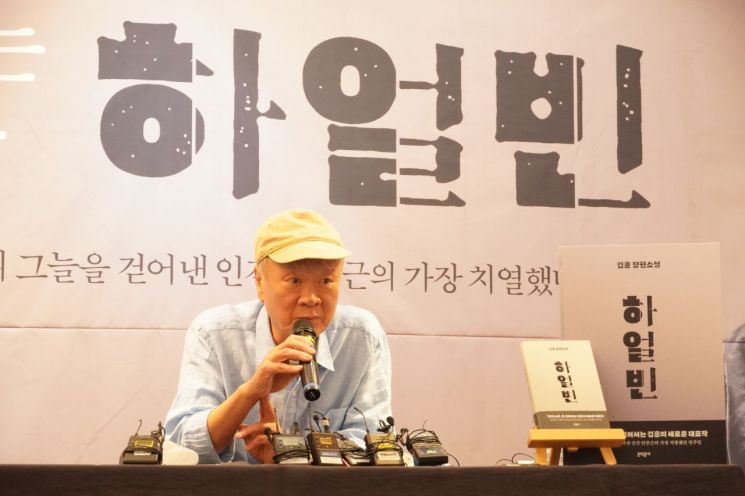
[Asia Economy Reporter Seomideum] Yi Sun-sin and An Jung-geun are the historical figures most respected by writer Kim Hoon. They are the characters he has always wanted to portray in his works. Having previously depicted Yi Sun-sin in "The Song of the Sword," he now shines a spotlight on An Jung-geun in his new novel "Harbin."
At the book launch event held on the 3rd at a cafe in Mapo-gu, Kim Hoon appeared quite embarrassed. “I told them not to create this kind of setting (a book launch), but the publisher went ahead and made it, so I’m breaking out in a cold sweat,” he said awkwardly while posing for photos. Despite the marketing phrase “surpassing ‘The Song of the Sword,’” he expressed reluctance, saying, “I told them not to do this...” When a publisher staff member asked him to pose holding the new book "Harbin," he shook his head and waved his hands in refusal.
In fact, "Harbin" is a novel Kim Hoon has wanted to write since he was young. He was “deeply shocked” after accidentally reading An Jung-geun’s interrogation records. Kim said, “The very bottom of human ideology is extremely chaotic, but those who embark on revolution based on ideology carry themselves so lightly. They truly rise up suddenly,” adding, “I thought this was the driving force of revolution and the passion of life,” explaining his motivation for writing.
It took a long time for the novel to be published, mainly due to his declining health. He said he went through a physically difficult period in 2021. “I didn’t have the confidence to handle (the vastness of the novel),” so he postponed the work and focused on making a living, but eventually felt he could no longer delay and picked up the pen.
Although he initially planned an extensive work, experiencing physical ups and downs led him to focus on finishing quickly, even if less satisfactorily. He began writing on January 1 of this year and completed the manuscript in eight months. Although he traveled to Japan to research the growth and prime years of Ito Hirobumi, he abandoned that material and concentrated on the brief days surrounding An Jung-geun’s assassination of Ito on October 26, 1909. He focused on “depicting An Jung-geun’s youth, soul, and vitality” rather than glorifying him as a hero. Likewise, Ito was portrayed not as a villainous character deserving death but with an effort to depict both “civilization enlightenment” and “survival of the fittest” aspects.
In this novel, Kim abandoned the third-person perspective he had often used. He described this process as “very painful,” explaining, “There are many characters, and I couldn’t use the aesthetic expressions of (third-person).” Referring to his recently published essay “Alone Over There,” he said, “Writing essays made me accustomed to writing in the first person,” adding, “The sentences feel stretched out and sometimes lack a subject.”
The most impressive scene for him was when An Jung-geun meets Woo Seok-soon in a shabby bar in Vladivostok. This was ten days before the assassination of Ito. “The two young men did not say a single word about why they had to do this (the assassination) or about the cause. They didn’t discuss whether the task was easy or difficult, or whether they had enough funds for the operation,” he explained, adding, “Their anguish was heavy, but their demeanor was light. This scene is the most surprising, beautiful, and explosively youthful energy.”
In the “Author’s Note,” the brief statement “An Jung-geun cannot be confined to his era” reflects concerns about the present age. Kim said, “An Jung-geun’s theory of peace in East Asia is still alive. In fact, the situation is more desperate now,” expressing worry that “the protagonists of that era were a declining Japan and victims of Western imperialism, but now North Korea is nuclear-armed and has a military alliance with China, and Japan is once again aiming to become a military power.” He lamented, “Peace in East Asia is in a more severe crisis than in An Jung-geun’s time.”
Regarding the notable aspects of the work, he said, “I put a lot of effort into the conflicts, resolutions, and conclusions involving civilization, survival of the fittest, An Jung-geun, and Catholic priests who were partly entangled with imperialism,” and added, “I don’t think it’s well written, but I hope readers pay attention to these points.”
© The Asia Business Daily(www.asiae.co.kr). All rights reserved.
![Clutching a Stolen Dior Bag, Saying "I Hate Being Poor but Real"... The Grotesque Con of a "Human Knockoff" [Slate]](https://cwcontent.asiae.co.kr/asiaresize/183/2026021902243444107_1771435474.jpg)















