July Inflation Rate 6.3%... Highest Since Foreign Exchange Crisis
BOK "In Line with Expectations"... Indicates 0.25%p Interest Rate Hike
Big Step Unlikely but Uncertainty Remains High
Significant Rate Hike Inevitable if Oil Prices and Exchange Rates Surge
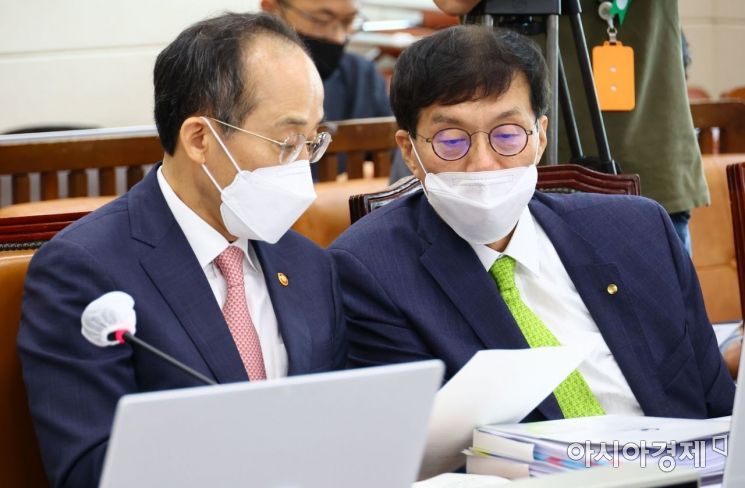 Deputy Prime Minister for Economy Choo Kyung-ho and Bank of Korea Governor Lee Chang-yong attended the full meeting of the Planning and Finance Committee held at the National Assembly on the 1st and are talking before the meeting started. Photo by Yoon Dong-ju doso7@
Last month, the consumer price inflation rate reached its highest level in 23 years and 8 months, strengthening expectations that the Bank of Korea will continue its policy of raising the base interest rate at the Monetary Policy Committee meeting on the 25th. Since Lee Chang-yong, the governor of the Bank of Korea, has already stated several times that a 'gradual increase' is desirable, a 0.25 percentage point hike is likely for the time being, but changes may occur depending on domestic and international conditions such as international oil prices and exchange rates.
According to Statistics Korea on the 2nd, the consumer price index for July (108.74) rose 6.3% compared to the same month last year, marking the highest increase in 23 years and 8 months since November 1998 (6.8%) during the foreign exchange crisis. It is also the first time since 1998 that the inflation rate has recorded over 6% for two consecutive months, following June (6.0%). The sharp rise in international grain prices and increased outdoor activities due to the lifting of quarantine measures contributed to the larger inflation increase.
The Bank of Korea stated that the July consumer price inflation rate was "in line with the expectations at the Monetary Policy Committee meeting on the 13th of last month," but since price stability is the Bank's top priority, it is expected to respond with a base interest rate hike. Governor Lee said at the National Assembly's Planning and Finance Committee plenary session the day before, "At this point, the inflation risk is greater, and since a high inflation trend is expected to continue for the time being, it is necessary to maintain the policy of raising the base interest rate."
This month, a 'baby step' (0.25 percentage point increase in the base interest rate) is more likely than a 'big step' (0.50 percentage point increase). Governor Lee said at a press conference immediately after the Monetary Policy Committee meeting on the 13th of last month, when the first-ever big step was taken, that interest rates would be raised by 0.25 percentage points for the time being. Since the Bank of Korea stated that the July inflation rate aligns with the Committee's expectations at that time, it is highly likely to maintain the existing rate hike policy. In particular, the Bank expects the inflation rate to peak in October and then stabilize, so there is little incentive to implement a big step immediately.
However, due to significant uncertainties surrounding the domestic and international economic situation recently, the Bank of Korea's monetary policy stance may change in the future. One of the biggest variables is international oil prices. The price of Dubai crude oil, which approached $120 per barrel in mid-June, has recently turned downward but could rise again depending on developments in the Ukraine situation. Governor Lee said the day before, "The most important criterion is probably the oil price level," adding, "If oil prices rise significantly after October, inflation could increase unexpectedly, and the monetary policy stance could change."
The exchange rate is also a major variable. The won-dollar exchange rate fell into the 1,290 won range after the Federal Open Market Committee (FOMC) meeting on the 27th (local time), but surged again to the 1,310 won range during the day, showing an upward trend. This is interpreted as a decline in the value of the won, which is linked to the yuan, due to increased risk aversion after it became known that Nancy Pelosi, Speaker of the U.S. House of Representatives, who is touring Asia, planned to visit Taiwan that day. If the exchange rate continues to rise, it will negatively affect import prices, necessitating responses such as interest rate hikes.
The inversion of the Korea-U.S. base interest rates is also a concern. The U.S. Federal Reserve recently raised its base interest rate by 0.75 percentage points from 1.50-1.75% to 2.25-2.50%, causing an inversion where the U.S. rate is higher than Korea's base rate (2.25%). Although the Fed is unlikely to continue raising rates rapidly due to growing recession concerns, expectations for the Fed's monetary policy could be adjusted if employment indicators show improvement. Even if immediate capital outflow concerns are not significant, if the interest rate gap widens further, side effects could increase, so the Bank of Korea is also on high alert.
© The Asia Business Daily(www.asiae.co.kr). All rights reserved.

















