Deputy Prime Minister Park Sunae Expresses Position on Lowering School Entry Age Policy
"If Admission at Age 5, Curriculum and School Spaces May Change"
Acknowledges Lack of Public Consultation: "Official Opinion Gathering Was Difficult"
Emphasizes Not Final Plan: "Collecting Opinions on Various Alternatives"
Expert Meeting in August, Nationwide Survey of 20,000 to Be Conducted
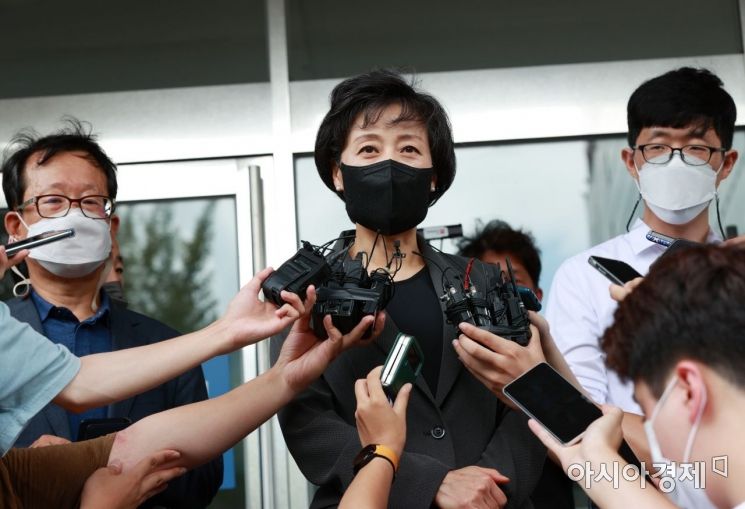 On the 1st, Park Soon-ae, Deputy Prime Minister and Minister of Education, met with reporters in front of the Korea Educational Facilities Safety Institute in Yeouido, Seoul, and responded to questions regarding the policy on lowering the school entry age.
[Asia Economy Reporter Han Jinju] On the 1st, Deputy Prime Minister and Minister of Education Park Soon-ae addressed criticisms that the policy to lower the elementary school entrance age by one year does not reflect the developmental status of young children, stating, "We also have proposals to change the first-grade curriculum and operate care programs until 8 p.m. for first and second graders."
Deputy Prime Minister Park met with reporters in front of the Korea Educational Facilities Safety Institute in Yeouido on the same day and explained, "If students entering first grade are 5 years old, the curriculum will be changed differently from the existing one, and the school space may also be different. Regarding the concerns from mothers about the need for care, we also have a proposal to provide care until 8 p.m. for first and second graders."
Park acknowledged that the policy was not included in the national agenda and that there was no prior public consultation. She added, "The official opinion-gathering process is actually at the level of a work report, so it was difficult to conduct because policies can be adjusted in various ways during the work report process."
Park emphasized several times that the school system reform plan announced by the Ministry of Education is not the final decision and that they will gather opinions on various alternatives. She also mentioned that they are considering unresolved issues such as the integration of kindergartens and daycare centers.
Park added, "The current policy has not been decided yet, and I hope you see this as a process of gathering opinions on whether we can better adapt to a changing society and foster future capabilities when incorporating alternatives into the larger task of school system reform."
She said, "Most agree with the goal of children entering the public education system early to receive better educational services, and various scenarios can be included in the alternatives."
She continued, "The integration of kindergartens and daycare centers has been discussed for over 20 years, and many have said partial integration is necessary, but no progress has been made. We are looking for alternatives within the larger framework of state-responsible education. We are firmly committed to ensuring children receive better services, and the government is open-minded to any better alternatives that can achieve that goal."
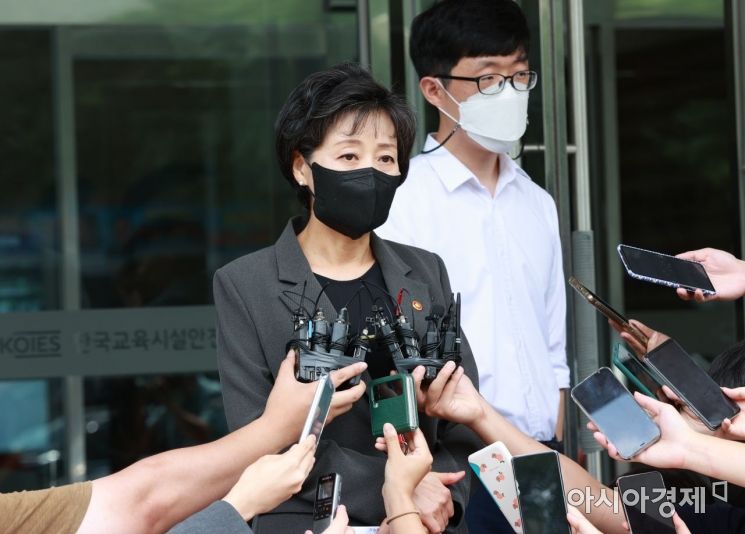 On the 1st, Park Soon-ae, Deputy Prime Minister and Minister of Education, met with reporters in front of the Korea Educational Facilities Safety Institute in Yeouido, Seoul, and responded to questions regarding the policy on lowering the school entry age.
The Ministry of Education plans to hold expert meetings starting this month and conduct a nationwide survey targeting 20,000 people, then finalize the plan once the National Education Commission is launched. Park said, "I think the National Education Commission will be formed by September," adding, "After that, all alternatives are open."
Regarding concerns about overcrowded classes and increased competition for entrance exams during the transitional period from 2025 to 2029, Park said, "I mentioned that the transitional period of four years could be extended." In a radio interview that day, she also said, "We are considering a plan to advance the entrance age by one month each year over 12 years."
Even if the scenario of enrolling 25% of students each year over four years is implemented, the Ministry of Education's position is that the sharp decline in the school-age population will allow accommodation with the current space and teachers.
If the Ministry of Education enrolls children born at age 5 in three-month intervals starting in 2025, the expected number of first graders over the next five years is ▲ 402,491 in 2025 (all children born in 2018 and those born January to March 2019) ▲ 363,176 in 2026 (children born April to December 2019 and January to June 2020) ▲ 331,544 in 2027 (children born July to December 2020 and January to September 2021) ▲ 325,625 in 2028 (children born October to December 2021 and all of 2022) ▲ 260,500 in 2029 (all children born in 2023).
Deputy Prime Minister Park explained, "In 3 to 4 years, the school-age population will decrease significantly compared to now, so even if the plan proceeds as is, most overcrowded classes will not occur. This was a hypothetical situation I mentioned," adding, "It was not an intention to definitely implement it. Please understand it as an effort to present alternatives and build a consensus process."
© The Asia Business Daily(www.asiae.co.kr). All rights reserved.
![Clutching a Stolen Dior Bag, Saying "I Hate Being Poor but Real"... The Grotesque Con of a "Human Knockoff" [Slate]](https://cwcontent.asiae.co.kr/asiaresize/183/2026021902243444107_1771435474.jpg)
















