Positive Awareness of 'Veganism' Spreads
Interest Grows but Some Feel a 'Price Barrier' to Entry
 Interest in veganism (vegetarianism) is increasing, but the cost of purchasing plant-based products is cited as a barrier to entry. The photo is not related to the specific content of the article. [Image source=Pixabay]
[Asia Economy Reporter Yoon Seul-gi] Although interest in veganism (vegetarianism) is increasing, cost issues are holding people back. To use plant-based products, consumers have to pay more than for conventional products, and a kind of 'vegan tax'?an additional cost imposed on vegan products?is making vegan choices difficult, critics say.
According to a recent perception survey on the 'veganism lifestyle' (targeting 1,000 adults aged 19-59 nationwide) conducted by the market research firm Embrain Trend Monitor, positive responses toward the 'veganomics' (vegetarian + economics, the economic industry targeting vegetarians) market were observed.
Although only 3.4% responded that they 'aspire to or practice veganism,' positive perceptions were high, with 59.9% saying 'vegan products seem worth trying at least once,' 55.6% saying 'they seem to help protect the environment in the long term,' and 49.5% saying 'they seem to be beneficial not only for the environment but also for health.'
The factor making 'veganism' difficult was identified as cost. 61.4% said 'maintaining a vegan lifestyle seems expensive,' and 23.1% said 'a vegan lifestyle itself requires economic support,' revealing the perception that veganism is costly. While interest in vegetarianism is growing as the 'value consumption' trend?reflecting one's values?spreads, cost issues appear to be a factor causing hesitation in practicing veganism.
 Interest in veganism (vegetarianism) is increasing, but the cost of purchasing plant-based products is cited as a barrier to entry. The photo is not related to the specific content of the article. [Image source=Pixabay]
Office worker A (25) also feels interested in 'living a vegan-oriented life,' starting from environmental concerns, but cites price as the reason why it is difficult to challenge veganism. A said, "It's hard to change eating habits overnight, but I try to reduce meat consumption from daily to 2-3 times a week or buy products with a vegan mark," adding, "But the prices are too high. Recently, I bought a vegan shampoo bar instead of regular shampoo, which was about 9,000 won for 100g. Although it is used less frequently than regular shampoo, the price is more than twice as high."
Plant-based meat was also found to be priced higher than regular processed meat. At the end of last month, Shinsegae Food launched Better Meat plant-based luncheon meat 340g priced at 7,680 won, while E-Mart's representative private label (PL) No Brand Real Luncheon Meat 340g costs 2,480 won on E-Mart Mall, about three times cheaper. Other companies' products show similar trends. Dongwon's New Luncheon Meat 340g is 4,780 won, Han Sung Enterprise's Luncheon Meat is about 3,000 won (8,990 won for 3 packs), and Lotte Ham's Luncheon Meat is about 3,200 won (9,710 won for 3 packs). Although similar in price to Spam (7,180 won), classified as premium canned ham, plant-based meat still remains relatively expensive.
Moreover, vegetarians have to pay more even for a latte containing milk. Additional charges apply when substituting with plant-based milk. Global coffee brand Starbucks emphasizes vegan, eco-friendly, and health trends, but customers must pay an extra 600 won when substituting with oat milk, a plant-based beverage.
Lee Won-bok, head of the Korea Vegetarian Union, explained the price barrier of vegan products: "Since vegan products are made from eco-friendly ingredients, their price competitiveness is inevitably lower," adding, "As the vegan market is growing, it is difficult to achieve economies of scale (where unit costs decrease as production scale increases) like conventional products."
He continued, "Although the high price is somewhat unavoidable, companies must provide explanations about the price that consumers can accept," emphasizing, "If costs are added to vegan products like a tax without any reason, consumers will inevitably turn away."
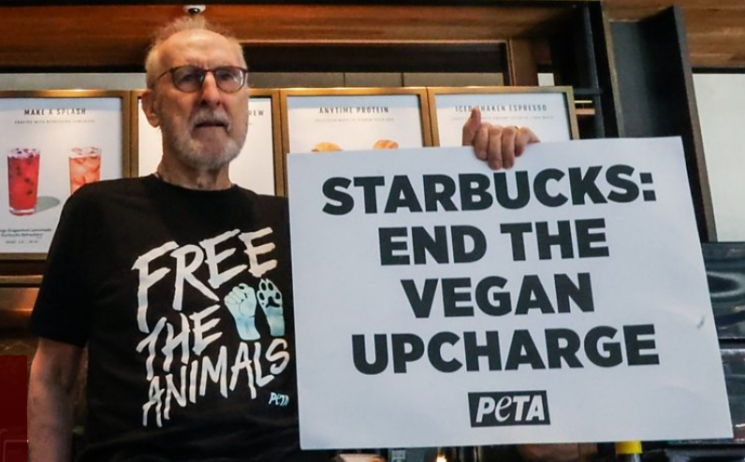 Last May, American actor James Cromwell staged a protest at a Starbucks store in Manhattan, New York, where he glued his hand to the counter. The sign he held read, "Starbucks, stop charging extra fees for vegetarians." Photo by CNN.
Meanwhile, overseas, there is already shared awareness of the issue of the 'vegan tax'?additional costs imposed on choosing veganism. According to CNN, in May, American actor James Cromwell staged a protest at a Starbucks store in Manhattan, New York, by sticking glue-covered hands to the counter, criticizing Starbucks for passing the cost of plant-based beverage substitutions onto consumers.
The media reported that Starbucks charges up to 80 cents extra for dairy alternative drinks such as soy, coconut, almond, and oat milk depending on the U.S. city. Regarding this, Cromwell wrote in an article for The Washington Post (WP) that "they charge more than ten times the actual cost of the alternative drink," pointing out that "they impose unfair fees for profitability." He also criticized the policy for ignoring animal abuse issues rampant on dairy farms and making consumers reluctant to make eco-friendly choices by forcing them to pay more.
© The Asia Business Daily(www.asiae.co.kr). All rights reserved.
![Clutching a Stolen Dior Bag, Saying "I Hate Being Poor but Real"... The Grotesque Con of a "Human Knockoff" [Slate]](https://cwcontent.asiae.co.kr/asiaresize/183/2026021902243444107_1771435474.jpg)

















