Power Supply Disruptions Expected in China Amid Ongoing Heatwave
Germany Faces Energy Crisis Due to Reduced Russian Gas Supply
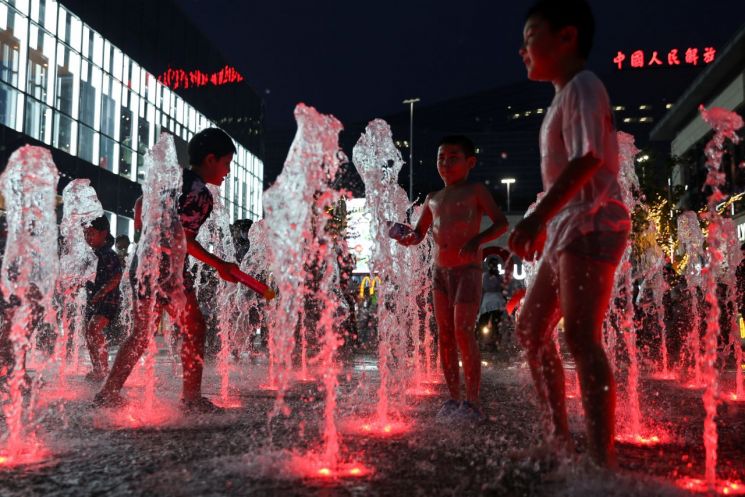 Zhejiang Province in China announced power usage restrictions, including a ban on elevator operation. The photo shows children cooling off by playing in fountain water in Beijing, China.
 [Image source=Yonhap News]
[Asia Economy Reporter Park Hyun-joo] As unprecedented heatwaves cause a surge in electricity usage, countries around the world are announcing measures to reduce power consumption.
Recently, the scorching heat has intensified in China. In the central and southern regions, daytime high temperatures have exceeded 35 degrees Celsius, with some areas surpassing 40 degrees, resulting in a month-long heatwave.
Due to this, electricity consumption has surged, causing the power peak (maximum load) to reach an all-time high. Concerns have arisen about potential disruptions in power supply. Especially, considering that the power peak period is from late this month to early August, electricity consumption is expected to increase further for the time being.
He Yang, President of the Power Division at the National Energy Administration of China, stated at a regular briefing on the 27th, "Since the beginning of this month, the power peak has consecutively broken records, reaching 1.26 billion kWh on the 15th." This represents a 5.7% increase compared to last summer's power peak (1.102 billion kWh).
Accordingly, Zhejiang Province has implemented power usage restrictions. Zhejiang has instructed companies to reduce load by using electricity during nighttime hours, and commercial and residential facilities have also been asked to cut down on electricity use. Additionally, power-saving guidelines were announced, including ▲maintaining indoor temperatures above 26 degrees Celsius ▲prohibiting elevator operation below the 3rd floor ▲reducing the operating hours of illuminated signs ▲stopping the use of promotional light boards.
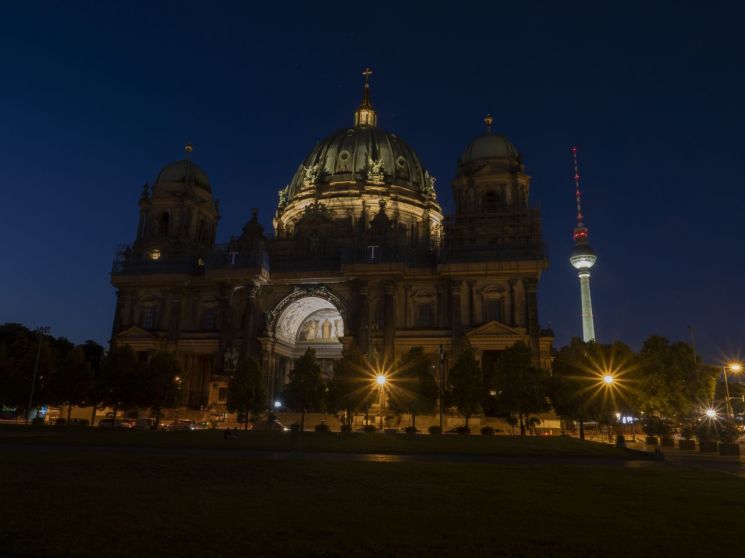 Cities such as Berlin and Hanover in Germany have announced energy-saving measures. The photo shows the Berlin Cathedral shrouded in darkness on the 27th (local time) in accordance with energy-saving policies. [Image source=Yonhap News] Photo by Yonhap News
Germany is also implementing various measures to conserve energy. This is due to a surge in cooling demand caused by abnormal heat and a significant reduction in natural gas supply from Russia.
According to the British daily The Guardian on the 28th (local time), the northern German city of Hanover decided to shorten heating hours in public buildings, excluding daycare centers, schools, and hospitals, from October this year to March next year. Sports centers and gyms will have indoor temperatures limited to 15 degrees Celsius, while other buildings will be limited to 20 degrees Celsius. The use of portable air conditioners, heaters, and radiators is also prohibited.
Energy consumption from lighting will also be reduced. Major buildings such as city halls and museums will turn off lights at night. Lighting will be replaced with light-emitting diodes (LEDs), and motion sensors will be installed in restrooms, bicycle storage areas, parking lots, and corridors where lights will remain on continuously.
Other cities are also announcing energy-saving measures one after another. The capital, Berlin, turned off nighttime lighting that focused on about 200 historical monuments and city hall buildings starting from the 27th. Munich turned off nighttime lighting illuminating city hall and decided not to supply hot water inside city hall. Additionally, Nuremberg closed three out of four indoor swimming pools operated by the city and will continue to operate outdoor pools until September 25.
© The Asia Business Daily(www.asiae.co.kr). All rights reserved.
![Clutching a Stolen Dior Bag, Saying "I Hate Being Poor but Real"... The Grotesque Con of a "Human Knockoff" [Slate]](https://cwcontent.asiae.co.kr/asiaresize/183/2026021902243444107_1771435474.jpg)
















