Consumer Prices Rose 6% Last Month, July Forecast Also in the 6% Range
Increase in Used Goods Trading Users... "Looks New but Much Cheaper"
"Even with Some Blemishes, Prefer Cheaper"… Rise in 'Motnani Gwail' Purchases
 Consumers facing an era of high inflation have turned to self-help measures such as trading secondhand goods and seeking out 'motnani products' (imperfect products). The photo is not related to the specific content of the article.
[Asia Economy Reporter Kim Jung-wan] #. Kang Mo (31), a fourth-year office worker living alone in Seoul, has recently started using secondhand trading platforms more frequently. With soaring prices increasing various expenses, he is trying to reduce consumption as much as possible. Kang said, "It's good to be able to get products that don't differ much in quality at a cheaper price," adding, "There were times when I enjoyed spending, but these days prices have risen so much that I have to save wherever I can."
Prices are showing no signs of easing. There are even forecasts that the consumer price index for July will show a 6% increase rate, similar to last month. Due to this situation, consumers have tightened their belts by increasing secondhand transactions. They are seeking self-help measures such as looking for relatively less marketable but cheaper products like 'motnani gwail' (imperfect fruit).
On the 29th, Bang Ki-sun, the First Vice Minister of Strategy and Finance, held an emergency economic vice ministerial meeting at the Export-Import Bank of Korea in Seoul and stated, "The consumer price index for July is expected to show a 6% increase rate again due to the rise in agricultural product prices caused by the rainy season and heatwave." Last month's consumer price index rose 6.0% compared to the same period last year, marking the first time in 23 years and 7 months since November 1998 (6.8%) during the IMF financial crisis that the increase rate reached the 6% level.
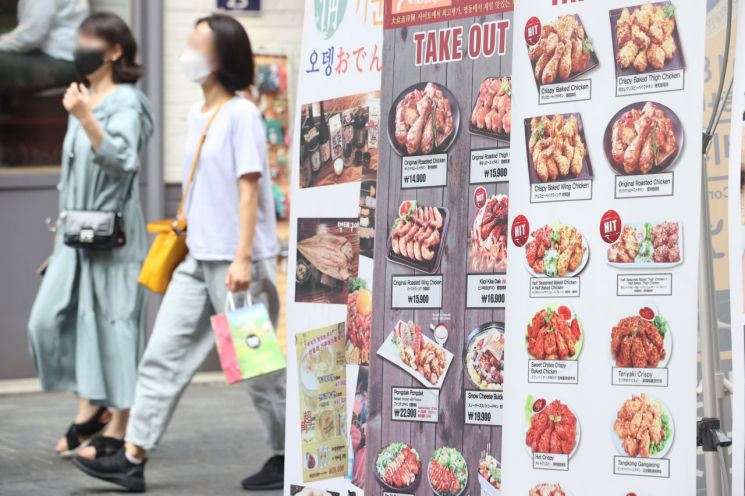 In June, the consumer price inflation rate soared to the 6% range for the first time in about 24 years since the foreign exchange crisis. There are also forecasts that the consumer price inflation rate in July will record a 6% increase. [Image source=Yonhap News]
As food prices and various living costs sharply rise, the expected inflation rate, which forecasts consumer price increases over the next year, also hit an all-time high. According to the 'July 2022 Consumer Sentiment Survey Results' released by the Bank of Korea on the 27th, the expected inflation rate for the next year rose by 0.8 percentage points from 3.9% in June to 4.7%. This is the highest since related statistics began in July 2008, and the 'price perception,' which reflects the perceived inflation rate over the past year, also reached a record high of 5.1%.
Due to this situation, the number of consumers using secondhand trading platforms has also increased. They buy necessary items secondhand at relatively low prices to save every penny. According to Mobile Index, a mobile big data analysis platform, the monthly active users (MAU) of four secondhand trading platforms (Junggonara, Danggeun Market, Bungaejangter, Hello Market) increased from 19.74 million at the end of January to 20.35 million in April.
It was found that items frequently purchased include daily necessities and relatively expensive home appliances. According to the Korea Consumer Agency, a survey of 1,150 consumers who used the four secondhand trading platforms in April showed that the main secondhand transaction items were △daily necessities 21.1% △home appliances 16.2% △clothing 13.7%, in that order.
Choi Mo, a worker in his 30s, decided to buy an additional fan as the heatwave continued day after day. While browsing secondhand trading platforms, he succeeded in finding a fan with almost no signs of use. Choi said, "It was almost like new, but I bought it for more than half the original price," adding, "For the time being, I plan to buy what I need in the cheapest way possible."
 Homeplus announced on the 15th that it will offer discounts on 'Matnani Agricultural Products'.
 [Image source=Yonhap News]
The number of people looking for products with little difference in quality but with dents or bruises that reduce marketability, such as 'motnani gwail' (imperfect fruit), has also increased. According to Lotte Mart, cumulative sales of 'motnani gwail' (win-win fruit) from January to July this year increased by more than 180% compared to the same period last year. Homeplus also reported that sales of 'motnani gwail' (Matnani agricultural products) from July 4 to 10 increased by about 13% compared to the same period last year.
Kim Mo, a housewife in her 50s living in Dongjak-gu, Seoul, said, "These fruits are not for guests but for the family to eat quickly, so even if they have some blemishes, I tend to buy the cheaper ones," adding, "This is a difficult time when we try to endure by saving reasonably even on fruits." She also expressed, "In a way, it’s a good habit, but I hope prices calm down quickly."
© The Asia Business Daily(www.asiae.co.kr). All rights reserved.
![Clutching a Stolen Dior Bag, Saying "I Hate Being Poor but Real"... The Grotesque Con of a "Human Knockoff" [Slate]](https://cwcontent.asiae.co.kr/asiaresize/183/2026021902243444107_1771435474.jpg)


















