Initially Expected '300,000 per Day' Lowered by 100,000
Considering Reduced Variant Impact and Slowed Increase in Confirmed Cases
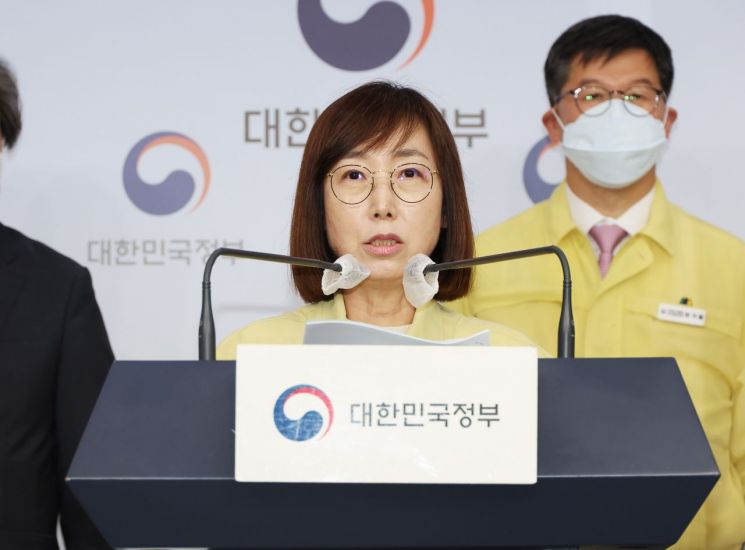
[Asia Economy Reporter Kim Young-won] The government has lowered its forecast for the peak of the COVID-19 resurgence by 100,000 cases from the initially expected "300,000 cases per day."
On the 29th, Baek Kyung-ran, Commissioner of the Korea Disease Control and Prevention Agency (KDCA), stated at the Central Disaster and Safety Countermeasures Headquarters briefing, "There is a possibility that the peak, at around 200,000 cases per day, which is lower than initially expected, will form earlier than anticipated."
Previously, on the 15th, the government predicted that due to the spread of BA.5, the COVID-19 outbreak could see a daily maximum of around 250,000 cases by mid to late next month. Additionally, they prepared and announced response plans for the resurgence on the 13th and 20th, anticipating up to 300,000 daily cases.
The authorities explained that the forecast was revised due to the reduced impact of variants such as BA.2.75 and the recent slowdown in the increase of confirmed cases. At an expert briefing hosted by the KDCA the previous day, Professor Jung Jae-hoon of the Department of Preventive Medicine at Gachon University College of Medicine said, "The spread rate of BA.2.75 appears to be slower than expected," adding, "The impact of BA.2.75 on the scale of this outbreak will be limited."
Commissioner Baek said, "If the outbreak progresses within the predicted range, it is expected that the prepared medical and quarantine capacity will be sufficient to respond without uniform social distancing measures such as restrictions on gatherings or the number of people." He added, "Although confirmed cases will increase for the time being due to new variant outbreaks and waning vaccine effectiveness over time, the medical response system will operate stably thanks to improved vaccination rates and increased prescription rates."
However, the government stated that if significant changes occur in the outbreak situation, partial social response measures may be introduced. Significant changes refer to situations such as increased intensive care unit bed occupancy rates, higher fatality rates, or the continued 'very high' risk assessment.
The introduction of partial social response measures will be implemented after the National Infectious Disease Crisis Response Advisory Committee reviews the risk level of the quarantine situation, the effectiveness of non-pharmaceutical interventions, and the social and economic cost assessments.
© The Asia Business Daily(www.asiae.co.kr). All rights reserved.

















