High Interest Rates and Inflation Dilemma... Dark Clouds Still Over Small Business Owners
Self-Employed Loan Balance at 960 Trillion Won... Increased by 276 Trillion Since Before COVID-19
Ministry of SMEs to Convert Loans with Over 7% Interest to Low-Interest Starting from the 29th
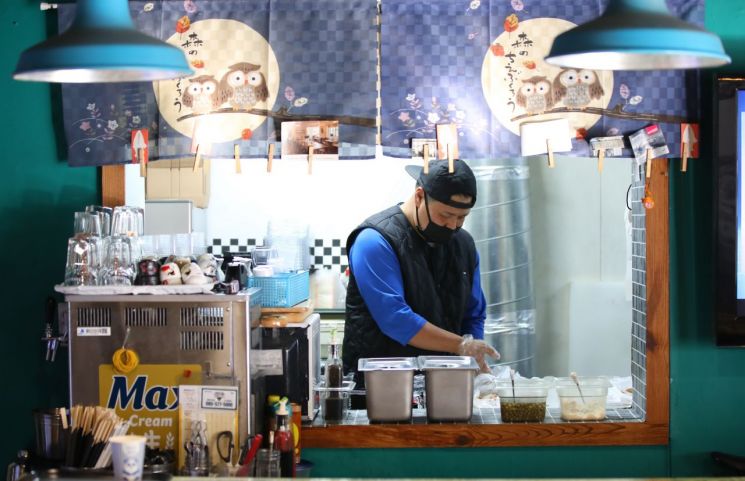 Stock photo of a self-employed person / Unrelated to the article content. [Image source=Yonhap News]
Park, who runs a 200㎡ mart in Eunpyeong-gu, Seoul, took out a high-interest loan at an annual rate of 16% from a capital company three years ago. He said, "After the COVID-19 outbreak, I thought 'it will calm down soon,' so I borrowed 50 million won despite the high interest rate," adding, "I have been paying 1.2 million won monthly for principal and interest, but the high interest rate is quite a burden."
As sales declined due to COVID-19 and his financial capacity weakened, Park applied for a guaranteed loan at a government-operated guarantee institution last January. However, he received a response saying, "It is difficult because your credit rating is not good, and you have national tax arrears and capital loan cases." After paying about 4 million won in comprehensive income tax last month, Park reapplied for the guarantee earlier this month. This time, he was advised to reapply in October, with the explanation that "manufacturing is the first priority, and wholesale and retail are secondary." Park said, "With the worsening economic situation, I am suffering from a double burden of declining sales and high interest rates," and added, "If high-interest loans for small business owners could be converted to low-interest loans, it would help put out the urgent fire immediately."
Small business owners are struggling with financial costs. Especially during the COVID-19 period, a significant portion of them took out loans from the secondary financial sector at high interest rates. They urgently borrowed money to resolve cash flow problems caused by temporary income reductions. However, as the COVID-19 crisis prolonged and sales declined due to economic downturn, the burden of loan interest is suffocating small business owners.
News predicting an economic recession does not ease their anxiety. As prices of daily necessities handled in marts rise rapidly due to soaring inflation, more consumers are tightening their wallets. The situation where daily COVID-19 cases approach 100,000 also heightens the anxiety of small business owners who have endured the pandemic for the past two and a half years.
According to the 'Financial Stability Report' released by the Bank of Korea in June, loans to self-employed individuals stood at 960.7 trillion won as of the end of March this year, an increase of about 276 trillion won compared to the end of 2019 before COVID-19. The Bank of Korea stated, "If loan interest rates rise and the effects of the end of financial support measures become fully realized, the delinquency of self-employed loans is likely to increase rapidly."
According to the 'Small Business Financial Market Trends Report' released by the Small Enterprise and Market Service in April, loan growth rapidly increased in △face-to-face service industries △non-bank sectors △low-income groups. As of the third quarter of 2021, leisure service industries (20.1%) and wholesale and retail industries (12.7%) showed higher loan growth compared to a year earlier. During the same period, the loan growth rate in the non-bank sector (19.8%) increased faster than that in the banking sector (11.3%). By income level, middle- and low-income groups (1st to 3rd quintiles) showed high growth rates.
Oh Yun-hae, a KDI research fellow, stated, "Policy financial support that lowers the credit risk of small business owners, whose debt has significantly increased to the extent that they must use high-interest loans during the COVID-19 crisis and whose risk of insolvency has increased due to rising interest burdens, must continue."
Meanwhile, the Ministry of SMEs and Startups will start today (29th) a debt refinancing program that converts high-interest loans of 7% or more from the secondary financial sector into low-interest loans from banks for low-credit small business owners. It is expected that about 10,000 people will benefit if an average of 20 million won per person is supported. From the end of September, the government plans to implement a guaranteed debt refinancing loan worth 8.5 trillion won through the Korea Credit Guarantee Fund under the Financial Services Commission.
© The Asia Business Daily(www.asiae.co.kr). All rights reserved.
![Clutching a Stolen Dior Bag, Saying "I Hate Being Poor but Real"... The Grotesque Con of a "Human Knockoff" [Slate]](https://cwcontent.asiae.co.kr/asiaresize/183/2026021902243444107_1771435474.jpg)















