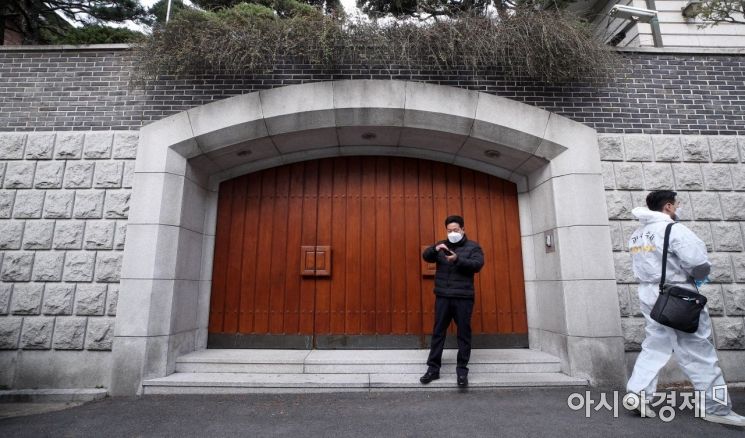
 Former President Jeon Du-hwan, who served as the 11th and 12th president, passed away on the 23rd at the age of 90. The former president, who had been suffering from chronic illness, died around 8:40 a.m. at his residence in Yeonhui-dong, Seodaemun-gu, Seoul. Former President Jeon was found collapsed inside his home, and the police and fire department were notified at 8:55 a.m. The police confirmed his death at approximately 9:12 a.m. Photo shows the residence in Yeonhui-dong on the day. Photo by Kim Hyun-min kimhyun81@
[Asia Economy Reporter Kim Hyung-min] Lee Yoon-hye, the daughter-in-law and owner of the annex of former President Jeon Du-hwan’s Yeonhui-dong residence, has lost the final lawsuit she filed in opposition to the prosecution’s seizure.
The Supreme Court’s 1st Division (Presiding Justice Oh Kyung-mi) on the 28th upheld the lower court’s ruling that dismissed Lee’s appeal in the lawsuit she filed against the Seoul Central District Prosecutors’ Office Chief to nullify the seizure order.
However, the court stated, "Since the execution of property penalties such as confiscation or fines is generally carried out against the person who was tried, if the person who was tried has died, execution cannot proceed unless there are special provisions," and "Therefore, after Jeon Du-hwan’s death, the execution of fines cannot continue against the plaintiff (Lee Yoon-hye)."
Furthermore, the court explained the reasoning behind the ruling, saying, "When Jeon Du-hwan’s brother-in-law won the auction for the real estate in question (the annex of the Yeonhui-dong residence) during the compulsory auction process, the payment was made using Jeon Du-hwan’s slush funds, making it illegal property," and "The lower court’s conclusion that the seizure order is valid is acceptable."
A Supreme Court official explained, "It explicitly confirmed that, in principle, seizure orders cannot continue after the defendant’s death, and the prosecutor must issue a decision of non-execution and lift the seizure order."
The Seoul Central District Prosecutors’ Office seized the Yeonhui-dong residence in 2018 and put it up for public auction after Jeon Du-hwan failed to pay the 220.5 billion won fine even though the Supreme Court confirmed his guilty verdict in 1997. The residence was auctioned off the following year for 5.137 billion won through the Korea Asset Management Corporation (KAMCO) acting as the auction agent. In response, Jeon’s family filed objections to the criminal trial execution with the court, and Lee Yoon-hye filed an administrative lawsuit, initiating a legal battle.
Lee filed an administrative lawsuit against the Seoul Central District Prosecutors’ Office and KAMCO, requesting the cancellation of the seizure and auction of the annex registered under her name. Among the Yeonhui-dong residence, the main building is registered under his wife Lee Soon-ja’s name, the garden under the secretary’s name, and the annex under daughter-in-law Lee’s name. Lee also lost the administrative lawsuit against KAMCO, with the Supreme Court confirming the lower court’s ruling against her in April. On the other hand, the auction of the main building and garden was canceled after Lee Soon-ja and others won their lawsuit against KAMCO in March. Jeon paid only 124.9 billion won of the 220.5 billion won fine by the time of his death last year.
Meanwhile, on the same day, the Supreme Court also confirmed a partial victory for a domestic trust company in a separate lawsuit it filed against the Seoul Central District Prosecutors’ Office Chief to nullify a seizure order. The trust company had entered into a real estate collateral trust contract in 2008 for buildings owned by Jeon’s family in Yongsan-gu, Seoul, and forest land in Osan, Gyeonggi Province, and registered ownership transfer. When the real estate was seized in 2013, the trust company filed an objection. The Seoul High Court ruled in November 2019 that the seizure of the Yongsan-gu building in 2013 occurred before the enforcement of the special confiscation law related to public official crimes, which allows confiscation of illegal property from persons other than the criminal, and the Supreme Court upheld this ruling.
© The Asia Business Daily(www.asiae.co.kr). All rights reserved.
![Clutching a Stolen Dior Bag, Saying "I Hate Being Poor but Real"... The Grotesque Con of a "Human Knockoff" [Slate]](https://cwcontent.asiae.co.kr/asiaresize/183/2026021902243444107_1771435474.jpg)















