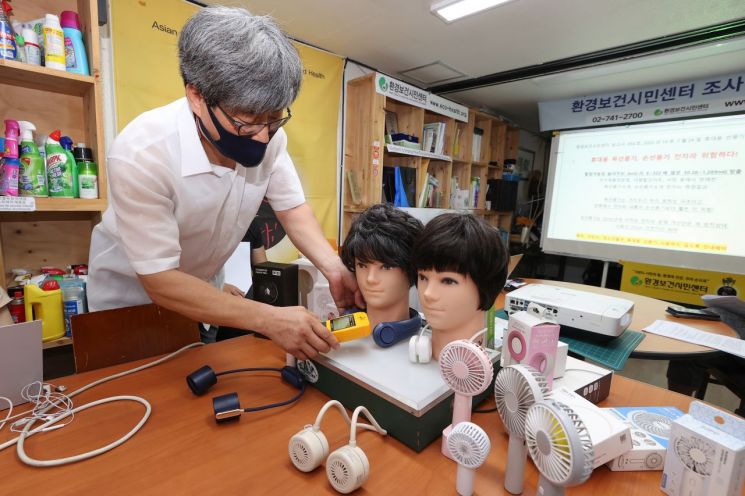
[Asia Economy Reporter Gong Byung-sun] An environmental organization has reported that portable neck-hanging fans emit electromagnetic waves exceeding the World Health Organization (WHO) carcinogenic exposure standards.
On the 26th, the Environmental Health Citizens' Center announced that it purchased four neck-hanging portable fans and six handheld fans sold at large supermarkets and bookstores this month to measure electromagnetic waves.
According to the investigation, electromagnetic waves were emitted from the motors of battery-operated portable fans, similar to general home appliances. The average electromagnetic wave value measured six times around the blades and motor of the neck-hanging fans was 188.77 mG (milligauss). The minimum value was 3.38 mG, and the maximum was 421.20 mG. For handheld fans, electromagnetic waves ranged from a minimum of 29.54 mG to a maximum of 1,289 mG, with an average of 464.44 mG.
According to the Environmental Health Citizens' Center, the International Agency for Research on Cancer (IARC), under the WHO, classifies electromagnetic waves as possibly carcinogenic (Group 2B). Furthermore, the organization explained that research shows prolonged exposure to electromagnetic waves above 4 mG increases the incidence of childhood leukemia. Both neck-hanging and handheld fans emit electromagnetic waves far exceeding the WHO's warning standards.
A representative of the organization stated, "In the case of neck fans, it is difficult to adjust the distance, so exposure to electromagnetic waves is inevitable," and added, "For handheld fans, a safety distance of about 25 cm should be maintained during use."
The organization criticized the government's human protection standards for not adequately reflecting the negative effects on the human body. Currently, the government uses the International Commission on Non-Ionizing Radiation Protection (ICNIRP) standard of 883 mG as the human protection standard. A representative of the organization said, "Reports indicate that even below the government's 883 mG standard, there may be health effects such as cancer incidence," and urged, "The National Assembly should institutionalize the WHO carcinogen designation background research value of 4 mG as a new safety standard."
© The Asia Business Daily(www.asiae.co.kr). All rights reserved.

















