"State-led quarantine is difficult to sustain" statement clarified
KCDC-KMA joint statement "Practice daily quarantine"
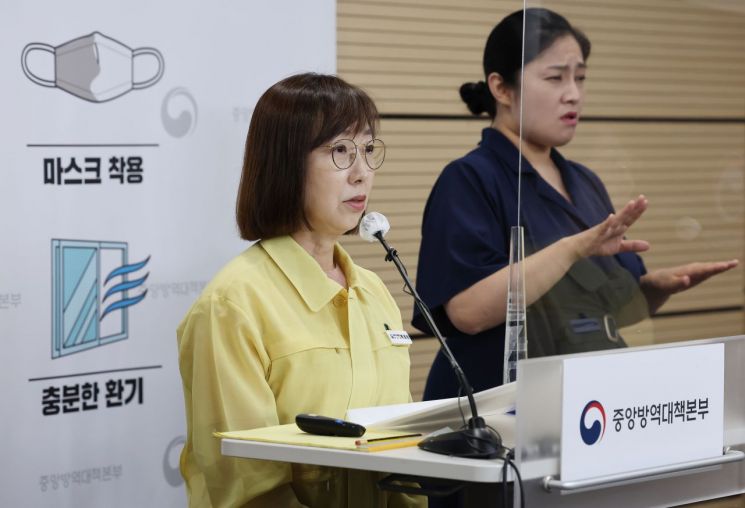
[Asia Economy Reporter Jo In-kyung] Baek Kyung-ran, Commissioner of the Korea Disease Control and Prevention Agency (KDCA), described the recent COVID-19 situation as "the first resurgence without uniform restrictive measures" and urged the public to voluntarily participate in preventive measures. Regarding the controversy over her remarks a week ago that were interpreted as denying state-led quarantine efforts and sparked debate about "each person fending for themselves," she explained that "the message was insufficiently conveyed."
At a regular briefing on the 26th, Commissioner Baek said, "This is the first resurgence we are facing without uniform restrictions such as limits on gathering sizes or time," and urged, "Let the entire community unite through participation in prevention and solidarity to overcome the resurgence crisis and restore a sustainable daily life."
She emphasized, "The important thing is to continue daily life recovery while simultaneously overcoming the resurgence crisis," adding, "With the voluntary practice of social distancing and participation by the public, we can successfully overcome the outbreak."
Commissioner Baek also noted, "Recently, some companies have been implementing their own strengthened preventive measures, such as refraining from business trips and dinners, and enhancing non-face-to-face video meetings and remote work," stressing, "If individuals participate in distancing to protect their own safety and workplaces, we can wisely overcome this crisis as well."
She directly addressed the criticism from political circles and public opinion that arose after her statement on the 19th briefing that "state-led quarantine is difficult to sustain," which was interpreted as advocating "each person fending for themselves" quarantine.
Commissioner Baek explained, "Previously, I mentioned that government-led quarantine focused on control measures such as restrictions on gathering times or numbers is not sustainable, but it seems the message was not adequately conveyed," adding, "What I meant was that if the government imposes time or number restrictions, the effectiveness is greatly reduced."
She explained that various analyses of the current outbreak situation and the transmissibility of Omicron have shown that social distancing measures like time or number restrictions have very limited effectiveness in controlling the outbreak.
She said, "To sustain daily life recovery, sustainable quarantine policies are necessary. Rather than the government imposing time or number restrictions, it will be helpful to overcome this crisis and serve as a driving force for continuing daily life recovery if the public actively participates using the wisdom gained from their experience over the past two and a half years."
Meanwhile, the KDCA and the Korean Medical Association (KMA) issued a joint statement at the briefing titled 'Joint Position on Overcoming the Second Half COVID-19 Resurgence,' urging the public to practice daily preventive measures. Both sides emphasized, "To continue daily life recovery and effectively overcome the current outbreak, close cooperation between the medical community and the government, as well as active daily preventive practices by our citizens, are necessary."
They recommended ▲ reducing unnecessary or non-urgent outings and meetings, refraining from attending large-scale events and visiting enclosed facilities where many people gather ▲ adhering to personal preventive guidelines and regularly ventilating and disinfecting everyday spaces ▲ complying with the 7-day isolation requirement for confirmed cases ▲ actively utilizing remote work, non-face-to-face meetings, and remote classes.
© The Asia Business Daily(www.asiae.co.kr). All rights reserved.
![Clutching a Stolen Dior Bag, Saying "I Hate Being Poor but Real"... The Grotesque Con of a "Human Knockoff" [Slate]](https://cwcontent.asiae.co.kr/asiaresize/183/2026021902243444107_1771435474.jpg)















