[Asia Economy New York=Special Correspondent Joselgina] 'Recession or not.'
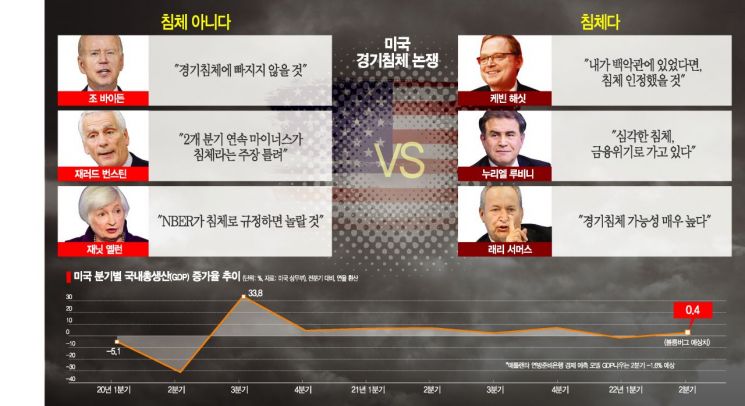
As the announcement of the U.S. second-quarter economic growth rate approaches, the so-called 'technical recession' debate is intensifying. Even if the usual condition for a technical recession?'two consecutive quarters of negative growth'?materializes, the U.S. administration argues that it is difficult to define it as a recession considering the strong labor market and other factors. On the 25th (local time), U.S. President Joe Biden also stated that "we will not fall into a recession."
◇ Biden also says "Not a recession"... U.S. administration launches public opinion battle
The U.S. Bureau of Economic Analysis will release the preliminary GDP figures for the second quarter on the 28th. Currently, Wall Street's forecast is around 0.4%. However, the Atlanta Federal Reserve Bank's GDPNow, which compiles real-time data, estimated on the 19th that the U.S. second-quarter GDP growth rate will record an annualized -1.6%. With the possibility of negative growth in the second quarter following the first quarter, the market is increasingly analyzing whether the economy has already entered a recession.
In particular, this debate has heated up again as the long-standing controversy over whether 'two consecutive quarters of negative growth' can be defined as a 100% recession has reignited. Jared Bernstein, a member of the White House Council of Economic Advisers (CEA), appeared on CNBC that day and said, "The idea that two consecutive quarters of negative growth is the technical definition of a recession is wrong." He added, "The first half data does not align with a recession," and assessed, "Consumers are doing well, spending, and earning more income. There are also many jobs."
This is in line with Treasury Secretary Janet Yellen's statement the previous day that "if the National Bureau of Economic Research (NBER), which officially defines recessions, classifies this period as a recession, it would be surprising." Brian Deese, Director of the National Economic Council, also appeared on CNN and said, "From a technical definition perspective, this is not a recession," adding, "We consider much broader data."
Since the 21st, the White House has launched a public opinion campaign through a post titled "How do economists determine a recession?" stating that 'two consecutive quarters of negative growth' is neither an official definition nor an evaluation method. Especially on this day, President Biden, who was diagnosed with COVID-19, raised his voice through a video Q&A, saying, "In my opinion, we will not fall into a recession."
The Washington Post (WP) reported, "There will be significant political debate over the definition of the word recession by this weekend," and noted that "the Biden administration is proactively pushing back on the recession issue."
◇ How is a recession defined?
Counterarguments are also strong. Kevin Hassett, who served as chairman of the White House Council of Economic Advisers during the Trump administration, rebutted, saying, "I find it hard to agree with the claim that this is not a recession." He appeared on CNBC's Squawk Box that day and said, "If I were in the White House, I would not deny that this is a recession." Regarding the administration's claim of a strong labor market, he pointed out, "Historically, the labor market moves slowly."
Professor Nouriel Roubini of New York University, known as 'Dr. Doom,' also warned again that "a perfect storm will push the U.S. into the worst recession in history." He said, "There are many reasons why we will experience a severe recession and a serious debt and financial crisis," and dismissed the possibility of a "short and mild recession" raised by some as "complete delusion." Larry Summers, Harvard University professor and former Treasury Secretary under the Bill Clinton administration, also stated the previous day that "the possibility of a recession is very high."
In the U.S., the NBER, composed of eight economists, officially determines recessions. It evaluates by synthesizing eight major economic indicators, including GDP, labor statistics, consumer spending, and industrial production. Jeffrey Frankel, a Harvard Kennedy School professor who served as a member of the NBER Business Cycle Dating Committee from 1992 to 2019, explained in an earlier interview with Asia Economy, "Recessions are not judged solely by whether GDP shrinks for two consecutive quarters." A representative example is the 2001 recession, which was declared despite growth rates fluctuating between positive and negative in consecutive quarters. However, cases of two consecutive quarters of negative growth without a recession are rare. Tara Sinclair, a professor at George Washington University, said, "The only recorded instance was in 1947."
Some political interpretations suggest that the Biden administration, facing the midterm elections in November, will find it difficult to acknowledge a recession even if one occurs. The urgent need to normalize monetary policy to lower inflation, which is at its highest level in over 40 years, also acts as a dilemma. Bloomberg reported, "The Biden administration is underestimating data that could show the U.S. economy contracting for two consecutive quarters," adding, "The Federal Reserve is expected to take another giant step (a 0.75 percentage point hike) this week to curb inflation, putting new pressure on growth."
© The Asia Business Daily(www.asiae.co.kr). All rights reserved.
![Clutching a Stolen Dior Bag, Saying "I Hate Being Poor but Real"... The Grotesque Con of a "Human Knockoff" [Slate]](https://cwcontent.asiae.co.kr/asiaresize/183/2026021902243444107_1771435474.jpg)















