GAA Technology Applied 3nm Foundry Product Shipment Ceremony Held
Strengthening Business Competitiveness with Proactive Foundry Technology
Mass Production Ahead of Competitor TSMC
 On the morning of the 25th, attendees are applauding at the 'World's First GAA-based 3nm Mass Production Shipment Ceremony' held at Samsung Electronics Hwaseong Campus in Hwaseong-si, Gyeonggi-do. (From right) Park Hak-gyu, President of DX Division Management Support Office; Kyung Kye-hyun, CEO of DS Division; Lee Chang-yang, Minister of Trade, Industry and Energy; Choi Si-young, President of DS Division Foundry Business Unit. / Hwaseong - Photo by Kim Hyun-min kimhyun81@
[Asia Economy Reporter Park Sun-mi] On the 25th, Samsung Electronics held a shipment ceremony for its 3nm (nanometer; 1nm equals one billionth of a meter) foundry product applying next-generation transistor Gate-All-Around (GAA) technology. The ceremony, held at the V1 line (dedicated to EUV) of the Hwaseong Campus in Gyeonggi Province, was attended by about 100 people, including Lee Chang-yang, Minister of Trade, Industry and Energy; Kyung Kye-hyun, President and CEO of Samsung Electronics' Device Solutions (DS) Division; employees; and executives from partner companies and fabless firms.
President Kyung Kye-hyun: "An Innovative Result Creating Something from Nothing"
In his congratulatory speech, Minister Lee expressed gratitude to Samsung Electronics employees and the semiconductor industry for their hard work and urged, "To stay ahead in the fierce competition of fine processes, Samsung Electronics, the system semiconductor industry, and the materials, parts, and equipment (SoBuJang) industry must join forces." He also emphasized, "The government will spare no effort in supporting private investment, nurturing talent, developing technology, and building the SoBuJang ecosystem based on the 'Semiconductor Superpower Achievement Strategy' announced last week."
President Kyung encouraged employees, stating that this product mass production marks a milestone in the foundry business. He said, "Successfully developing GAA technology early, which will be a new alternative when FinFET transistors reach their technical limits, is an innovative result creating something from nothing."
Samsung Electronics began researching the GAA transistor structure in the early 2000s. Since 2017, it has been actively applying it to the 3nm process and announced last month the world's first mass production of the 3nm process with GAA technology. The 3nm process is the most advanced technology among semiconductor manufacturing processes. After starting mass production of 3nm GAA foundry process products at the Hwaseong Campus, Samsung plans to expand production to the Pyeongtaek Campus. Samsung is applying the 3nm GAA process to high-performance computing (HPC) for the first time and is collaborating with major customers to expand its application to various product lines, including mobile system-on-chip (SoC) products.
Jung Ki-tae, Vice President and Head of Technology Development at Samsung Electronics' Foundry Business Division, emphasized overcoming technological development limits through collaboration beyond business units, including the Foundry Business Division, Semiconductor Research Institute, and Global Manufacturing & Infrastructure Headquarters, in his technology development progress report. He also detailed the process from development to mass production. He stated, "Samsung Electronics' Foundry Business Division will move toward becoming the world's best with innovative technology," expressing the ambition to strengthen business competitiveness through 3nm GAA process mass production and proactive foundry technology.
Executives from partner companies and fabless firms also expressed high expectations for the 3nm foundry shipment. Lee Hyun-duk, CEO of semiconductor equipment company Wonik IPS, said, "Preparing for the 3nm GAA foundry process mass production with Samsung Electronics has further strengthened the capabilities of Wonik IPS employees," adding, "We will continue to do our best with Samsung Electronics for the development of the domestic semiconductor equipment industry."
The Significance of the 3nm Semiconductor Shipment Ceremony
Samsung Electronics holding a product shipment ceremony just one month after announcing the world's first mass production of the 3nm foundry process applying Gate-All-Around (GAA) technology is interpreted as a display of confidence in its superiority over Taiwan's TSMC in advanced processes and a determination to secure 'big-name' customers. Samsung plans to expand production of 3nm products, currently produced only at the Hwaseong Campus, to the Pyeongtaek Campus as additional 3nm foundry customers are secured.
According to the semiconductor industry on the 25th, it is widely believed that until Samsung Electronics secures global 'big-name' customers such as Apple, Qualcomm, and Intel stably in the sub-3nm advanced process, it will be difficult to significantly narrow the market share gap with TSMC, the number one foundry company.
Taiwanese market research firm TrendForce analyzed the foundry (semiconductor contract manufacturing) market share for the first quarter of this year as TSMC 53.6% and Samsung 16.3%. Compared to the fourth quarter of last year, TSMC's market share increased by 1.5 percentage points, while Samsung's decreased by 2 percentage points, widening the gap to 37.3 percentage points.
The key to changing the atmosphere lies in how many big-name customers Samsung Electronics can secure in the sub-3nm advanced process. Foundry processes are becoming increasingly miniaturized and rapidly more challenging. Samsung's application of GAA technology to the 3nm process for the first time in the industry is another proof of its 'innovative technological capability.' Previously, Samsung introduced EUV equipment to system semiconductors (7nm, 2019) and memory (3rd generation 10nm-class DRAM, 2020), demonstrating overwhelming technological competitiveness.
GAA refers to a technology where the gate surrounds the entire channel, including the bottom surface of the channel through which current flows, allowing more precise control of current flow compared to the existing 3D structure of FinFET. The industry expects TSMC to challenge 3nm foundry mass production as early as the third quarter, but it is also expected to apply the existing FinFET structure rather than GAA technology. The prevailing view is that TSMC will apply GAA technology starting from the 2nm process in 2025.
 On the 25th, researchers are shipping 3nm semiconductor mass production products at the world's first GAA-based 3nm mass production shipment ceremony held at Samsung Electronics Hwaseong Campus in Hwaseong-si, Gyeonggi-do. The 3nm process is the most advanced technology among semiconductor manufacturing processes, and GAA is also known as a next-generation core technology that enhances semiconductor efficiency through precise control. Photo by Hyunmin Kim / Hwaseong kimhyun81@
Samsung's Technological Superiority... Gaining the Upper Hand Over TSMC in Fine Process Technology
Even if Samsung Electronics and TSMC both succeed in mass-producing 2nm foundry processes in 2025, Samsung, which applied GAA technology three years earlier and enhanced stability, may have a technological edge over TSMC. For example, Samsung's 3nm GAA first-generation process reduces power consumption by 45% and improves performance by 23% compared to the existing 5nm FinFET process. The size is reduced by 16%. This means that more functions and higher performance can be integrated into semiconductors through ultra-fine processes with GAA applied.
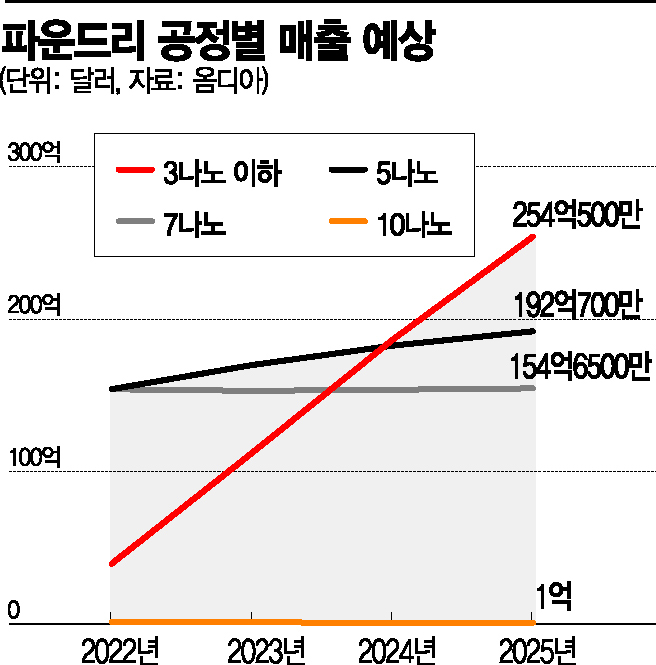
Especially in the foundry process below 10nm, where only Samsung and TSMC compete, the 10nm segment is expected to have an average annual growth rate of -9.4% until 2025, while the sub-3nm fine process is forecasted to grow rapidly at 85.6%.
An industry insider said, "TSMC, with its long foundry experience, holds a much higher overall market share because it has secured more share in processes that do not require much technological capability than Samsung," adding, "Samsung is focusing on ultra-fine processes with high growth potential based on advanced technology, presenting an opportunity to gain an advantage in the sub-3nm competition." He continued, "It will not be easy for customers to exclude Samsung, which can secure high yields through advanced mass production," and predicted, "Since Samsung's production timing is earlier, improving yield is only a matter of time."
Meanwhile, Samsung Electronics aims to secure more than 300 customers by 2026, leveraging advanced technologies such as 3nm and 2nm processes.
© The Asia Business Daily(www.asiae.co.kr). All rights reserved.
![Clutching a Stolen Dior Bag, Saying "I Hate Being Poor but Real"... The Grotesque Con of a "Human Knockoff" [Slate]](https://cwcontent.asiae.co.kr/asiaresize/183/2026021902243444107_1771435474.jpg)

















