US Treasury also signs currency swap with Mexico besides the Federal Reserve agreement
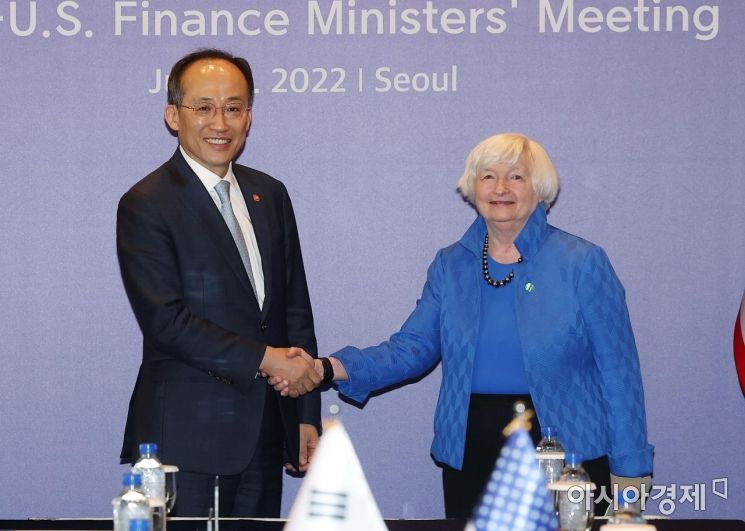 Deputy Prime Minister and Minister of Economy and Finance Choo Kyung-ho (left) and U.S. Treasury Secretary Janet Yellen shake hands at the Korea-U.S. Finance Ministers' Meeting held at Lotte Hotel in Sogong-dong, Jung-gu, Seoul on the 19th. Photo by Kim Hyun-min kimhyun81@
[Asia Economy Sejong=Reporter Kwon Haeyoung] As the won-dollar exchange rate fluctuates around 1,300 won, the government is exploring various cooperation measures that can produce similar effects beyond just renewing the currency swap agreement with the United States. The U.S. Treasury Department, separate from the Federal Reserve, directly enters into currency swaps through the Exchange Stabilization Fund (ESF) with Mexico, and our government is reportedly examining this type of foreign exchange stabilization cooperation model as well.
According to the Ministry of Economy and Finance on the 25th, in order to stabilize the won-dollar exchange rate, they are looking into cooperation measures with the U.S. government beyond the currency swap between the Bank of Korea and the U.S. Federal Reserve.
An official from the Ministry of Economy and Finance said, "There are means for the Treasury Department, not the U.S. central bank, to directly supply liquidity to stabilize the foreign exchange market," adding, "As a follow-up to the Korea-U.S. Treasury Secretary meeting, we are exploring what cooperation measures can be discussed."
At the Korea-U.S. Treasury Secretary meeting held on the 19th, both sides shared the recognition that they have the capacity to implement cooperation measures such as liquidity supply devices if necessary. This statement brings the possibility of resuming the Korea-U.S. currency swap under the Federal Reserve’s authority one step closer, while also leaving room to discuss liquidity supply measures at the Treasury Department level, according to the government.
Inside and outside the government, the case of the U.S. Treasury Department entering into a currency swap with Mexico through the Exchange Stabilization Fund (ESF) is cited as one example. The ESF is a fund accumulated by the U.S. government since 1934 to manage the dollar exchange rate, with the Treasury Secretary having considerable discretion over fund usage under presidential approval. Compared to Korea, it is similar to the 'Foreign Exchange Equalization Fund' established by the government to intervene in the foreign exchange market and manipulate foreign exchange trading to prevent sharp exchange rate fluctuations.
The U.S. Treasury Department has entered into currency swaps with Mexico through the ESF since 1941. In 1995, it supported Mexico with $12 billion (approximately 15.7 trillion won) from the ESF to stabilize the Mexican peso. When the Federal Reserve’s interest rate hikes destabilized emerging market currencies, in 2018, the currency swap scale with Mexico through the ESF was increased to $9 billion (approximately 11.8 trillion won), about three times the previous amount. This is separate from the currency swap agreements at the Federal Reserve level.
Even if the U.S. does not actually supply dollar liquidity, any form of Korea-U.S. currency swap agreement can serve as a safety net when the exchange rate continues to be unstable as it is these days. Our government has a strong will to strengthen cooperation for foreign exchange market stabilization, having requested the U.S. to renew the currency swap since the transition committee period. Accordingly, besides pushing for the Bank of Korea-Federal Reserve currency swap, various means such as foreign exchange stabilization cooperation through the ESF are being reviewed, and the government is expected to express its willingness to cooperate to the U.S. The key issue remains whether the U.S. will accept it.
An official from the Ministry of Economy and Finance said, "We plan to explore and discuss various cooperation measures with the U.S. government for foreign exchange market stabilization, but nothing has been concretized yet."
© The Asia Business Daily(www.asiae.co.kr). All rights reserved.
![Clutching a Stolen Dior Bag, Saying "I Hate Being Poor but Real"... The Grotesque Con of a "Human Knockoff" [Slate]](https://cwcontent.asiae.co.kr/asiaresize/183/2026021902243444107_1771435474.jpg)















