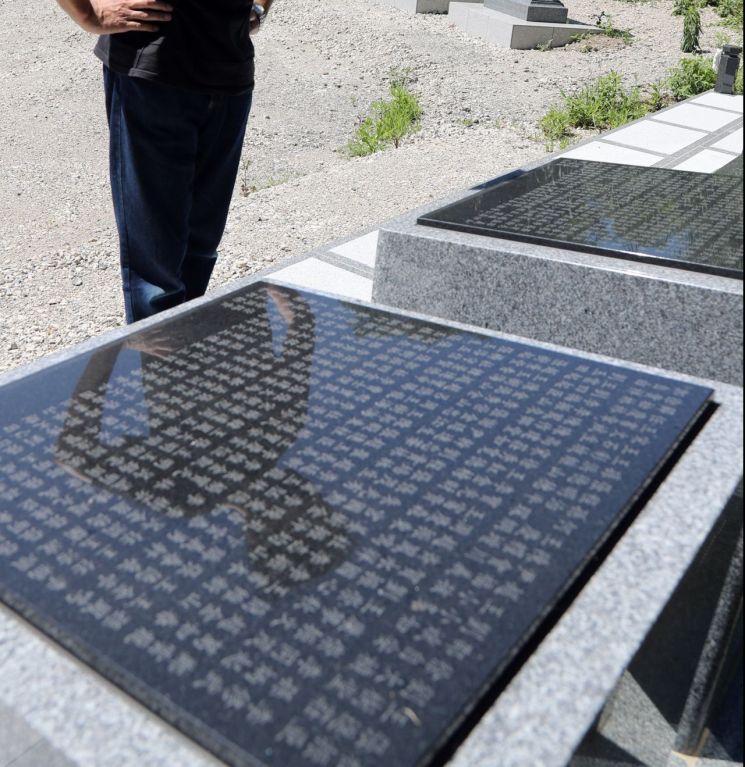
 A "Japan-China Friendship and Peace Monument" was erected in a park in Nagasaki City, Japan. This friendship monument was established as part of a project promised during the reconciliation in June 2016 between the Chinese victims forcibly taken to Hashima Island, Nagasaki Prefecture?also known as Battleship Island?and Mitsubishi Materials Corporation, one of the Mitsubishi Group's affiliates.
 [Image source=Yonhap News]
[Asia Economy Reporter Hwang Sumi] While the Japanese government denies the history of forced labor of Koreans during the Japanese colonial period, it has been confirmed that Mitsubishi, a Japanese company that forced Koreans to work on Hashima Island in the past, recently erected a friendship monument apologizing only to Chinese victims. The UNESCO World Heritage listing of Sado Mine, a site where Koreans were forcibly mobilized during the Japanese colonial period, is still being pursued since February.
In response, VANK (Voluntary Agency Network of Korea, Cyber Diplomatic Mission) announced on the 23rd that it will launch a campaign opposing Japan's UNESCO listing of Sado Mine.
Through its official blog, VANK stated, "We want to actively inform the world about the issues of Sado Mine." According to VANK, Sado Mine in Japan was a place where Koreans were forced to work during the Japanese colonial period. However, after submitting a recommendation letter for Sado Mine's listing to the UNESCO World Heritage Center in February, the Japanese government has been actively working at the government level to secure the listing.
In response, VANK produced and distributed card news opposing the listing in both Korean and English. The card news, consisting of nine pages, includes messages such as "Japan is using the World Heritage system to erase the history of Japanese imperialism," along with images depicting the disappearance of photos of Korean forced laborers during the Japanese colonial period.
This is a protest against the Japanese government's continued distortion of imperialist invasion history. Previously, in 2015, Japan registered industrial facilities such as Hashima Island, where Koreans were forced to work, with UNESCO and promised measures to inform about the history of forced labor. However, they have yet to fulfill this promise.
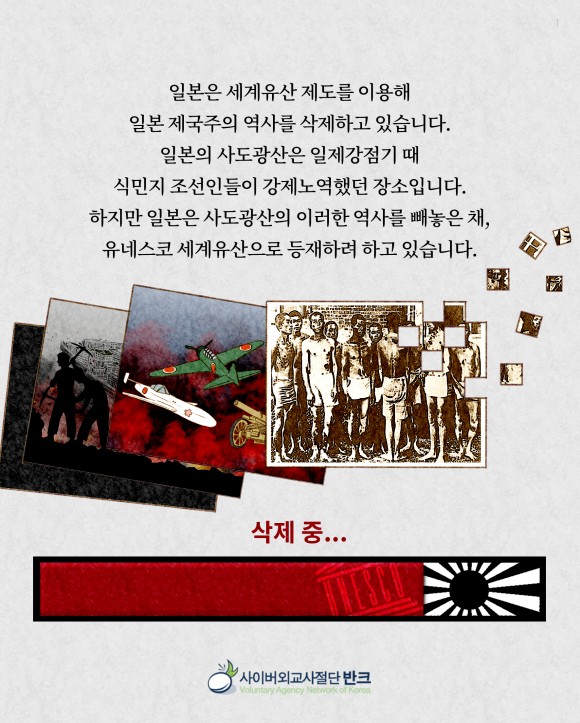 On the 23rd, VANK (Voluntary Agency Network of Korea) produced and distributed a card news opposing Japan's Sado Mine UNESCO inscription.
 [Photo by VANK official blog capture]
Recently, it was revealed that Mitsubishi Group, a Japanese company that forced Koreans to work on Hashima Island, completed the construction of a memorial monument dedicated only to Chinese victims of forced mobilization, sparking controversy.
According to Yonhap News on the 5th, a "Japan-China Friendship Peace Monument" was installed in a park on the outskirts of Nagasaki City, Japan. This monument was built as part of a project promised in June 2016 when the Chinese victims forcibly taken to Hashima Island, formerly known as Gunkanjima in Nagasaki Prefecture, reconciled with Mitsubishi Materials Corporation, one of Mitsubishi Group's affiliates.
The monument is inscribed in Japanese and Chinese with facts such as approximately 39,000 Chinese laborers being forced into labor and dying from harsh working conditions at the time.
However, there was no mention of Korean laborers. Koreans also endured forced labor and severe human rights violations on Hashima Island, making no essential difference from the Chinese victims. Nevertheless, Mitsubishi ignored the forced mobilization of Koreans and only acknowledged and apologized to the Chinese victims.
Moreover, the apology to the Chinese side contrasts with Japan's ongoing denial of the forced mobilization of Koreans. Mitsubishi Heavy Industries is known to refuse apologies and compensation to Korean forced labor victims. Previously, victims of forced mobilization during the Japanese colonial period filed lawsuits against these companies for damages, but the trials were not properly held as the Japanese side consistently remained unresponsive. Finally, on the 21st, the first hearing of the damages lawsuit was held after two years and six months since the lawsuit was filed.
Victims and their families criticized Japanese war crime companies for deliberately delaying the trial. These companies reportedly avoided receiving lawsuit documents and, when faced with the risk of losing by default judgment, hastily hired lawyers and appeared in court at the last minute.
Meanwhile, related to this issue, Professor Seo Kyung-duk criticized on social media on the 18th, stating, "(Hashima Island) is a painful historical site where Koreans were forcibly taken and made to work during the Japanese colonial period," and added, "The Japanese government's denial of the forced mobilization and forced labor of Koreans is a crime deserving divine punishment." He emphasized, "We must continuously pressure the Japanese government through global public opinion to ensure Japan acknowledges the historical facts of Korean forced labor."
© The Asia Business Daily(www.asiae.co.kr). All rights reserved.
![Clutching a Stolen Dior Bag, Saying "I Hate Being Poor but Real"... The Grotesque Con of a "Human Knockoff" [Slate]](https://cwcontent.asiae.co.kr/asiaresize/183/2026021902243444107_1771435474.jpg)
















