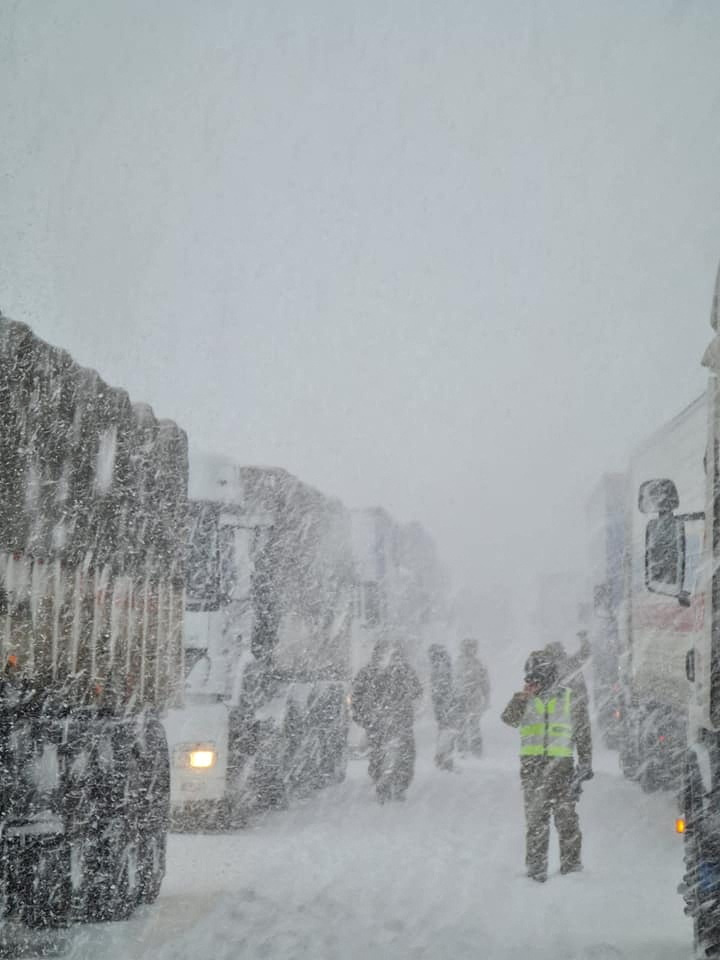
 On the 10th (local time), police officers were controlling vehicles in a snowstorm on the road in the Los Andes area of Valparaiso, a port city in South America, Chile.
 [Image source=Yonhap News]
[Asia Economy Reporter Sumi Hwang] The globe is suffering from climate change. While the Northern Hemisphere, including the United States and Europe, is sweltering in a heatwave, the Southern Hemisphere, entering midwinter, is experiencing a series of floods and heavy snow damage. Some voices express concern that the climate crisis may be worsening as global fossil fuel consumption increases due to the energy crisis triggered by the Ukraine war and other factors.
According to AFP on the 22nd (local time), a snowstorm recently hit the Los Andes area of Valpara?so, a port city in Chile, South America. Sudden heavy snowfall and subzero temperatures paralyzed transportation, with snow accumulating over 1 meter in some places, temporarily trapping about 400 people.
To manage the situation, Chilean disaster authorities and military police deployed rescue operations for those isolated and conducted snow removal using heavy equipment, normalizing vehicle traffic after about two weeks.
Notably, the Valpara?so region, which experienced the heavy snowfall, is known to have an average temperature of around 7 to 13 degrees Celsius in July. This was an unusual heavy snowfall in an area where snow rarely falls. Experts believe this occurred due to prolonged abnormal temperatures.
In another Southern Hemisphere country, Australia, severe damage occurred due to flooding. Local media such as ABC reported that since early this month, heavy rain and floods in New South Wales (NSW) in the east have displaced more than 30,000 people. According to the Australian Bureau of Meteorology, some areas between Newcastle north of Sydney and Wollongong to the south received over 1 meter of rain within 24 hours.
Meanwhile, the Northern Hemisphere, including the United States and Europe, is suffering from heatwaves. According to CNN and others, on the 19th, temperatures in the UK soared to a record high of 40.3 degrees Celsius. The heatwave caused issues at London Luton Airport’s runway, temporarily halting flights. Railway tracks exposed to the scorching sun also warped. London transport authorities announced, "Rail temperatures exceeded 48 degrees," and said, "We are painting the tracks white to prevent overheating."
 On the 18th (local time), outside Buckingham Palace in London, England, where a heatwave struck, a police officer is giving water to a royal guard wearing a bearskin hat while on duty.
 [Image source=Yonhap News]
In Texas, USA, underground water pipes burst. The city of Fort Worth in Texas attributes this to ground movement caused by high temperatures and drought. Of the 476 water pipe bursts reported in the city this year, 221 occurred within the last 90 days.
Italy is suffering from a double blow of heatwaves exceeding 40 degrees Celsius and the worst drought in 70 years. The Italian Ministry of Health issued heatwave warnings for 14 cities, including Rome and Milan. Additionally, wildfires caused by heat and drought near Caruso, Italy, spread across the border into Slovenia, damaging over 2,000 hectares.
Earlier, on the 9th, the Financial Times (FT) reported, citing Copernicus, the EU’s Earth observation agency, that the overall temperature of the European continent last month was 1.6 degrees higher than usual, making it the second highest June temperature on record.
In this context, carbon neutrality policies worldwide appear to be regressing. Originally, to combat climate change, the US, EU, and others agreed at the 26th UN Climate Change Conference of the Parties (COP26) held in Glasgow, UK, last November to phase down coal power, the main culprit of carbon emissions, but this commitment is reportedly not being upheld.
According to the Wall Street Journal (WSJ), major global economies such as the US, Europe, and China are increasing fossil fuel use due to the energy crisis caused by shortages of natural gas and oil following the Ukraine conflict.
The US increased coal power generation after experiencing an early heatwave last month. China, the world’s largest coal consumer, is also expanding coal production and power generation to secure sufficient electricity supply. India is raising its coal dependency as energy demand grows.
The WSJ pointed out that the revival of coal, which emits about twice as much carbon dioxide as natural gas when burned, could nullify international efforts to return global temperatures to pre-industrial levels by the end of this century.
© The Asia Business Daily(www.asiae.co.kr). All rights reserved.
![Clutching a Stolen Dior Bag, Saying "I Hate Being Poor but Real"... The Grotesque Con of a "Human Knockoff" [Slate]](https://cwcontent.asiae.co.kr/asiaresize/183/2026021902243444107_1771435474.jpg)
















