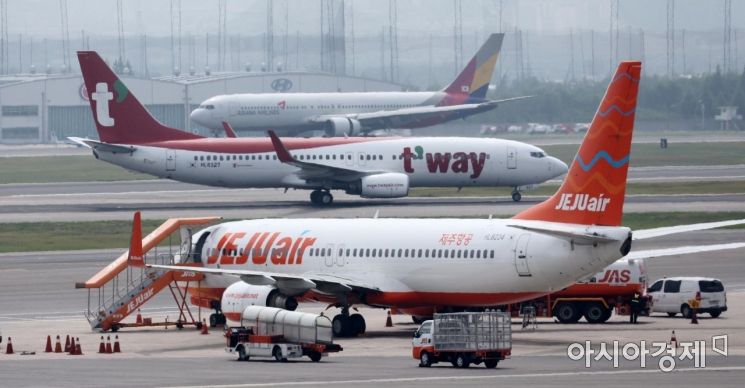
[Asia Economy Reporter Yoo Hyun-seok] The polarization between full-service carriers (FSC) and low-cost carriers (LCC) in the aviation industry is expected to deepen in the second quarter. FSCs are projected to show noticeable performance improvements due to continued strong cargo demand and the resumption of some long-haul routes. On the other hand, LCCs are expected to face headwinds as operating losses widen due to high fuel prices and the continued closure of routes to China and Japan. However, from the second half of the year, performance improvements are anticipated with the increase in international flights.
According to FnGuide, a financial information company, securities firms estimate that Korean Air's second-quarter revenue and operating profit will be 3.1 trillion KRW and 543.1 billion KRW, respectively. This represents a 54% increase in revenue and a 180.6% increase in operating profit compared to the same period last year. Korean Air's performance outlook continues to rise, with revenue projections up 5.35% and 9.54%, and operating profit projections up 48.71% and 19.57% compared to one month and three months ago, respectively. Asiana Airlines is also expected to record revenue of 1.349 trillion KRW and operating profit of 66 billion KRW, up 36.95% and 18.07%, respectively, over the same period.
The strong performance of FSCs is largely due to robust cargo operations. According to NH Investment & Securities and Incheon International Airport Corporation, Korean Air and Asiana Airlines transported 360,706 tons and 157,432 tons of cargo in the second quarter, respectively. Although these figures represent decreases of 9.24% and 11.83% compared to the same period last year, they remain at high levels compared to 2020.
The reopening of international routes is also a positive factor. Last month, the number of international passengers at nationwide airports increased by 418% year-on-year to 1.287 million. Domestic passengers also rose 6% to 3.23 million during the same period. Korean Air and Asiana Airlines transported 359,074 and 253,190 international passengers last month, marking increases of 343.2% and 398.9%, respectively, compared to the previous year.
In contrast, the outlook for LCCs is bleak. Jin Air is expected to record second-quarter revenue of 123.3 billion KRW and an operating loss of 29.8 billion KRW. While revenue is projected to increase by 94.59% year-on-year and operating losses are expected to decrease, the loss is larger than the 25.5 billion KRW operating loss forecasted one month ago.
Other LCCs show similar trends. Jeju Air and T'way Air are expected to post second-quarter revenues of 163.1 billion KRW and 113.1 billion KRW, up 117.08% and 99.19% year-on-year, respectively. Operating losses are forecasted at 48 billion KRW and 24.7 billion KRW, down from the previous year. However, many have revised their forecasts to expect larger deficits than previously anticipated.
This is largely attributed to soaring jet fuel prices. Fuel costs account for 30% of airline revenues. With jet fuel prices averaging $143 per barrel in the second quarter and remaining at high levels, this poses a significant burden on LCCs, which have weaker cargo operations. The slow recovery of short-haul routes, especially to China and Japan, further delays performance improvements in the second quarter.
An industry insider said, "Full-service carriers are expected to perform well due to cargo and international passenger recovery," but added, "LCCs will likely continue to struggle as short-haul route recovery remains slow." The insider also noted, "From the third quarter, performance is expected to improve with the peak season and international route recovery."
Meanwhile, airlines are actively recalling employees who were on leave due to the expansion of international flights. According to the industry, Korean Air's leave rate this month is reported to be below 20%. Jeju Air has reinstated about 630 flight crew members starting this month in preparation for expanded international operations, and T'way Air's leave rate is also reported to be in the 15% range. All 1,900 employees are expected to return next month.
© The Asia Business Daily(www.asiae.co.kr). All rights reserved.
![Clutching a Stolen Dior Bag, Saying "I Hate Being Poor but Real"... The Grotesque Con of a "Human Knockoff" [Slate]](https://cwcontent.asiae.co.kr/asiaresize/183/2026021902243444107_1771435474.jpg)















