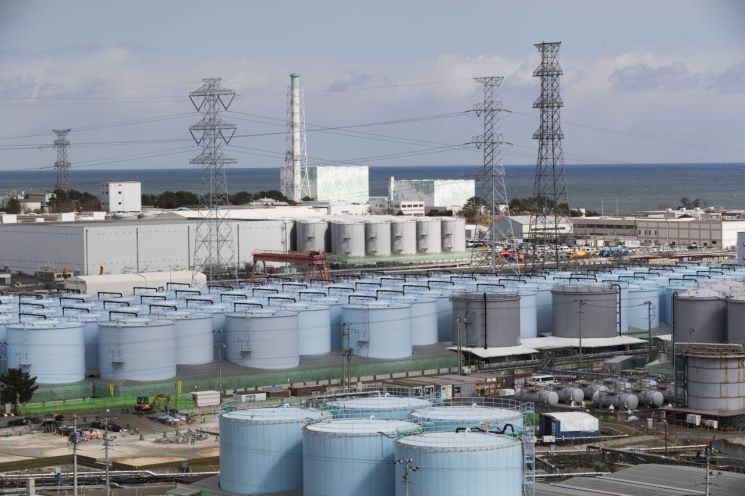
[Asia Economy Reporter Park Byung-hee] The Nuclear Regulation Authority of Japan announced on the 22nd that there are no safety issues with Tokyo Electric Power Company's (TEPCO) plan to release treated water from the Fukushima Daiichi Nuclear Power Plant into the ocean, granting approval for the plan, according to Kyodo News.
The Nuclear Regulation Authority approved the plan submitted by TEPCO in May of this year, and after hearing public opinions, officially authorized the plan on this day, stating that "there are no safety issues." With the completion of the approval process by the Nuclear Regulation Authority, TEPCO plans to begin construction of facilities for the discharge of contaminated water after obtaining consent from the relevant local governments. TEPCO intends to release the contaminated water (referred to as "treated water" by the Japanese government) into the sea about 1 km offshore from the Fukushima Daiichi Nuclear Power Plant using an undersea tunnel.
Earlier, the Japanese government decided in April last year to treat the contaminated water from the Fukushima nuclear plant with the Advanced Liquid Processing System (ALPS), dilute it with seawater to reduce the concentration of the radioactive substance tritium below the standard level, and then discharge it. TEPCO, the plant operator, applied for a review of this plan to the Nuclear Regulation Authority in December last year.
The Japanese government and TEPCO aim to start the discharge from next spring, but local fishermen's groups and others still strongly oppose the plan.
While ALPS can remove 62 types of radioactive substances including cesium when purifying the contaminated water, tritium cannot be filtered out.
© The Asia Business Daily(www.asiae.co.kr). All rights reserved.
![Clutching a Stolen Dior Bag, Saying "I Hate Being Poor but Real"... The Grotesque Con of a "Human Knockoff" [Slate]](https://cwcontent.asiae.co.kr/asiaresize/183/2026021902243444107_1771435474.jpg)
















