Opposition: "Intending to Cut Taxes for Chaebols, Large Corporations, and the Wealthy"
Corporate Tax and Comprehensive Real Estate Tax Likely to Retreat Significantly Compared to Government Proposal... Income Tax Reform Seen as Positive
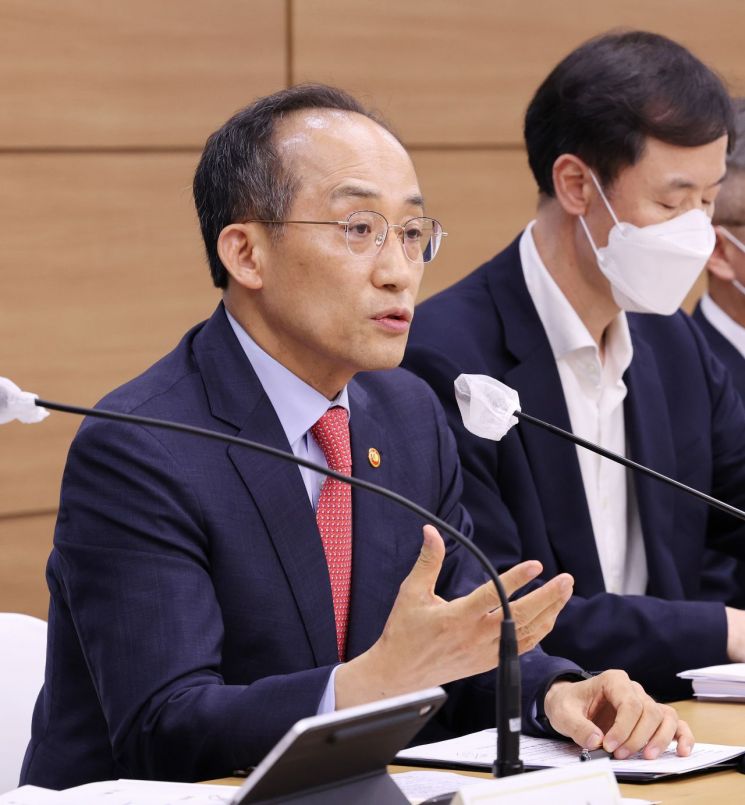
[Asia Economy Sejong=Reporter Kwon Haeyoung] Although the government has announced a tax cut policy exceeding 13 trillion won, the largest since the MB administration, actual legislation is expected to face difficulties. The new administration has clearly revealed its tax cut stance through measures such as lowering the corporate tax rate, which is high compared to the global average, and normalizing the comprehensive real estate tax that had turned into a punitive measure. However, the main opposition party is sharply criticizing it as a "tax cut for the rich," making it inevitable that the government’s proposal will significantly retreat during the National Assembly discussions.
According to the Ministry of Economy and Finance on the 22nd, the 2022 tax reform plan announced the previous day requires amendments to a total of 18 laws, including the Corporate Tax Act, Inheritance and Gift Tax Act, Income Tax Act, Comprehensive Real Estate Tax Act, and Restriction of Special Taxation Act. This number exceeds the 16 laws targeted for amendment in the tax reform plan introduced in the first year of the MB administration, which clearly showed a tax cut stance. It also surpasses the 17 laws under the Park Geun-hye administration and the 13 laws under the Moon Jae-in administration announced in their first years.
Through this tax reform plan, the government has revealed a clear stance of "private-led growth" through tax cuts and deregulation. However, the core policies such as lowering the corporate tax rate (top rate from 25% to 22%) and the comprehensive real estate tax (from 6% to 2.7%) all require legal amendments, which is problematic. The Democratic Party, holding a majority with 169 seats, has already declared its intention to block the passage of the law, criticizing it as a tax cut for the wealthy. Kim Seong-hwan, the policy chief of the Democratic Party, held a press conference immediately after the government’s announcement of the tax reform plan and sharply criticized it as "cutting taxes for conglomerates, large corporations, and the wealthy." The Democratic Party opposes the reform of the comprehensive real estate tax and the reduction of the top corporate tax rate.
According to the Ministry of Economy and Finance, if this tax reform plan is realized, tax revenue is expected to decrease by 13.1 trillion won. By tax item, corporate tax revenue will decrease by 6.8 trillion won, of which large corporations will see a reduction of about 4.1 trillion won, and small and medium-sized enterprises about 2.4 trillion won. The comprehensive real estate tax will decrease by 1.7 trillion won. Since the reduction in corporate tax from large corporations and comprehensive real estate tax, mainly borne by high-income earners, is expected, persuading the Democratic Party is anticipated to be difficult. This is why a retreat from the government’s proposal is expected.
Previously, the Lee Myung-bak administration also pursued a reduction in tax rates across all four income brackets in 2008, but postponed the implementation twice for the highest income bracket exceeding 88 million won and eventually abandoned it. The decisive factor was that even the ruling party felt burdened by the tax cut on income tax due to the "tax cut for the rich" frame.
Therefore, conflicts over key issues are expected during the National Assembly discussions. Regarding the income tax reduction included in this tax reform plan, it mainly consists of raising the lower two income brackets to reduce the tax burden on low- and middle-income earners and reducing the earned income tax credit limit for those earning over 120 million won, so the passage of the law is expected to proceed smoothly.
© The Asia Business Daily(www.asiae.co.kr). All rights reserved.
![Clutching a Stolen Dior Bag, Saying "I Hate Being Poor but Real"... The Grotesque Con of a "Human Knockoff" [Slate]](https://cwcontent.asiae.co.kr/asiaresize/183/2026021902243444107_1771435474.jpg)











