Minor Adjustments Ended for Income Tax... Tax Cuts Minimal Compared to Inflation Rate
[Asia Economy Sejong=Reporter Son Seon-hee] As the government is pushing for a tax reform policy of ‘super tax cuts’ that will reduce national revenue by more than 13 trillion won starting next year, it has been revealed that the income tax reform for workers is only minor. Amid growing criticism that real income has decreased due to steep inflation, the government has undertaken income tax reform for the first time in 15 years, but evaluations suggest it falls short of workers’ expectations. The expansion of the excessive exemption rate, a chronic problem of earned income tax, has also become a point of controversy.
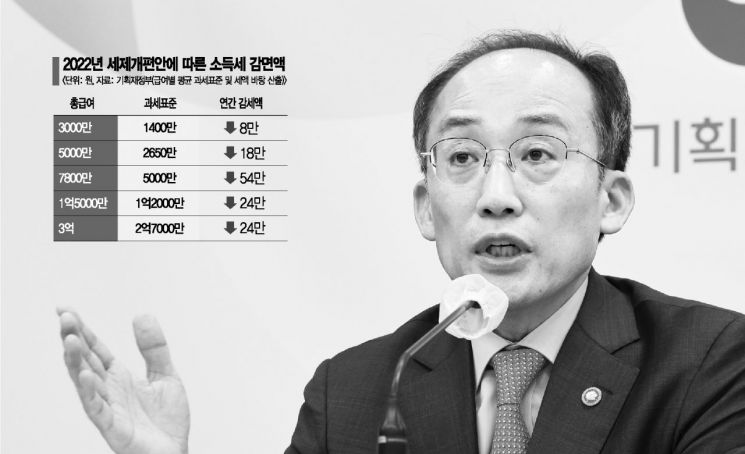
According to the ‘2022 Tax Reform Plan’ announced by the Ministry of Economy and Finance on the 21st, the current income tax reform raises the upper limit of the taxable standard to which the lowest tax rate (6%) applies by 2 million won (from 12 million to 14 million won), and adjusts the upper limit of the next bracket (15%) by 4 million won (from 46 million to 50 million won).
Applying the tax rates according to the revised taxable income brackets, a single-earner household earning 78 million won annually is estimated to reduce its tax burden by up to 540,000 won. This amounts to about 45,000 won less per month. For an income earner of 50 million won per year, the tax reduction is 180,000 won, which translates to only 15,000 won per month. Although the government stated it would reduce the tax burden on low- and middle-income earners due to high oil prices and inflation, the actual reduction is far below the inflation rate. Since June 2008, when the income tax brackets were last adjusted, the inflation rate until June this year has been 31.9%. Given that inflation was the original reason for the need to reform income tax, if the tax had been adjusted accordingly, the tax relief would have been greater.
At least, as a measure against high inflation, the government expanded the income tax exemption limit for meal allowances from 100,000 won to 200,000 won, but this is also considered to have little impact on office workers’ perception. For example, a worker receiving a monthly meal allowance of 200,000 won is estimated to benefit about 180,000 won annually if average income and tax deductions are applied for workers earning between 40 million and 60 million won per year, and about 290,000 won for those earning 80 million won annually.
There are also criticisms that the expansion of the exemption rate contradicts the principle of ‘universal taxation’ that all citizens should pay taxes. The existing earned income tax exemption rate was about 37.2% (as of 2020), and this reform is expected to increase that rate by about 1%. Regarding this, Ko Gwang-hyo, Director of the Tax Policy Bureau, explained, “This is only a temporary increase, and in the mid- to long-term, it is expected to continuously decline by 2% annually.”
Meanwhile, along with the minor income tax reform, the government relaxed the asset requirements for earned income and child tax credits for low-income households from 200 million won to 240 million won. The earned income tax credit was increased by about 10% for each household type, and the child tax credit is planned to be increased by 100,000 won to 800,000 won compared to before.
© The Asia Business Daily(www.asiae.co.kr). All rights reserved.
![Clutching a Stolen Dior Bag, Saying "I Hate Being Poor but Real"... The Grotesque Con of a "Human Knockoff" [Slate]](https://cwcontent.asiae.co.kr/asiaresize/183/2026021902243444107_1771435474.jpg)















