UK Records 40.3 Degrees... Highest in History
"Extreme Situations Have Become Reality Due to Climate Change"
 On the 19th, Network Rail, the UK rail infrastructure organization, announced that the temperature of the railway tracks soared up to 62 degrees Celsius. The tracks can become about 20 degrees hotter than the air temperature, which can cause expansion, bending, and damage to the rails. Photo by Network Rail Twitter capture.
[Asia Economy Reporter Yoon Seul-gi] The United Kingdom has been thrown into chaos by the worst heatwave in its history. The extreme heat has caused fires that disrupted train operations, as well as warped railway tracks and melted road surfaces. London fire authorities have declared a 'major incident' and are responding accordingly.
According to the UK Met Office on the 19th (local time), the temperature in Coningsby, Lincolnshire, in central England, reached 40.3 degrees Celsius as of 4 p.m. The temperature in the Heathrow area of central London also soared to 40.2 degrees around 1 p.m. This is the first time London’s temperature has exceeded 40 degrees this year. The previous highest temperature was 38.7 degrees in Cambridge during the summer of 2019.
Accidents caused by the heatwave have occurred one after another. The extreme heat caused railway tracks to warp and road surfaces to melt and bulge upwards. Network Rail, the UK’s railway infrastructure operator, reported that track temperatures in Suffolk reached as high as 62 degrees Celsius. Due to the heat generated by fast-moving trains, Network Rail limited train speeds for safety reasons.
Fires caused by sagging high-voltage power lines also led to railway service suspensions. London Mayor Sadiq Khan appealed on Twitter, saying, "London Fire Brigade has declared a 'major incident.' Please do everything you can to prevent fires."
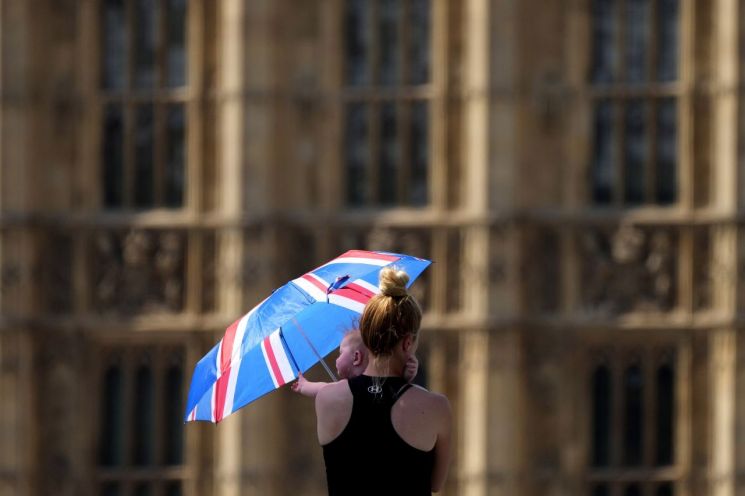 On the 9th (local time), a mother is using a parasol to protect her baby from the scorching sunlight on Westminster Bridge in London, UK. On this day, temperatures in the UK exceeded 40 degrees Celsius, setting a new historical record. [Image source=AP Yonhap News]
In response to the situation, the UK declared a national emergency on the 15th. Many schools were closed, and most train and subway services were canceled or reduced.
However, damage from the heatwave is expected to continue. This is because very few homes in the UK are equipped with air conditioning. According to local media, only about 3 to 5% of households have cooling facilities.
Steven Belcher, Chief Scientific Officer at the UK Met Office, told the BBC, "According to Met Office research, it was virtually impossible for UK temperatures to reach 40 degrees. However, due to climate change caused by greenhouse gases, extreme situations have become a reality."
Meanwhile, the World Meteorological Organization (WMO) forecasted that temperatures will remain higher than usual until mid-next week. Robert Stefanowski, Head of the WMO Applied Climate Services Division, said at a press conference held at the Geneva Secretariat on the 19th (local time) regarding the heatwave across Europe, "According to current weather model analyses, the heatwave in Europe is expected to peak today, Tuesday. Temperatures exceeding normal levels are expected to continue across Europe until mid-next week."
© The Asia Business Daily(www.asiae.co.kr). All rights reserved.
![Clutching a Stolen Dior Bag, Saying "I Hate Being Poor but Real"... The Grotesque Con of a "Human Knockoff" [Slate]](https://cwcontent.asiae.co.kr/asiaresize/183/2026021902243444107_1771435474.jpg)
















