Surge in Reservations for Ultra-Compact Electric Vehicles Highlights Urgent Need to Resolve Key Parts Supply
Commitment to Using Verified Parts for Quality Maintained Despite Increased Costs
Domestic Production Plant Expansion Under Review with Upcoming Launches of Two-Wheelers and Cargo Models
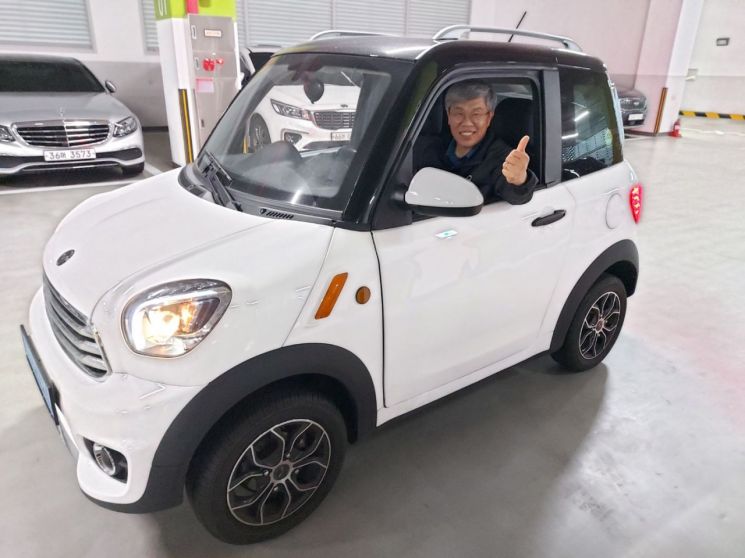 Kim Jong-bae, CEO of Maibeu, smiling while driving the ultra-compact electric vehicle 'Maibeu.' This photo was taken at the request of readers to capture a rare smile from CEO Kim, who seldom smiles.
 [Photo by Kim Jong-hwa]
[Asia Economy Reporter Kim Jong-hwa] "A production line with a capacity of 200 units per month only produced 10 units in July."
Small and medium-sized automobile manufacturers struggling to obtain parts due to soaring international raw material prices are feeling the heat. The ultra-compact electric vehicle 'Maibeu,' which costs only 40,000 KRW per month for maintenance?just one-tenth of the maintenance cost of conventional compact cars?is gaining popularity, but Kim Jong-bae, CEO of Maibeu, cannot smile.
With gasoline prices exceeding 2,000 KRW per liter, ultra-compact electric vehicles are gaining attention for short-distance deliveries and commuting. Maibeu, a leader in the ultra-compact electric vehicle market, currently has over 300 people on the waiting list as of the 21st. Although 2 to 3 people reserve Maibeu vehicles daily, the delivery schedule is uncertain, and customers are being asked to "please wait a little longer."
CEO Kim explained, "The global parts supply chain, including China, is in crisis. Even if one bolt is missing, the car cannot be made, so production has almost stopped this month." He added, "We are doing everything possible to secure parts, but it is difficult to obtain parts with verified quality."
In particular, the supply of key parts such as the OBC (On Board Charger) urgently needs to be resolved. The OBC is a component that converts alternating current (AC) power to high-voltage direct current (DC) to charge the battery. However, it is also one of the parts with the highest defect rates, so suppliers are rarely changed. Despite this, as supply has reached its limit, they are sourcing parts from multiple suppliers to continue vehicle production, but the situation remains difficult.
Maibeu uses verified products even if they are expensive because the quality of parts determines vehicle safety. Due to the surge in raw material prices, the battery pack price has increased by 30%, and the unit price of key parts has risen by about 20%, increasing cost burdens by more than 40% compared to before. However, this is a principle they do not give up for safety.
CEO Kim stated, "A 100-won part must be purchased for 100 won. If you buy it for 90 won, there will definitely be a 10-won problem." He emphasized, "There can be no compromise regarding the quality of parts directly related to vehicle safety."
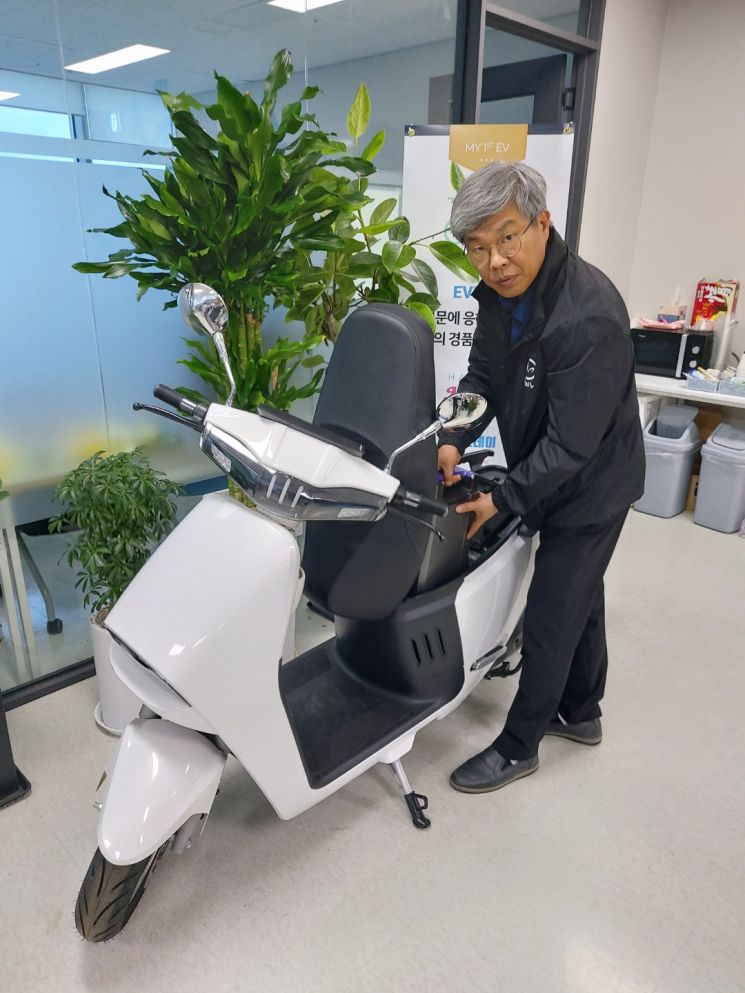 CEO Kim Jong-bae exchanging the battery of the upcoming electric two-wheeler 'Myve D1'.
 [Photo by Kim Jong-hwa]
Ultra-compact electric vehicles, smaller than compact cars, have a maximum rated output of 15 kW or less, engine displacement of 250cc or less, weight of 600 kg or less (passenger vehicles), and a speed of 80 km/h or less, accommodating two passengers. In particular, Maibeu has received the 'EU L7 certification,' proving its safety in crash tests. According to CEO Kim, the vehicle maintenance cost is only 40,000 KRW per month even when driving more than 100 km per day. The first model, 'M1,' can travel 100 km on a single charge costing 1,730 KRW. In contrast, a gasoline compact car cannot travel more than 20 km on 1,730 KRW worth of gasoline.
Its small size makes driving and parking convenient, there are no acquisition or registration taxes, and the annual automobile tax is about 130,000 KRW. Parking fees are half price, and the only consumable is brake oil, which needs occasional replacement. With subsidies from local governments, it can be purchased for 8 to 9 million KRW. However, due to increased cost burdens, the vehicle price rose about 8% from 17.49 million KRW to 18.92 million KRW starting this month, which is a burden for consumers.
Maibeu plans to release the 'M2,' which applies Korea's first battery swapping technology and extends driving range by about 50%, and the 'M3,' equipped with a wireless charging system, by the end of this year and next year, respectively. They are also developing and testing a cargo model capable of large-volume freight transport. Additionally, development is complete for the delivery-only single-seater 'Maibeu Mini,' electric two-wheeler 'Maibeu D1,' tourist-type three-wheeled electric bicycle 'Maibeu T1,' and battery-swappable electric bicycle 'Maibeu B1.'
With increasing orders, they are considering expanding production facilities at either Gyeongsan or Gimcheon in Gyeongbuk Province, following the Incheon Songdo factory. CEO Kim hopes that parts supply will improve from next month and expects to surpass 1,000 cumulative sales this year.
© The Asia Business Daily(www.asiae.co.kr). All rights reserved.
![Clutching a Stolen Dior Bag, Saying "I Hate Being Poor but Real"... The Grotesque Con of a "Human Knockoff" [Slate]](https://cwcontent.asiae.co.kr/asiaresize/183/2026021902243444107_1771435474.jpg)
















