[Asia Economy Reporter Park Byung-hee] With the reopening of the Black Sea export ports that were blocked following the outbreak of the Ukraine war, there are expectations that exports of key Ukrainian grains, including wheat, will resume this week.
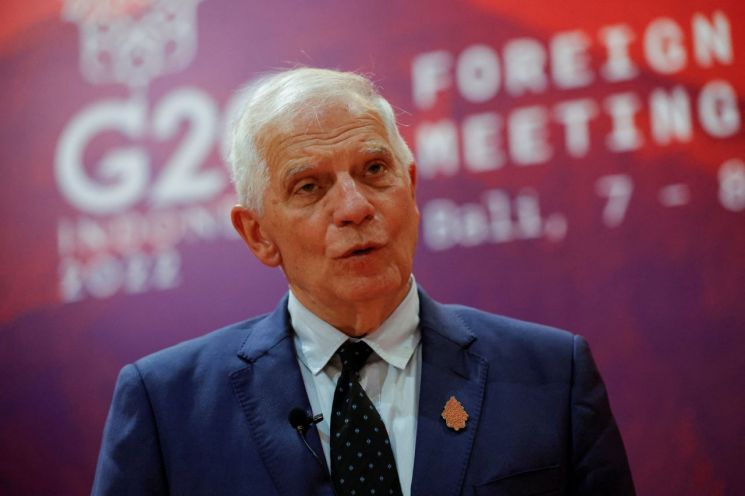
According to major foreign media on the 18th (local time), Josep Borrell, the EU High Representative for Foreign Affairs and Security Policy, said at the EU Foreign Ministers' meeting held in Brussels, Belgium, that day, "We expect an agreement between Ukraine and Russia to lift the blockade on Black Sea port cities such as Odesa this week." It is reported that Russia and Ukraine are close to an agreement allowing cargo ships to safely navigate the Black Sea under mutual supervision.
It is estimated that the amount of Ukrainian wheat currently stuck around the Black Sea is between 20 million and 25 million tons. Ukraine is a major exporter accounting for 9% of the global wheat market, with wheat exports reaching 18 million tons in 2020. Ukraine exported large quantities of grain through the Black Sea. Before the war, Ukraine exported 5 to 6 million tons of grain monthly through six Black Sea ports in the Odesa region. After the war broke out and the Black Sea was blocked, Ukrainian grain exports sharply declined, leading to severe food inflation. There were concerns that tens of thousands of people in Africa could lose their lives due to famine.
High Representative Borrell said, "The lives of tens of thousands depend on this agreement," adding, "This is not a diplomatic issue but a matter of life and death for many."
Discussions to resume grain exports through the Black Sea have steadily progressed over the past few weeks. Notably, significant progress was made during negotiations between Russia and Ukraine mediated by the United Nations in Istanbul, Turkey, on the 13th. An EU official stated that ahead of the EU Foreign Ministers' meeting, Ukrainian Foreign Minister Dmytro Kuleba would report on the progress of negotiations among Ukraine, Russia, and Turkey to resume grain exports.
Russian President Vladimir Putin is scheduled to visit Iran on the 19th and meet Turkish President Recep Tayyip Erdo?an in Tehran. It is expected that Putin and Erdo?an will exchange views on Black Sea grain exports.
The EU is reportedly set to clearly state that in exchange for Russia agreeing to Black Sea grain exports, Russian grain and food products will be exempted from sanctions.
Countries in the Middle East and Africa, suffering from severe food shortages, have claimed that EU sanctions have worsened the food crisis by affecting Russian grain exports. While the EU has previously refuted these claims, it has recently acknowledged that there may be some impact. An EU official said, "The EU has never imposed sanctions on agricultural products," but added, "However, because the sanctions are complex, they may have affected some Russian grain exports." The official emphasized, "It must be clear that food supply should not be disrupted."
At the EU Foreign Ministers' meeting, it is reported that the issue of applying exceptions to food products among the prohibited transactions with Russian state-owned enterprises was discussed. The EU is expected to make it clear that it will not take any sanctions measures that could exacerbate the global food crisis, including those related to Russian agricultural products and food.
© The Asia Business Daily(www.asiae.co.kr). All rights reserved.
![Clutching a Stolen Dior Bag, Saying "I Hate Being Poor but Real"... The Grotesque Con of a "Human Knockoff" [Slate]](https://cwcontent.asiae.co.kr/asiaresize/183/2026021902243444107_1771435474.jpg)















