Meeting with Deputy Prime Minister Choo Kyung-ho and Bank of Korea Governor Lee Chang-yong
Finance Ministers' Meeting This Afternoon
Yellen Likely to Push for South Korea's Participation in Russian Oil Price Cap
Focus on Foreign Exchange Market Cooperation Message
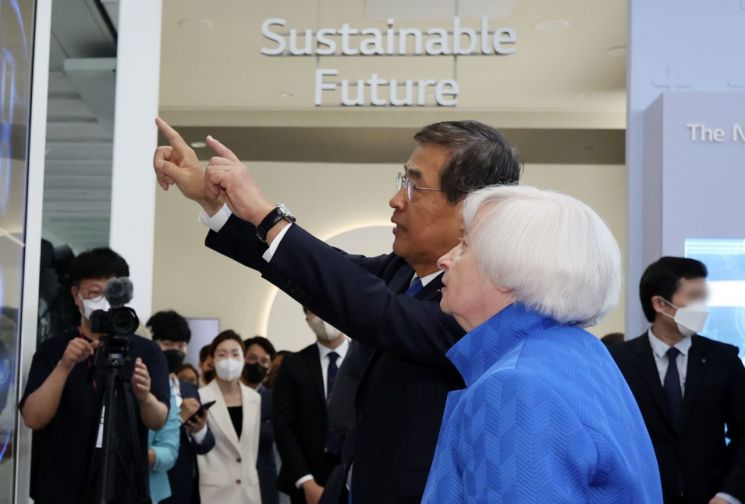
[Asia Economy Reporter Seo So-jeong, Sejong=Reporter Son Seon-hee] On the 19th, Deputy Prime Minister and Minister of Economy and Finance Choo Kyung-ho will hold the first Korea-US Finance Ministers' Meeting since taking office with Janet Yellen, the US Secretary of the Treasury, who is visiting Korea. This is the first visit by a US Treasury Secretary to Korea in about six years since 2016, and it is Yellen's first visit to Korea since she took office early last year.
During this visit, Secretary Yellen will pay a courtesy call on President Yoon Suk-yeol and discuss additional sanctions on North Korea, global supply chain issues, and more. She also plans to meet with Lee Chang-yong, Governor of the Bank of Korea.
Deputy Prime Minister Choo and Secretary Yellen will discuss ▲ global and Korean economic trends and outlook ▲ response to the Ukraine war ▲ foreign exchange market trends and cooperation ▲ climate finance ▲ global health at the first Korea-US Finance Ministers' Meeting to be held at Lotte Hotel in Jung-gu, Seoul, in the afternoon.
Both Korea and the US are currently facing difficulties due to steep inflation. At this meeting, Secretary Yellen is expected to reiterate the necessity of introducing a price cap on Russian crude oil and encourage Korea's participation. This measure is both a sanction against Russia, which initiated the war, and a solution to increase oil supply to control the rise in international oil prices, which is considered a major cause of inflation. The two finance ministers already held a conference call on the 1st (Korean time) to discuss this issue, and Deputy Prime Minister Choo expressed consensus on the purpose of the introduction.
Prior to the Korea-US Finance Ministers' Meeting, Secretary Yellen will also hold a bilateral meeting with Governor Lee Chang-yong of the Bank of Korea. Following the agreement on 'cooperation for foreign exchange market stability' at the Korea-US summit in May, and with recent increased volatility in the foreign exchange market, the key focus is whether concrete discussions on concluding a Korea-US currency swap will take place. Since the currency swap would be between the Bank of Korea and the US Federal Reserve (Fed), it is unlikely that the swap agreement will be concluded during Yellen's visit, but there is growing anticipation that a message of cooperation related to the foreign exchange market may be announced.
On the day, the won-dollar exchange rate opened at 1,318.0 won, up 0.6 won from the previous day's closing price, fluctuating between 1,317 and 1,319 won in the early session. Moon Hong-chul, a researcher at DB Financial Investment, predicted, "Assuming export growth slows down by the end of this year, the won-dollar exchange rate could rise to 1,370 won."
Experts emphasize the necessity of concluding a Korea-US currency swap to prepare for increased volatility in the foreign exchange market. The won-dollar exchange rate has surged to its highest level in 13 years and 2 months, continuously hitting new highs this month and maintaining a sharp upward trend. Kim Jung-sik, Professor Emeritus of Economics at Yonsei University, said, "As the exchange rate rises, foreign stock investment outflows accelerate, so stabilizing the exchange rate is an urgent task. The foreign exchange authorities should resume the Korea-US currency swap, which ended late last year, to reduce concerns about foreign exchange supply."
The recent sharp rise in the won-dollar exchange rate has also raised concerns as foreign exchange authorities have intervened to defend the exchange rate, causing a significant decrease in foreign exchange reserves. As of the end of June, Korea's foreign exchange reserves stood at $438.28 billion, down $9.43 billion from the end of the previous month. This is the largest decline in 13 years and 7 months since November 2008 (-$11.75 billion) during the global financial crisis.
Park Sang-hyun, a researcher at Hi Investment & Securities, said, "While the Korea-US currency swap could reduce market anxiety, it is difficult to expect a trend reversal. However, if the currency swap is actually concluded, the won-dollar exchange rate could temporarily fall to the 1,200 won range."
© The Asia Business Daily(www.asiae.co.kr). All rights reserved.
![Clutching a Stolen Dior Bag, Saying "I Hate Being Poor but Real"... The Grotesque Con of a "Human Knockoff" [Slate]](https://cwcontent.asiae.co.kr/asiaresize/183/2026021902243444107_1771435474.jpg)















