Chairperson Team of Future Network Research Group Secures Total of 11 Seats
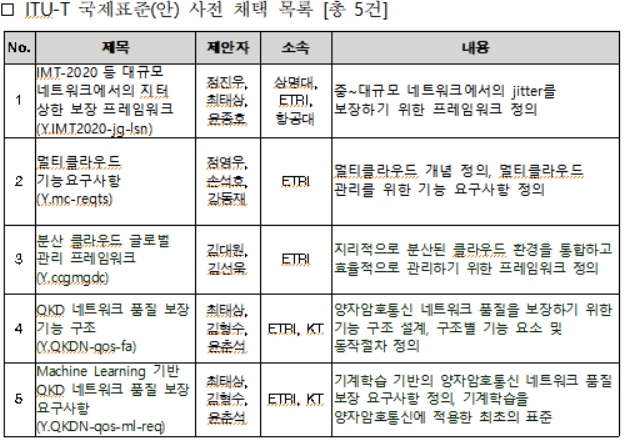
[Asia Economy Reporter Lim Hye-seon] The National Radio Research Agency under the Ministry of Science and ICT announced on the 18th that five draft international standards related to 5G, cloud computing, and quantum cryptography communication, developed under South Korea's leadership, were pre-adopted at the International Telecommunication Union Telecommunication Standardization Sector (ITU-T) Future Networks Study Group (SG13) meeting held in Geneva, Switzerland until the 15th. Additionally, South Korea secured 11 seats in the SG13 international chairmanship.
The standard for the "5G (IMT-2020) Jitter Upper Bound Guarantee Framework in Large-Scale Networks" prevents data delay in large-scale networks to provide stable and deterministic services. Based on this, it is expected to contribute to the activation of industries related to ultra-low latency services in 5G, the Internet, metaverse, and more.
The "Multi-Cloud Functional Requirements" standard is an achievement of South Korea leading the world's first development of multi-cloud technology standards, providing the concept and functional requirements of multi-cloud. The "Distributed Cloud Global Management Framework" standard defines the requirements for distributed cloud, a core application technology of 5G. These two standards are expected to form an expanded new market in the existing cloud computing environment and serve as a guide for it.
The standards for "Quantum Key Distribution Network (QKDN) Network Quality Assurance Functional Architecture" and "Machine Learning-Based QKDN Network Quality Assurance Requirements" include technologies for ensuring the quality of quantum cryptography communication networks, which are attracting attention as future secure communication technologies. They are expected to greatly assist in the commercialization through the construction of quantum cryptography communication networks using these technologies and service quality evaluation in the future.
Meanwhile, following the World Telecommunication Standardization Assembly (WTSA) held in March, a new study period (2022-2024) began, and the reorganization of the chairmanship of the organizations under the Future Networks Study Group (3 working groups, 13 research task groups, etc.) was also discussed. South Korea secured 11 seats in the SG13 chairmanship, with 9 seats reappointed, and achieved additional entry into 2 seats including the chairmanship of the Cloud & Big Data working group and the Machine Learning Joint Coordination Group (JCA-ML), newly established under South Korea's leadership.
© The Asia Business Daily(www.asiae.co.kr). All rights reserved.
![Clutching a Stolen Dior Bag, Saying "I Hate Being Poor but Real"... The Grotesque Con of a "Human Knockoff" [Slate]](https://cwcontent.asiae.co.kr/asiaresize/183/2026021902243444107_1771435474.jpg)















