'Youth Targeted' Product Offering Up to 14.4 Million KRW + α
"Loan Interest Reduced Plus Savings Benefits"... Dissatisfaction Among 40s and 50s
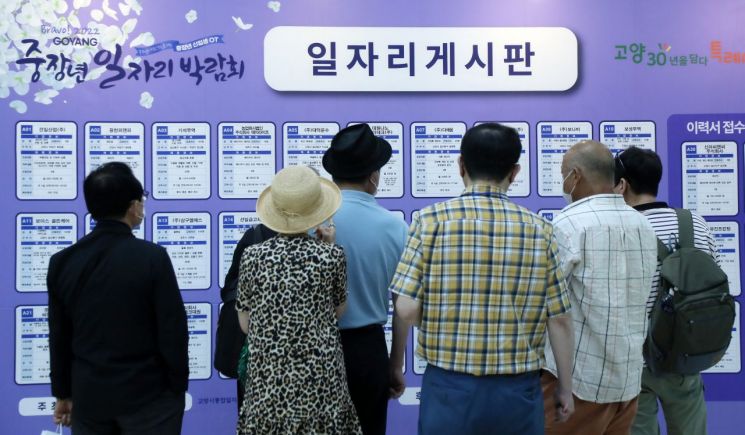 On the 14th of last month, citizens visiting the Middle-aged and Senior Job Fair held at the Goyang Flower Exhibition Hall in Ilsan, Goyang-si, Gyeonggi-do, are looking for job information on the job bulletin board. [Image source=Yonhap News]
[Asia Economy Reporter Yoon Seul-gi] As the government expands support for the relatively economically vulnerable younger generation, dissatisfaction is growing among the 40s and 50s generations who have been excluded from various policies. While young people receive financial benefits such as loan interest reductions, repayment deferrals, and support for accumulating lump sums, there is no concentrated support for the middle-aged and older generations, leading some to voice complaints of "reverse discrimination."
The government has introduced a policy to help young people accumulate lump sums. It is the "Youth Tomorrow Savings Account" product, where saving 100,000 KRW monthly can yield up to 14.4 million KRW plus interest after three years. According to the Ministry of Health and Welfare, applications for the Youth Tomorrow Savings Account can be submitted from the 18th until August 5.
The eligibility criteria are young people aged 19 to 34 with earned or business income exceeding 500,000 KRW but not exceeding 2 million KRW per month. The household income of the young person must be at or below 100% of the median income standard, and household assets must be below 350 million KRW for metropolitan areas, 200 million KRW for small and medium cities, and 170 million KRW for rural areas. For basic livelihood security recipients and near-poverty groups, the eligible age range is 15 to 39 years, and the earned or business income criteria do not apply.
The Youth Tomorrow Savings Account works by the young person saving 100,000 KRW monthly, with the government adding an additional 100,000 KRW each month. At the end of the three-year term, the total savings amount will be 7.2 million KRW, including the individual's 3.6 million KRW contribution and the government's 3.6 million KRW support, plus deposit interest. For basic livelihood security recipients and near-poverty groups, the government support is 300,000 KRW monthly. At maturity, including the individual's contributions, the total savings amount will be 14.4 million KRW plus deposit interest.
Prior to this, the government also prepared policies to reduce the debt burden on young people. At the 2nd Emergency Economic and Livelihood Meeting chaired by President Yoon Seok-yeol on the 14th, considering the economic difficulties faced by young people due to recent interest rate hikes, a "Youth Special Program" was established to provide support such as up to 50% interest reductions.
Specifically, low-credit young people aged 34 or younger, with credit scores in the bottom 20% (NICE 744 points, KCB 700 points), can receive interest reductions and repayment deferrals even before delinquency. Depending on the debt burden considering income and assets, low-credit young people can receive interest rate reductions of 30 to 50%. The program will be operated temporarily for one year through the Credit Recovery Committee.
Additionally, during the principal repayment deferral period, a 3.25% interest rate will be applied to low-credit young people, and it is expected that up to 48,000 young people will benefit from an annual interest burden reduction of 1.41 to 2.63 million KRW per person.
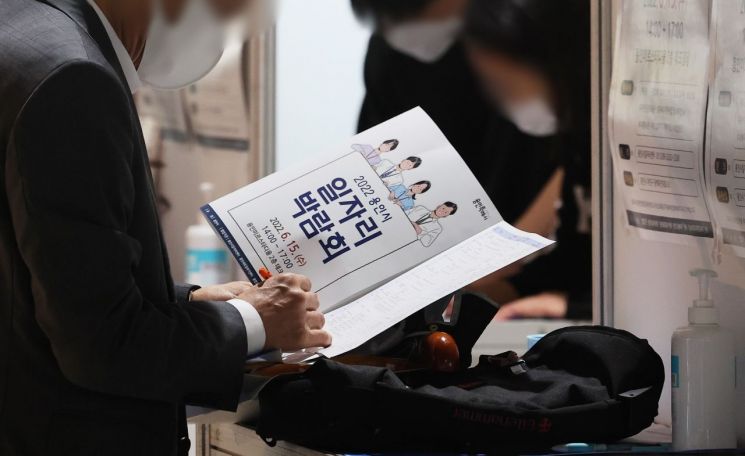 On the afternoon of the 15th of last month, job seekers were looking over employment information at the "Yongin City Job Fair" held at Mir Stadium in Yongin-si, Gyeonggi-do. [Image source=Yonhap News]
As the government focuses financial benefits on the younger generation, dissatisfaction among the 40s and 50s generations is growing. They argue that although they pay more taxes, the benefits go to the 20s and 30s generations.
Office worker Jeong (51) said, "They say support is for those 34 and under, but what difference does one year, 34 or 35, make?" He added, "It would be better to lower interest rates for diligent borrowers who are committed to repaying their debts. Benefits should go to those who make efforts, but now it seems that those who work hard are the ones suffering."
A man in his 50s, Mr. A, said, "Actually, people in my age group have the highest expenses," adding, "We have to take care of our parents above and our children below. My college student child is about to start the semester, and even with national scholarships, I have to pay an additional 2 million KRW, which is a heavy burden." He continued, "Since there are no savings benefits or loan interest reductions from the government, I feel neglected."
There are also concerns that the 40s and 50s generations facing economic difficulties are being neglected. Usually, the 40s and 50s generations are perceived to have an established economic base, so welfare benefits for them are limited, but this could leave middle-aged people in blind spots unattended.
Income disparities within the middle-aged generation are also confirmed by statistics. According to the "2020 Middle-aged Administrative Statistics Results" released by Statistics Korea in December last year, 57.1% of middle-aged people have an annual income below 30 million KRW. This means that 6 out of 10 middle-aged people earn less than the average income of 36.92 million KRW. On the other hand, 33.8% of middle-aged people earned more than 50 million KRW in the past year. Mr. Park (59), a personal taxi driver, said, "Young people are important, but policies for the middle-aged are also necessary," adding, "Support should be based on income, not age."
© The Asia Business Daily(www.asiae.co.kr). All rights reserved.
![Clutching a Stolen Dior Bag, Saying "I Hate Being Poor but Real"... The Grotesque Con of a "Human Knockoff" [Slate]](https://cwcontent.asiae.co.kr/asiaresize/183/2026021902243444107_1771435474.jpg)
















